Listen on Download · Apple Podcasts · Spotify · Castro · RSS
Transcript
Automatic transcript: names and words may be misheard. Press a time to play from there.
Derek Oswald Hello, and welcome to the AltWire podcast where we share candid interviews with some of the best names in the entertainment industry. I'm Derek Oswald, and today, we'll be talking about the upcoming record, Lessons Learned, with our special guest, Robert Deleo. Most of you will be familiar with Robert from his work as the bassist and principal songwriter for Stone Temple Pilots. Robert is here to promote his first solo record, Lessons Learned, and we're thrilled to have him on the show. Let's get started. Ready.
Robert Deleo Go. We have Robert Deleo on the phone with us today. Thanks for joining us, Robert. How are doing? It's going as good as it can go. I love doing this on iPhone. I I I don't have to be on camera and get out of my pajamas. I love it.
Derek Oswald Little known secret that people who will be listening won't know is that I'm actually in my pajamas as well, so I didn't even get into any special attire for this. So hope you're not offended. Oh, man. We got a jammy party in the making. Now this is a really interesting record for you considering that this is the first time that you've gotten to explore your full range by recording virtually all the instrumentation yourself. Can you talk about what it was like writing this album as compared to some of your previous work?
Robert Deleo Well, I think all the writing comes from, you know, whether it's, you know whatever atmosphere or thing you're trying to create, it's always from a personal experience and more so on the more gentle side of things. There's a certain you know thing of sitting down and really getting in touch with the instruments that you have. Know it's funny because I just posted something on Instagram about you know sitting down with some good friends of mine which were all my instruments, mostly vintage, that I really adore and they really have been like great friends because each time you pick up one of these instruments, it leads you in a certain direction of where your feelings were intended to go and that's what I love about old instruments with some age. They have a certain quality that inspire me to do that and that's kind of where it started. Know, it was the world has changed and the world allowed a lot of time to all of us and I took advantage of that time and kind of got reacquainted with my good friends so to speak. You had a lot of those good friends in a promo photo that you did for this record. Given that you've amassed such a huge collection
Derek Oswald over your career, what would you consider to be the most prized of your collection in regards to your vintage instruments?
Robert Deleo You know, as a bass player, I always dreamt of there's certain instruments that you grow up watching your idols play and, you know, James Jamerson of Motown, you know, has always been my top of the list bass player and acquiring… It's actually in the picture at the top row on the left. It's a 1959 Fender P Bass and I've always you know wanted one of those in my collection. That is a beautiful one. As far as guitars go, mean there's certain instruments that you electrically speaking you know I have a 1963 Gretsch Country Gentleman which is the same as George Harrison's and you know how could you not like George Harrison on a '63 Country Gentleman, but also the person that guitar is named after is one of my favorite guitar players is Chet Atkins. Chet is, you know, I grew up listening to him, been a huge influence on me and really got me motivated on my finger picking. You know what? Music is amazing because it goes down into different people and you know I think the way that I got exposed to Chet Atkins was through Steve Howe of Yes. And I've always admired Steve Howe. He's one of my favorite guitar players and Steve always was a master of picking up any kind of stringed instrument and just you know just doing something really special with it. And you know those are the kind of people that I really admire as artists that can have these things and there's another thing in the bottom right of that picture of me. It's called a marxophone and it's kind of a combination of an auto harp and a hammered dulcimer. It was used on Doors tracks and some Loving Spoonful tracks and it was I think it was sold door to door in the teens of the twenties and I found this one with all the original music books in it from that age and era. You know, I'm just always fascinated with different instruments, strings especially.
Derek Oswald With the marxophone, as you said, that's a very hard to get instrument. It's it's a little more rare than your common instrument that you get used at a guitar store, for instance. Are there any instruments that are still out of your reach that you're hoping you can find one day, maybe some super rare instrument that you've been searching for your entire career?
Robert Deleo You know, I love Middle Eastern instruments too, and there's an instrument called a sarad that I really love. And, you know, I don't own a sitar and you know, it's always been fascinated by by instruments from The Middle East. Just beautiful instruments. There's a lot of Celtic instruments that I love too. I think I need to pay more attention to my travels to acquire these instruments but I have such a love for different instruments. And it's it's interesting because when you get on different instruments, like I said, they guide you in a certain direction. And it's like that with guitars too, know, growing up and having posters on my wall and seeing Jimmy Page with a Les Paul and knowing what a Les Paul does and you know, seeing somebody with a Telecaster and you know what a Fender Telecaster does and Yeah. You know, all these voice voicings and great inventions so to speak that you know became a part of our lives. It's amazing. As a fellow bassist,
Derek Oswald what drew you to the Schecter Model T basis? What makes them stand out to you?
Robert Deleo You know, I I worked for Schechter. I was working for Mesa Boogie at the time, and this is probably 1990 right before we got signed, and I got booted. I got canned, sacked from that store. And I needed a job and I I went down the street and a good friend of mine was kind enough to hire me at Schechter. Nice. And he runs Schechter now by the way, Mike Servolo, and we worked together there. Schechter built my first base for me when we got signed that I used Encore and toured with for for quite a while. I still have that base. They made me what I wanted and they were very very kind to me and made some great basses for me that I used throughout most of my touring through the '9… Well, all of my touring through the nineties and early two thousands.
Derek Oswald In your announcement for this record, you spoke on how your life has revealed many changes. What stories were some of the most important ones for you to tell on this upcoming album?
Robert Deleo Well, I think the main focus and the main thing here I had to come up with for the whole, you know, journey was universal feelings that we all feel. Love, heartbreak, love gained, love lost and there's really nothing new I'm writing here. I guess it's just my version, my interpretation of that and you know, I think it was a matter of kind of coming up with a title for the record and at the end of the journey, I thought, know, these are all lessons learned. That's pretty much puts a bow on the whole experience and journey that I've gone through.
Derek Oswald In line with the title of the album, over the course of your career and lifetime, what have been some of the most challenging experiences
Robert Deleo or hardest lessons for you to learn? You know, there's been there's been many. I moved out here from the East Coast when I was 18 and I I lived lived in my car and I came out here with $1,200 to California and I don't know if I really came out to make it. I think I fooled my mom and telling her I was gonna go to art school just till I, you know, looked like I was going to do something. Mhmm. But I moved out here and got a $250 base. I got a Music Man Stingray, a '78 Music Man Stingray back when they were $250. Wow. And I bought a $650 1976 Volkswagen Rabbit. And the the car died and the base got stolen eventually. So I definitely learned not to put instruments in the trunk of your car when you're going to see a gig because it will get stolen. I also learned from that to not get a 1976 Volkswagen Rabbit because I think I had to drive every five miles. I had to get out and fill up the radiator because I just I didn't have enough money to fix it. So I ran that thing into the ground. Then I started working at Mesa Boogie up in the valley in a not a very nice area of the valley and my owner at the time, it was right around Christmas time and he was unloading the register without the door locked right before we were closing and two guys came in and held us up and I had a had a 38 in my gut and I had my hands tied with whirlwind cable and I… There was a big lesson there learned. It was called lock the door before you open the register and start counting money. So all that led into being in a band and getting signed with Atlantic Records and you know things took off very quickly. And one of the biggest things I learned came from a gentleman by the name of Tom Carolyn who was our A and R guy at the time and he said, fasten your seat belts. And that was a big lesson I learned from Tom Caroline is I did fasten my seat belt and it was quite a ride. Through that, you know, relationships and like I said, more universal things happening in life that everyone experiences. You know, still trying to figure out what life and love really is. You know, I think that's really what Salem is about is just taking a look at what life and love is really is and questioning it. You know? Yeah. It's been quite a journey, Derek.
Derek Oswald Hey. I think I can speak for pretty much every fan of your music out there that I'm happy that you made it out of that holdup. You know, the world might have been might have been robbed of a quite talented musician if that had gone a little bit differently. So
Robert Deleo Oh, man. Yeah. I remember I remember getting a 38 in my stomach and saying, we're gonna have a party. I remember… That's what I remember coming from his mouth and tied us up in the back with whirlwind cable, guitar cables. You know what's funny? They got a $140.
Derek Oswald For all that trouble, a $140.
Robert Deleo They got a 104… $140, but there was a 1956 fender Strat in the window that was probably at the time worth about $5. But they didn't take that.
Derek Oswald Makes no sense. Right?
Robert Deleo Right. Yeah.
Derek Oswald Just to kind of wrap things up a little bit, you have been talking about universal languages and universal things that everyone goes through. I consider music to be one of those spiritual universal languages that everybody can identify with. For artists, it's like imprinting your own spiritual energy onto a recording forever. How often have you considered the musical legacy that you're leaving behind?
Robert Deleo You know, I respect it, but I wanna move forward. I think music is eternal. And as long as you're… You know, we're all we're all mortal, but music music is a way of making yourself immortal and it'll live on and on. And the music that I listened to from the nineteen twenties, nineteen thirties, I mean, the forties, fifties, sixties, seventies, This this is all music that not only is immortal but really becomes a part of your DNA and it's something that I feel in music. Every day I feel that And I think being a musician and having a certain way to channel life into music is is a… It's a gift, man. It's a gift and I never take it for granted. It's my friend. It's my therapist. It's my love sometimes. It's a gift to be able to do that. I wanna keep moving forward and like I said, to answer your question, I do respect the past immensely.
Derek Oswald I couldn't have said it better myself. I just wanna, you know, thank you for always being so insightful. We actually first spoke a couple years ago back when Jeff first joined the band. And back then and even now, you always give the best thought out answer, so I appreciate it. Thank you, man. Hopefully, nobody forces you to go on camera within the next couple of interviews. That way you can, you know, enjoy your your coffee and stay in your pajamas if possible. So
Robert Deleo They're gonna be like, woah. Hey, is Robert there? Where's he at? Who's who's this, Obo?
Derek Oswald Thank you so much for joining us and I really do hope you have a great rest of your day. Oh, Derek. Thank you so much, man. I'm so kind of you, man. Thank you. Thank you. That brings us to the end of this episode. Thanks to Robert Deleo for joining us to talk about his upcoming new record, and thank you for listening to the AltWire podcast. If you enjoy our show, please rate and review us on Apple Podcast, and be sure to come back for more episodes. Until then, this is Derek Oswald, and thanks for listening to the AltWire podcast.
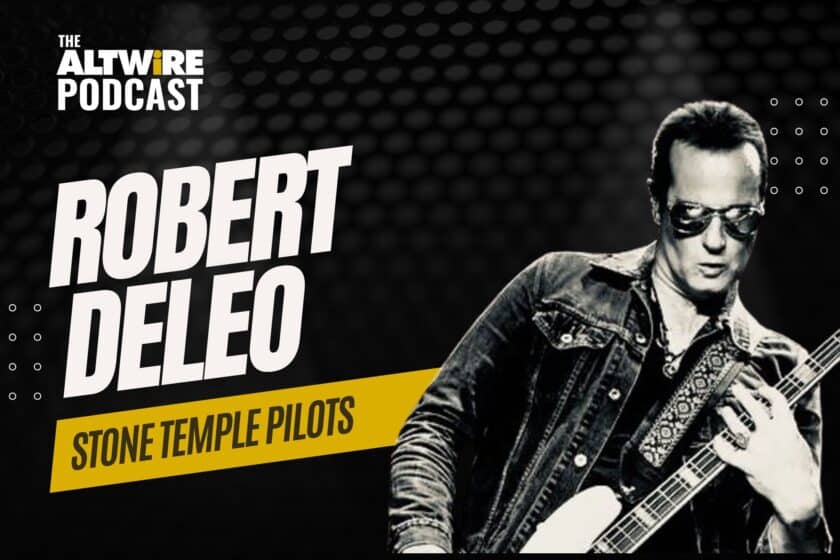
Robert Deleo (Stone Temple Pilots) calls in to the Altwire studio to discuss his upcoming solo record Lessons Learned…in his pajamas. Welcome to the Altwire Podcast, your go-to source for engaging conversations with some of the most talented and influential artists in the alternative music scene!
For those new to our podcast, we pride ourselves on providing a platform where musicians can share their stories, experiences, and insights in a relaxed and candid atmosphere. We aim to uncover the human side of the artists we love, delving into their creative processes, challenges, and triumphs. We’re thrilled to announce the much-anticipated relaunch of The Altwire Podcast, and we couldn’t be more excited about our first guest—none other than Robert DeLeo, the bassist, and co-founder of the legendary rock band Stone Temple Pilots. Robert will join us to discuss his upcoming solo album, Lessons Learned, set for release in October 2022.
Robert DeLeo’s illustrious career has spanned over three decades, during which he has made an indelible mark on the rock music landscape. As a founding member of Stone Temple Pilots, Robert played a crucial role in defining the band’s unique sound, earning them numerous accolades, millions of albums sold, and a devoted fan base. With Lessons Learned, Robert steps into the spotlight as a solo artist, showcasing his remarkable talent and versatility.
In this exclusive episode of The Altwire Podcast, we’ll dive deep into Robert’s musical journey, exploring his experiences with Stone Temple Pilots, the making of Lessons Learned, and the stories behind his rise in music. We’ll also discuss the creative process behind the album, the themes it explores, and how it reflects Robert’s growth as an artist. This conversation perfectly aligns with the ethos of our podcast, offering a rare glimpse into the mind of a true rock icon.
Don’t miss out on this incredible opportunity to hear Robert DeLeo share his insights, inspirations, and anecdotes from a life spent in rock ‘n’ roll. Be sure to tune in to the relaunch of The Altwire Podcast and join us for this fascinating conversation with one of the most respected musicians in the industry.