
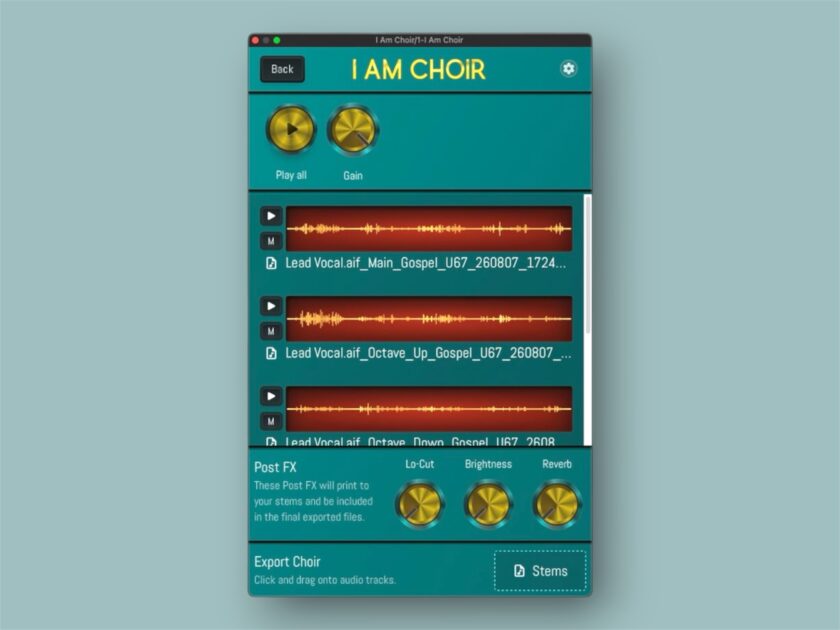
Lenard Skolnik, also known professionally as Yung Spielburg, loves the day the singers come in. On records where group vocals were part of the sound, he would sometimes bring ten people into the room at once. The energy of those sessions stuck with him.
“It’s my favorite day of the record, honestly,” he told me.
I AM CHOIR grew out of that experience, but Skolnik doesn’t talk about it as a replacement for a real choir. He still prefers the real thing when he can get people together in a room. For the other situations, the plugin can enhance an existing vocal performance or provide access to that kind of sound when it otherwise wouldn’t be available.
Skolnik developed I AM CHOIR through AM I AUDIO alongside Colin Brittain producer and Linkin Park drummer, and songwriter, producer and engineer Vincent Ernst. It took about three years to reach release.
It’s funny how badly I’ve wanted something like this. Years earlier, I’d told my friend Evan that I wished there were a way to take a vocal you’d already recorded and turn it into believable backing singers. The usual workaround only goes so far. Duplicate the take, pitch a few copies, shift the timing, process them differently, and sooner or later you can still hear the same person underneath it all.
I AM CHOIR takes that source vocal and converts it into one of three ensemble models: Gospel, Kids, or Shout. The current version costs $199 and runs as VST3, AU, and AAX on macOS 12 or later. Windows support is still forthcoming.
Ten Singers at a Time
Skolnik came up in Howard Benson’s production camp. In his telling, Benson “plucked me out of school” when he was around 20 and signed him as a producer. Programming and string arrangements eventually led into writing and co-production, and the circle around those studios later connected him with Brittain.
Group vocals became a regular part of the records Skolnik worked on, including his work with MIYAVI. Those sessions gave him years of firsthand experience with how a group vocal behaves.
I AM CHOIR began when Vincent Ernst approached him with an idea for a single-voice plugin. Voice-conversion tools were already around, and Skolnik wasn’t interested in making another one.
“I thought that was boring,” he said.
He proposed a choir-and-gang-vocal tool.
A Soloist With People Behind Them
Feed I AM CHOIR one vocal, and the software turns it into an ensemble vocal that follows the words, melody, phrasing, and timing.
Skolnik said the early tests produced multiple singers, but one personality still seemed to sit in front of the others.
It sounded, he said, like “a soloist with some people behind them.”
Timing, articulation, pitch, tone, and breath vary across a group. Skolnik said getting the software to stop searching for a single dominant identity was one of the main technical problems.
He calls the process timbre transfer. The plugin analyzes the source performance, including its notes and the phonetics occurring across them, then uses that information to generate the choir performance. The lyric, melody, phrasing, and timing come from the source vocal.
The Web App They Chose Not to Ship
This isn’t the first rodeo for I AM CHOIR. About a year and a half before release, I AM CHOIR existed as a web app. Skolnik said there was pressure to get something onto the market and start generating revenue.
“We’ve got to make this a plugin,” he said.
I knew exactly what he meant. Restricting it to a web app, is tedious. Export the vocal, open a browser, upload it, wait for processing, download the new version, then bring it back into the DAW. A plugin would deliver the same results much faster.
Skolnik agreed, but caught himself while talking about the people who would eventually use it.
“It’s weird when I say, like, users, customers. It’s my peers.”
The team rebuilt I AM CHOIR around local processing inside the DAW. Audio doesn’t get sent to a remote server for conversion, and the plugin isn’t tied to generation credits or tokens.
Processing still takes time. Skolnik said newer Apple Silicon machines move through it quickly, while older hardware such as an M1 can take longer. The DAW remains usable while the conversion runs.
The Singers Behind It
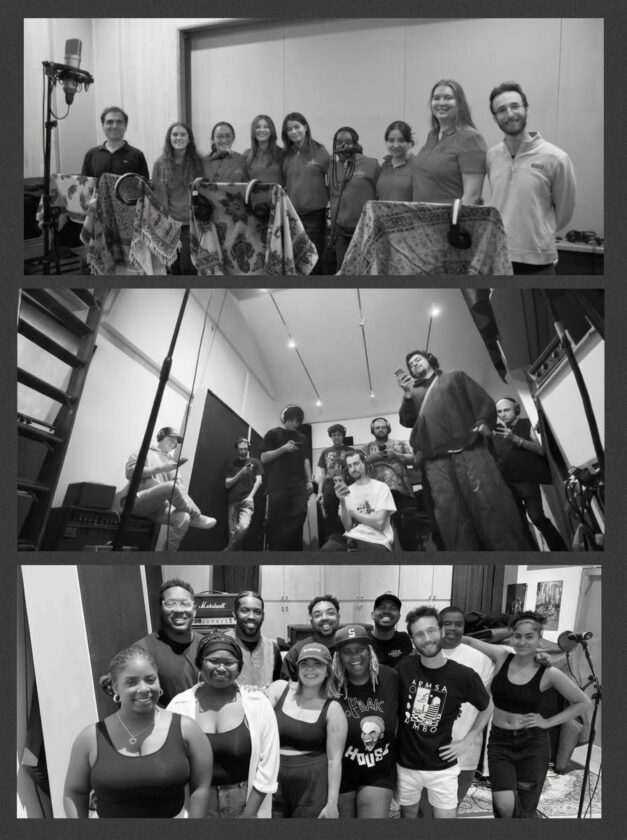
The best part is that the voices came from people the team already knew.
Brittain had been working with choir director Erica Howard, and the released plugin includes a Gospel model recorded with a choir Howard directed. Its Kids model was made with the MUSYCA Children’s Choir, while the Shout model came from metal vocalists in the team’s network.
AM I AUDIO says every singer contributed knowingly and consensually and was paid for the recording sessions.
Skolnik contrasted that with choir sessions he knew, where singers were often paid once and received no royalties. For I AM CHOIR, he said the singers also receive a royalty from sales of the plugin.
People in the plugin business warned him against setting it up that way.
“You are going to regret doing that,” he remembers being told.
He kept the arrangement, and I applaud him for that.
Note: AM I AUDIO doesn’t publish the royalty percentage, how it’s divided between performers, or how payments connected to the MUSYCA Children’s Choir are handled.
The Last Ten Percent
Once the recordings were finished, and the concept was proven, there was still the issue of QA. AM I AUDIO credits Cameron Olson and Kejie Li on the engineering side of I AM CHOIR, with Neutone also involved in development. Neutone CTO Andrew Fyfe wrote after release that the plugin uses Neutone’s Neural Synthesis engine for local inference.
“The hardest part was the last 10% of the plugin side,” Skolnik said.
He ran through FL Studio, Logic, Ableton, Pro Tools, Studio One, Reaper, and others while he described the QA process.
Some of the differences show up before a vocal is even processed. AM I AUDIO’s manual says dragging audio directly from the DAW isn’t supported in Cubase or Pro Tools. FL Studio requires you to drag from the Audio Clip tab in the Picker Panel. Logic 11.2.2 and later requires using the All Files tab.
Skolnik brought up Soundtoys as an example. Its plugins have kept working through years of DAW updates, operating-system changes, and new computers while users rarely think about it.
“It’s a miracle,” he said.
I AM CHOIR went through hundreds of beta testers during development. At the time of our interview, patches were already being prepared, and the team is constantly monitoring their support to ensure the patches keep up with user bug reports.
After Release
Records eventually leave the studio. But I AM CHOIR is an ongoing labor of love. Feedback has started coming back from producers, and just recently, I AM CHOIR hasbeen featured in a roughly two-hour livestream by gospel producer Matt Edwards.
With records, Skolnik said, he could hand the finished work to the artist and label. With software, he had become both ‘the artist and the label.’ I AM CHOIR still has patches and a feature list to work through. “This is never done,” he said.
Yet despite all this, AM I AUDIO already has another product idea, although Skolnik wouldn’t tell me what it is. Guess we’ll have to keep an eye out!
For more plugin features, check out our plugin archive here!
