

Max for Live is one reason I have such a hard time imagining myself leaving Ableton. I’m always finding a new developer who’s built a device that attacks an old problem from a new viewpoint, or gives me a new way to destroy or distort a sound. Rawton Forge does both.
Across Rawton’s product line, you’ll find kick synthesizers, stereo processors, waveshaping, modulation, filtering, and reverb. Most of the interfaces are pretty compact, yet there’s usually considerably more happening underneath them, and that’s the core of Rawton in a nutshell: keep the interface out of the way, put the complicated stuff underneath, and let the producer get back to making music.
Rotation: Stereo Processing Gets Strange
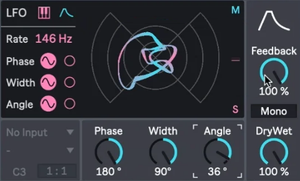
If there’s one Rawton device that parallels the above perfectly, it’s probably Rotation. It’s a very fresh approach to stereo widening: Rotation generates a quadrature version of the incoming signal using a Hilbert-transform-based process rather than creating width through the usual short-delay tricks.
To explain it further: Rotation creates two related components designed to sit 90 degrees apart in phase, then uses that quadrature relationship to manipulate the stereo image more like a rotating vector. You get Phase, Width, and Angle controls, with internal modulation adding movement on top of that. Its MIDI mode also links the rotation rate to incoming note pitch, which Rawton specifically points toward bass design and monophonic material.
Rawton also makes Rotation Mini, which pares the idea back to Phase, Width, and Angle. It’s free, so if everything I just wrote about quadrature signals sounded either fascinating or like complete mathematical witchcraft, that’s where I’d start.
Deviation: Distortion Doesn’t Have to Be Symmetrical
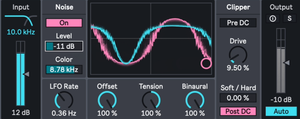
As mentioned in my feature of a different plugin, Terminal, I love to destroy sounds. Deviation may be the Rawton device that best matches my ongoing habit of seeing how badly I can abuse a sound to the point of non-recognition. Many familiar clipping and waveshaping designs use symmetrical transfer curves, meaning they treat the positive and negative halves of the waveform the same way; Deviation deliberately screws with that relationship.
Its main idea is a movable pivot point that changes how it shapes the positive and negative half-cycles. Treat those two sides differently, and the asymmetry introduces even-order harmonic content. Rawton then applies that idea independently across the left and right channels, letting the waveshaping create stereo differences as well.
The Binaural control and quadrature LFO bring movement into the stereo side of the waveshaping, while Dynamic Offset links DC compensation to the signal envelope. There’s also a crossover that restricts processing to the low band, RMS Auto-Gain for level-matched comparisons, noise injection, and an ADAA soft clipper. Written out like that, it sounds considerably busier than the actual interface feels.
For bass music, industrial, techno, or anything else where distortion becomes part of the sound design itself, Deviation is a wicked beast.
Impactor: Build the Kick Instead of Finding It
Rawton’s device, Impactor, solves the problem when you have 4,000 kick samples, gigabytes of samples taking up an external drive, and not one of them is the right choice. Impactor takes the opposite approach and lets you build one.
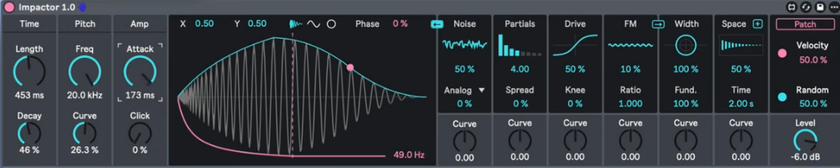
Its oscillator uses additive synthesis with up to twelve harmonics and adjustable inharmonicity, so the spectrum moves from cleaner harmonic structures into much more metallic or bell-like territory. The engine is also phase-driven, with control over what happens to the tail phase; Rawton says its analytic phase system can lock the tail phase to a defined state, keeping repeated hits phase-consistent. The engine has eight independent envelopes, plus noise, FM, a second oscillator, and velocity/random routing.
Impactor also handles stereo in a genuinely useful way. You can spread the upper harmonics while independently controlling the fundamental, letting the low end stay centered as the higher harmonics widen. Its reverb takes a more deliberate approach than simply firing the entire kick into an algorithm: Impactor separates the transient from the part feeding its feedback-delay-network reverb, allowing the body to develop more space without automatically smearing the initial attack.
Rawton calls Impactor a bass drum designer, although the synthesis architecture reaches beyond one narrow kick shape. If you make harder electronic music, the appeal here is pretty obvious.
Rupture 2: More Ways To Dial In The Best Kick
Rawton may offer two kick synths, but they’re not just two sides of the same coin; Rupture 2 is a Kick & Bass generator and handles kick generation from a completely different angle.
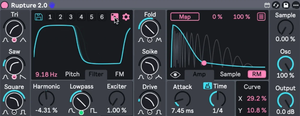
Impactor starts with additive harmonics and phase control; Rupture takes a different route with a morphable oscillator, waveshaping, pitch envelopes, FM, filters, noise, and sample layering. You start with a sine and push it through morphing, folding, saturation, and distortion while guiding how those changes develop through the sound. Dedicated pitch and amplitude shaping sit alongside velocity control by section, snapshots, parameter randomization, and the option to bring in your own samples for additional transient or texture layers.
Rupture 2 was also a full rebuild, not a cosmetic refresh. Rawton revised the pitch and amplitude behavior, sped up the envelopes, added MIDI control and a new velocity matrix, and moved the interface toward Ableton’s own visual language.
Impactor is the more procedural, additive instrument. Rupture uses more familiar building blocks: oscillator shaping, waveshaping, FM, filters, envelopes, and samples. Rawton positions Rupture specifically as a kick and mono-synthbass generator, while Impactor’s additive architecture reaches further into synthesized percussion and tonal impacts.
Rawton’s Older Tools
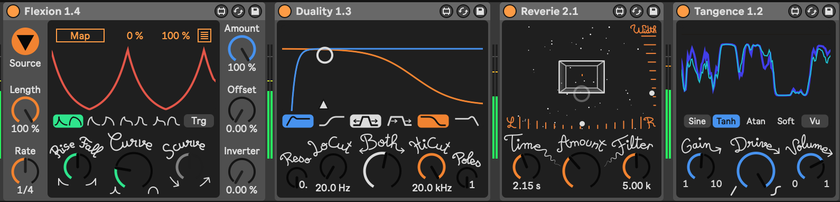
Rawton’s earlier devices are no longer for sale, but if you’re able to get a hold of them are still wonderful to have.
Reverie is a deliberately reduced creative reverb that retains the focus on time, amount, filtering, and stereo behavior instead of presenting a giant page of parameters.
Flexion is s an envelope generator, which admittedly doesn’t sound quite as exciting as quadrature processing or building a kick out of twelve harmonics. I know. Try to contain yourself. But it’s strength is in how far that one envelope reaches. Flexion triggers from MIDI or audio and maps its movement across multiple destinations in a Live set, so one contour influences a filter, an effect parameter, and another mapped control at the same time. It can also handle sidechain-style movement without forcing the job through a conventional compressor. If you want one focused envelope controlling several things around the set without building a more complicated modulation system, it has a very obvious use.
Duality combines a high-pass and low-pass filter into one compact device, including a linked control that moves both cutoff points together. That makes a lot of sense for transitions, narrowing the available band, or modulation rather than surgical EQ work.
Tangence handles saturation, with several waveshaping approaches including hyperbolic-tangent, arctangent, and soft-clipping behavior. Live has no shortage of filters, saturation, or reverb, either; here, the argument is mostly workflow. If one of these smaller interfaces gets you where you want to go faster, then it’s doing its job.
Rawton Has Clearly Gotten More Ambitious
Tangence, Reverie, and Duality took familiar production jobs and shrink them down, while Flexion pushed that same compact approach into modulation. Then Rawton started getting weird.
Rupture turned the idea of kick synthesis into a serious sound-design environment; Rotation messed around with quadrature signals; and Deviation built stereo movement into asymmetric waveshaping; Impactor combines additive percussion synthesis, phase control, and stereo generation inside the oscillator itself.
And Rawton never sleeps. Rupture received its full 2.0 rebuild in June 2026, Deviation reached 1.3 in July with a sample-rate-dependent smoothing fix, and Rotation is currently at version 2.1.
Where I Would Start
If you want to see what Rawton is about, start with Rotation Mini. It’s free and gives you one of the developer’s more unusual ideas without asking you to buy anything.
After that, it really depends on what you make. Rotation if stereo movement and bass-oriented sound design are the priority. Deviation if you want distortion that can also become part of the stereo design. Impactor if you want to build kicks and other tonal percussion from the harmonic structure upward. Rupture 2 if you want a more aggressive kick and mono-bass laboratory built around oscillator shaping, envelopes, FM, and layering.
Rotation, Deviation, Impactor, and Rupture all approach common production needs from unique angles, some very different than the norm. There’s some fairly technical processing happening inside them, yet the interfaces let you get your hands dirty quickly, with a focus on simplicity.
Right now, Rawton is one of my favorite Max for Live creators, and one I’ll keep an eye on.
