
Introduction – MV7+ A New Era
Over the last decade, podcasting and live‑streaming have turned spare bedrooms into mini studios. The Shure SM7B still sets the pro standard, yet many creators now want a mic that’s simpler, cheaper, and just as solid on sound.
Shure’s first MV7 hit that mark with dual USB/XLR outputs and onboard processing. The new MV7+ keeps that DNA but upgrades to USB‑C, improves the DSP, and adds a programmable LED strip. It’s built for solo creators who want plug‑and‑play pro vocals and flexible routing in one tidy package.
Build & Design
The MV7+ sports a rugged die‑cast aluminum chassis in black or white. It weighs 1.26 pounds, solid yet compact, feeling well-made and capable of taking a drop or two.
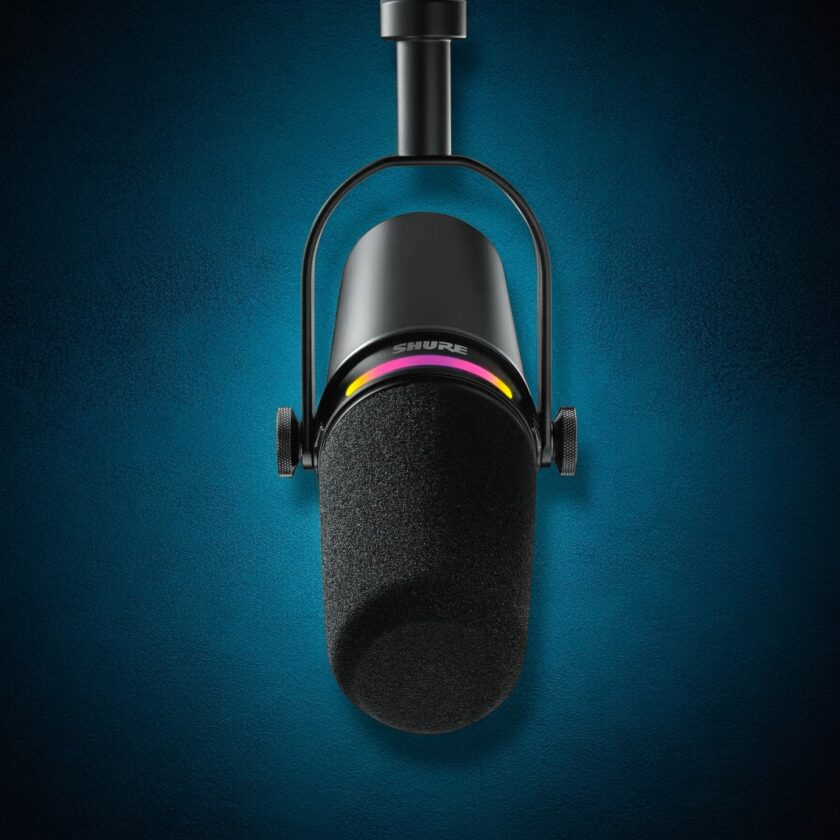
In a move that shows that they listen to user feedback, a revised foam windscreen now extends further over the grille. It fixes one of the biggest complaints I and others had with the original MV7: weak plosive rejection because of a small windscreen.
Visually, one of my favorite new features is the new LED strip. It glows steady green while recording, blinks red when muted, and doubles as a level meter. Green for safe, yellow for rising peaks, orange when you’re about to clip. Want further customisation? Open MOTIV Mix on desktop or ShurePlus MOTIV on mobile to choose from over 16 million colors.
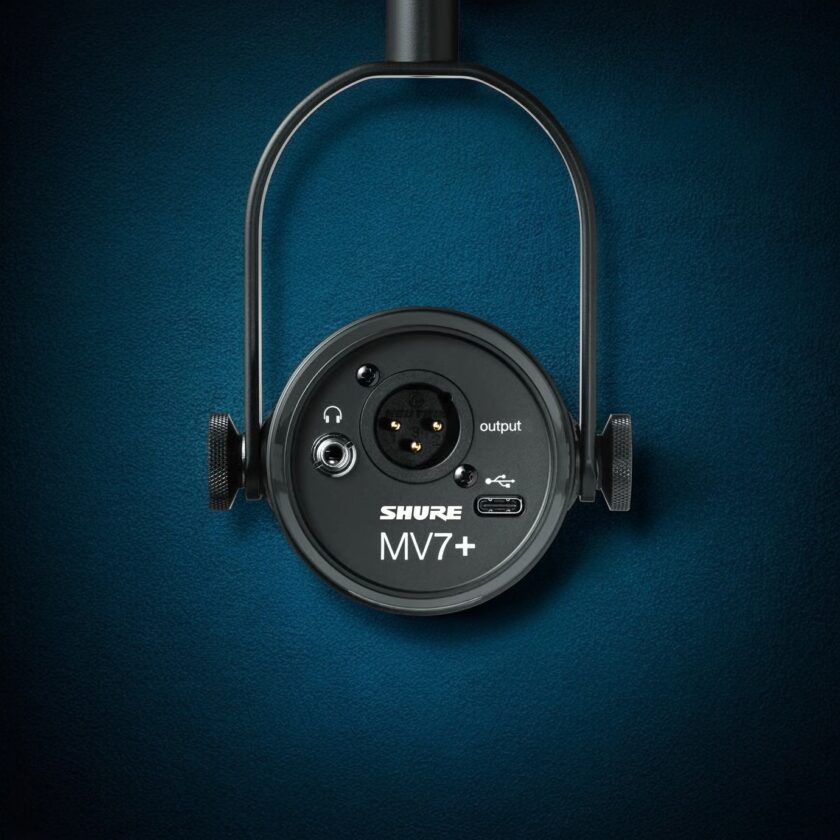
Ports include a USB‑C connector, a standard XLR output for analog routing, and a 3.5 mm headphone jack for real‑time, zero‑latency monitoring.
Setup & Workflow
The box includes a 3 m USB‑C to USB‑C cable. Plug it in and go. No drivers needed on macOS, Windows, iOS, or Android. OBS‑certified, it also slots right into Zoom, Teams, Google Meet, and all major DAWs.
Once connected, the adjustable onboard DSP settings will appear in MOTIV Mix or the ShurePlus app. The interface is clean, responsive, and easy to navigate.
Sound Quality
Inside sits a dynamic cardioid capsule tuned for clear vocals and a focused midrange. A gentle lift near 16 kHz keeps highs smooth while taming sibilance in untreated rooms.
The longer foam cover, plus Shure’s Digital Popper Stopper, handles plosives far better than the previous iteration. While the foam cover itself is already an improvement, the DPS catches what the windscreen misses.
XLR mode outputs an untouched analog signal. It sounds balanced and neutral, with strong off‑axis rejection and a usable proximity effect.
USB mode now matches that quality. A recent firmware update removed the baked‑in EQ curve that once colored the sound.
Consistency across outputs is rare in USB mics, and Shure deserves credit for closing the gap.
DSP & App Control
The beefed‑up DSP engine lets you dial in:
- Auto Level Mode – adjusts gain in real time
- Compressor – three strength settings
- Limiter – stops sudden peaks
- High‑pass filter – cuts low‑end rumble
- Denoiser – tames fan or traffic noise
- Reverb – Studio, Plate, and Hall options (also adjustable in desktop/mobile app)
Thanks to its brilliant Auto Level Mode, the MV7+ senses your distance automatically, replacing the MV7’s manual near/far switch. This is achievable because the microphone has a cardioid polar pattern.
The interface stays plain. Pick one of three tones—Dark, Natural, or Bright. Shure keeps rolling out firmware tweaks, and a busy user community trades presets and tips.
Note: all DSP, auto‑level, mute control, LED metering, and pop/noise filters work only in USB mode. On XLR, the MV7+ behaves like a standard dynamic mic.
Connectivity & Use Scenarios
Here’s the stand‑out move: USB and XLR run in parallel. Record a polished digital feed while capturing an untouched analog track for safety or later tweaks.
Need monitoring? Plug headphones straight into the mic for zero delay. It draws power over USB, so you can skip phantom power.
Best results come with the mic 6–12 inches from your mouth, making it ideal for voice‑overs, vocals, narration, streaming, and podcasting.
Comparison & Value
Put it against a Blue Yeti or any USB condenser and the MV7+ wins: less room bleed, fewer pops, and a tighter voice. Its dynamic capsule ignores the background noise condensers love to catch, so it thrives in an untreated bedroom.
Compared with the original MV7, upgrades include:
- USB‑C (goodbye micro‑USB)
- Deeper DSP with auto distance detection
- Longer foam windscreen
- LED strip with live level feedback
- Matching tone on USB and XLR
The SM7B still rules full studio rigs; the MV7+ aims at creators who need a smaller footprint.
Conclusion
The Shure MV7+ gives content creators professional sound minus the studio hassle. Smart DSP, intuitive software, rugged build, and true hybrid I/O make it a standout choice.
For podcasters, vocalists, streamers, and remote workers who crave clarity, flexibility, and simplicity in one tool, the MV7+ is an easy recommendation, bridging the gap between consumer convenience and broadcast‑grade audio.
Check out more hardware reviews here!
