AltWire may receive a small commission from purchases made after you click a link on this page.
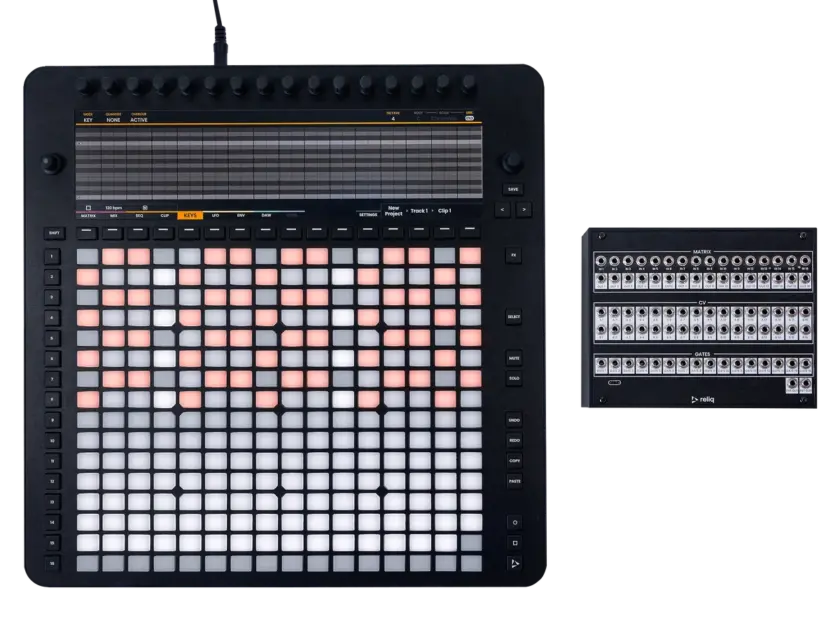
The Reliq sequencer combines a 16-track sequencer, analog matrix mixer, CV hub, modulation system, and DAW controller in one box.
I shifted substantially from in-the-box work toward physical gear recently, and learned fast that hardware grows sideways. A sequencer solves notes, a MIDI interface solves ports, a patchbay solves routing, then CV, clocking, DAW control, power, and another pile of cables show up behind all of them.
Two 1990s E-MU racks, a Quadraverb, a Boss SE-70, an Alesis 3630, and the synths around them have left more wires snaking through my setup than I’ve ever had before. I’ve spent enough time following those cables to know how quickly the creative part of a session can disappear into troubleshooting. Reliq’s developers describe much the same frustration from their own work with computers and hardware, which eventually led four musicians and engineers to develop Reliq for their own setups.
Inside the Reliq System
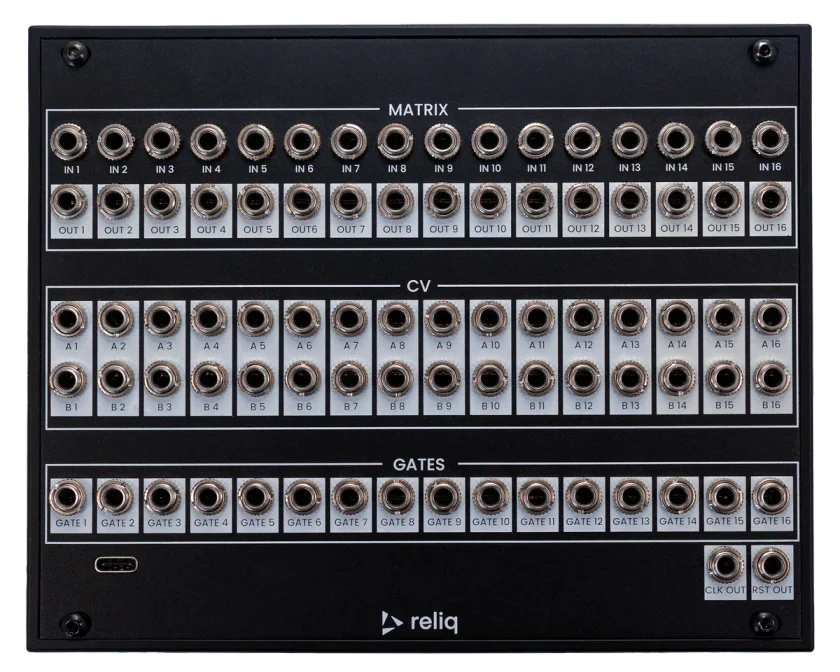
The 256-pad grid handles sequencing, analog routing, modulation, clips, song structure, and DAW control. Its breakout provides 16 analog inputs, 16 analog outputs, 32 CV outputs, and 16 gate outputs, along with clock and reset connections. Reliq doesn’t generate sound or record audio. The matrix routes and attenuates what you send into it, so an external mixer or audio interface still handles recording.
The €1,899 package includes that breakout and a Bitwig Studio 8-Track license. The main unit is roughly 400mm square and weighs 2.8kg, with the breakout adding another 0.8kg. A wide 12.6-inch display sits above the pads and 16 clickable encoders.
Sequencing the Signal Path
Sixteen analog inputs cross sixteen outputs on the grid, and pressing an intersection makes the connection. A synth could feed a clean interface channel and a hardware effects chain at the same time. Save that routing, and the Matrix Sequencer can bring the processed path in later without anyone crawling behind the rack to repatch it. For the kind of setup I’ve accumulated, the prospect of recalling those connections made Reliq a godsend.
The limitation is that level controls sit at the inputs and outputs, not at individual matrix connections. Lower an input and every destination it feeds gets quieter; lower an output and every signal arriving there changes. That works fine when splitting one instrument between clean and processed paths, but becomes more restrictive when several instruments share an effects output and each needs a different send level. A mixer with individual aux sends can handle that, although it means adding another piece of hardware to the setup.
The matrix handles a +/-10V range, which covers Eurorack signals and ordinary line-level gear, while the breakout’s 3.5mm connections keep the cable bundle beside the rack rather than across the main surface. It can also fit into 32HP of Eurorack space. The USB-C connection to the main unit uses Reliq’s own protocol rather than acting as a standard computer port.
The Reliq Sequencer
Each of Reliq’s 16 sequencer tracks can put as many as eight voices on a step, with independent timing, velocity, duration, and probability. Sequences can stretch across a huge number of sheets and clips, but that per-voice detail mattered more to me than the raw storage limit.
Tracks can run as Free, Melody, Chord, or Drum parts, with LFOs, envelopes, and automation alongside the notes. Reliq works at 768 PPQN internally, while outgoing MIDI Clock stays at the usual 24 PPQN and MIDI events can be configured up to 192 PPQN.
Firmware released recently, added Custom Output Routings, allowing tracks and modulation to address combinations of MIDI, CV, and gate destinations. That’s the change I was the most thankful for in my own setup, where connecting one more piece of hardware usually means rearranging something else. The newer releases also bring finer per-track speed control, ranging from ÷8 to ×8, a scale-folded piano roll, Key Detection, and more detailed Euclidean editing.
Clips, Follow-Up Measures, and Song Mode
A clip holds its sequence and track settings. On tracks using a standard MIDI output, it can also send a Program Change when triggered. Follow-up operations can move to another clip after a chosen period. Clip Sync determines whether that switch happens immediately or waits for a timing boundary. In a polyrhythmic project, several tracks can receive the same command and still change at different moments, which is a much better fit than forcing every part to start over on the same beat.
The Clip page has been reorganized, putting arm, solo, and mute controls directly on the grid. Individual clips can also loop a chosen part of their sequence, and Sheet Navigation makes moving through longer patterns easier.
Song Mode can recall a clip for each track, a saved matrix routing or Matrix Sequencer clip, LFO and envelope slots, and a DAW scene. Those settings come back together instead of leaving me to reconstruct them individually. Reliq won’t turn a loose jam into a finished arrangement for me. Nobody is fixing my bad ideas here. But once I build a good state, the notes aren’t the only part it remembers.
Getting Reliq Into the Studio
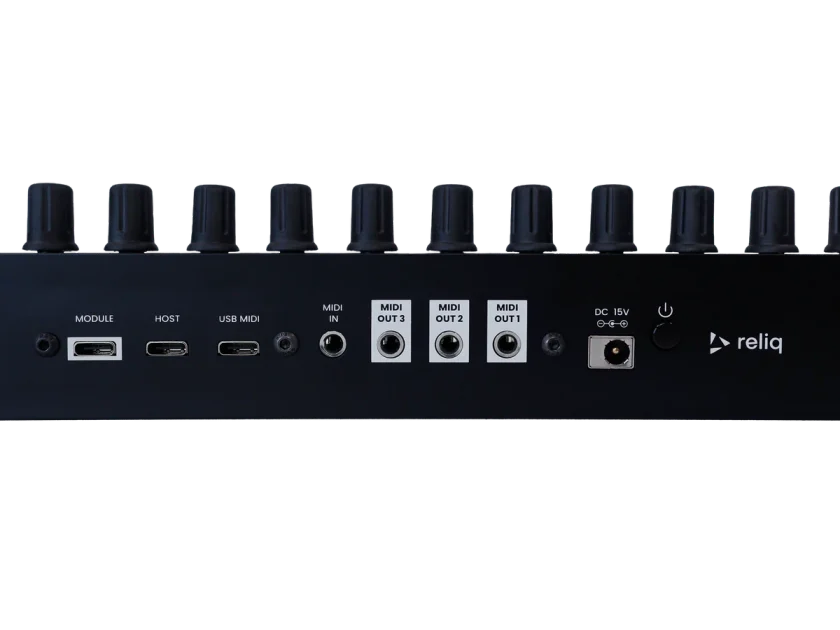
The Getting Started walkthrough is almost essential viewing, because Matrix, Sequencer, Clip, modulation, and Song pages all share project state. That takes some getting used to before the system feels manageable. I’d also update the OS before building a serious project. Firmware uses the HOST connection, with the breakout remaining connected to MODULE during the update.
Name the matrix inputs and outputs before you get clever. A saved routing isn’t much help when you can’t remember which socket belongs to which piece of gear. Grouping stereo pairs and establishing a few dependable clean and processed paths first make the more elaborate configurations easier to follow.
Reliq supports Ableton Live 12 and Bitwig Studio 5.3+ through a DAW page that handles clips, scenes, transport, and mixer controls, while hardware tracks can continue sequencing connected instruments. U-SYNC 2.0 now works on macOS and Windows and adds improved resynchronization and latency adjustment. Reliq describes U-SYNC as providing sample-accurate synchronization with a DAW.
Bitwig Extension 2.0 adds plug-in browsing, parameter access, launcher-clip editing, and track controls from Reliq. Ableton continues to use its control-surface script. The October firmware also lets the USB HOST port send MIDI directly to a computer or class-compliant USB MIDI device, with independent clock and Start/Stop settings for each destination. For a room already short on spare ports, that might cut the need for another MIDI interface.
Constant Updates
Reliq’s software has moved quickly since launch. Song Mode, undo and redo, MIDI automation, DAW control, and various MIDI effects arrived in earlier releases. July’s RLX 1.8.0 brought broader editing tools and, finally, a global MIDI metronome.
RLX 1.9.0 arrived September 10, followed by RLX 1.10.0 on October 15. Alongside the new features, Reliq’s release notes document fixes for drift during long sessions, held notes and gates, and project-loading problems.
Reliq, Hapax, and OXI One MKII
If I only needed a dedicated sequencer, Squarp Hapax would be easier to justify financially. Squarp lists it at €1,080 before VAT, versus Reliq’s €1,899 VAT-inclusive European price. OXI One MKII makes a different case with its battery, 950-gram weight, and up to 64 tracks in Multitrack Mode. Neither offers Reliq’s 16-by-16 analog matrix.
If that routing isn’t something your studio needs, the extra money and desk space that Reliq calls for may be overkill.
When the Studio Keeps Growing Sideways
Reliq doesn’t make my synths, effects, or cables disappear, and the studio hasn’t gotten smaller. But saving routing alongside clips and modulation has kept me from retracing the same connections every session.
Just make sure you have a proper table for this big boy.
Get the AltWire newsletter
The week's best from AltWire, with the artists and sections you pick first. Free; unsubscribe anytime.