
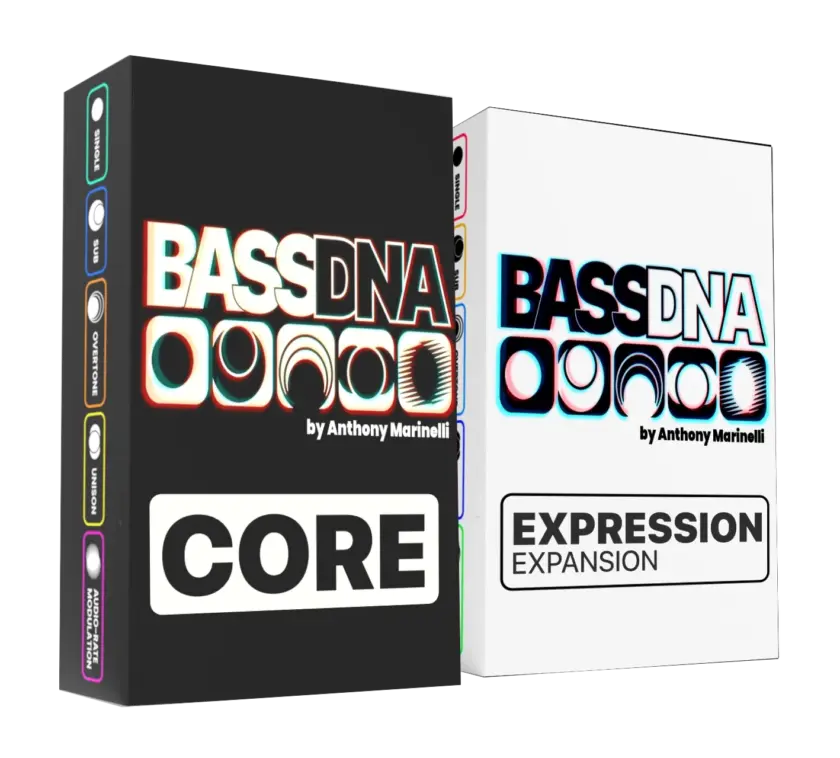
Rubbery Moog bass, P-Funk squelch, and modulation that gets downright weird. Anthony Marinelli’s Bass DNA covers a lot of sonic territory, from building a patch with a single oscillator to finding that sweet spot where a bass line locks into the groove.
I thought Anthony Marinelli had nailed it.
During Bass DNA’s Overtone lesson, he’d put together this wonderfully zappy, P-Funk-style bass that, to my ears, already sounded great over the beat. But Anthony heard something I hadn’t. The notes were hanging on just a hair too long.
He shortened them by a tiny amount, played the pattern again, and suddenly the whole bass line snapped into the pocket. Same patch, just a little change in timing. What a difference. And Bass DNA has plenty of those moments.
I reviewed Marinelli’s Think Like a Synth earlier this year, and learned a lot from its deep dive into synthesis theory. Bass DNA feels quicker on its feet. The lessons get into making sounds sooner, the pacing is easier to follow, and there’s a lot more emphasis on what happens when you put those sounds to work in actual music.
What’s in Bass DNA?
For anyone unfamiliar with Marinelli, his credits include synthesizer programming on Michael Jackson’s Thriller and composing for films such as Young Guns. He’s spent decades working professionally with synthesizers.
Bass DNA is built around five oscillator configurations: Single, Sub, Overtone, Unison, and Audio-Rate Modulation.
Marinelli demonstrates how the oscillators interact, then explores how filtering, envelopes, modulation, and performance affect the resulting sounds.
The course comes in two parts. CORE contains nine lessons totaling 3.9 hours, covering the individual configurations, ways to combine them, and their application within a track. EXPRESSION adds three lessons totaling 1.6 hours, covering keyboard performance, external control, and effects.
Everything is organized into video chapters hosted through Teachable.
Sound: Five Starting Points, Plenty of Possibilities
Marinelli wastes no time getting down to business with Single.
In it, he starts with just one oscillator and gets a surprising variety of sounds. There’s that smooth, buttery, rubbery Moog character I associate with classic 1970s and 1980s synth bass. Later, he creates more resonant, almost acid-like sounds by changing the waveform, filtering, and other controls.
Anthony clearly explains the real benefits of using a single oscillator for bass, including greater definition and avoiding the beating and phasing interactions that can occur when you layer several oscillators.
Sub bass adds lower-pitched oscillator content beneath the main sound, often an octave or more below it. The results are those boomy, deep-frequency sounds familiar from trap and other bass-heavy electronic music. Depending on the waveform and processing, they can be less crisp and less immediately recognizable than a traditional synth bass. Sometimes the rumble and weight are exactly what a track needs.
With Overtone, Marinelli starts with a fundamental, sometimes using a simple triangle waveform, then adds oscillators tuned to higher octaves or intervals to bring in more harmonics.
His Funk Bass recipe demonstrates this approach well. He works through different waveforms, including squares, while experimenting with attack, release, filtering, and noise. The result has that lively, squelchy character I associate with classic P-Funk. It’s also the sound he uses for the note-length adjustment mentioned at the beginning of this review.
Then there’s Unison, which might be the most entertaining lesson of the bunch.
The basic configuration involves multiple oscillators tuned to the same pitch, with slight detuning creating thickness and movement. Marinelli takes that starting point through a range of sounds that barely seem related.
In one video, using the same synthesizer, he moves between trap-style bass, short zapping tones, and thick, elastic funk textures. A few moments even reminded me of the opening synthesizer sound from Rush’s Tom Sawyer.
Other examples briefly take on an almost house-organ, donk-bass character, while some sound like thicker versions of the funk bass explored earlier. I loved hearing how much variety he could get from the same instrument.
After Unison, Marinelli moves into Audio-Rate Modulation, covering frequency modulation, amplitude modulation, ring modulation, and audio-rate filter modulation. I had a lot of fun with this section, especially when the ring and filter modulation experiments started producing some downright strange and aggressive bass sounds.
Ring modulation provides a good example of how Bass DNA differs from Think Like a Synth. In Bass DNA, Marinelli demonstrates its effect on the sound using an ARP 2600. It’s a relatively brief exploration, focused on hearing the result. Think Like a Synth gives ring modulation its own section, with more than 40 minutes devoted to understanding how the process works.
The ARP 2600 demonstration also contains one of the funniest moments in the course.
Marinelli appears slightly uncomfortable stretching to play the keyboard awkwardly from the side while reaching over to adjust the synthesizer without blocking the camera’s view of the controls. While this awkward method of playing was thoughtful as it meant nothing was obscured, a message appears on screen:
“I don’t recommend playing the keyboard from the side like this.”
I laughed.
Getting the Bass Into the Groove
After introducing the individual configurations, Marinelli demonstrates ways to blend them and use the results within musical arrangements.
The configurations work almost like a cheat code for approaching bass design. If I have a particular sound in mind, I now have a more organized way to decide where to begin, whether that’s the clarity of a single oscillator, the low-frequency weight of Sub, the harmonic character of Overtone, or the thickness of Unison.
I can dial in a starting sound and tweak it from there without feeling like I’m turning knobs aimlessly.
The funk-bass demonstration from the opening wasn’t a one-off. Throughout the course, Marinelli makes adjustments to sounds within an arrangement, and I occasionally found myself anticipating what he was about to change.
Those were genuine “aha!” moments for me. I began to hear the same issues he was addressing, which gave me a deeper insight into how to polish a bass sound for a particular track.
Features: Better Cameras, Better Explanations
Bass DNA follows a similar lesson structure to Think Like a Synth, although the production has improved.
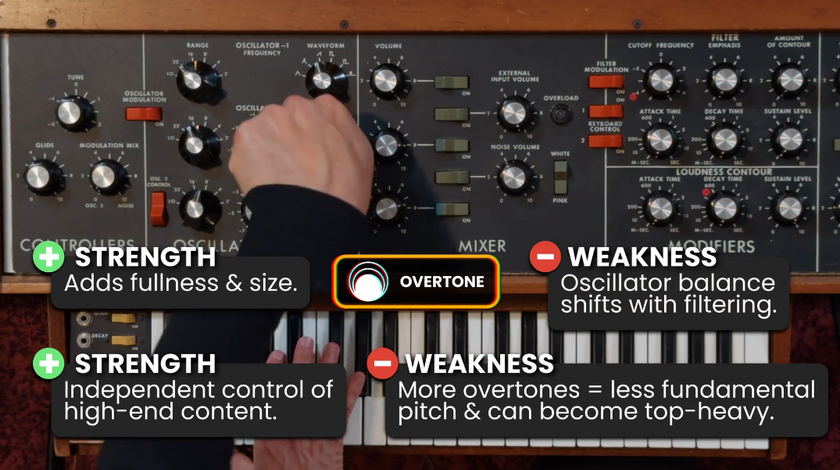
Many videos use two camera angles, with one showing Marinelli and another providing a close-up of the synthesizer he’s operating. You can see which controls he’s adjusting without having to decipher everything from a wider camera shot.
On-screen diagrams, notes, and graphics clarify oscillator relationships, signal flow, and what specific controls do.
The pacing seems different as well. Some lessons are still fairly long, yet I found them easier to follow than the more technical sections of Think Like a Synth. The explanations rarely feel drawn out, and the chapters are organized so you can return to a particular technique without much trouble.
There aren’t traditional worksheets or graded assignments to guide your practice. If you prefer structured exercises and regular knowledge checks, you’ll need to supply that element yourself.
EXPRESSION: How You Play Changes the Sound
The additional EXPRESSION lessons were another part of Bass DNA I enjoyed.
CORE establishes the oscillator configurations used to create different types of bass. EXPRESSION explores how the performance changes the character of those sounds.
Marinelli demonstrates short notes, long notes, alternating patterns, and different ways to articulate a bass line. He also gets into pitch bends, glides, glissando, and using the modulation wheel to introduce wobble. One example introduces noise to create a fluttering, almost tape-like instability.
The lessons go past traditional keyboard playing, exploring sequencers, vocoders, envelope followers, external control, and some of Marinelli’s favorite pedals and effects for processing bass.
For me, this material is every bit as relevant as the oscillator configurations.
Think about dubstep and tearout for a second. Half the fun is hearing a bass sound twist, wobble, growl, and change as the track progresses. You could have the nastiest bass patch imaginable, but without that movement and the right performance, it just wouldn’t hit the same way.
When I think about the synth and electric bass performances on Thriller, much of their character comes from how they’re played. The timing, articulation, and interaction with the other instruments are essential to their feel. I enjoyed having EXPRESSION alongside CORE because it covers techniques I can apply after I’ve built the sound, when the next challenge is making the bass line interesting to listen to.
Workflow and Ease: You Don’t Need Anthony’s Exact Synth
Marinelli uses different instruments throughout the course, including the Minimoog and ARP 2600.
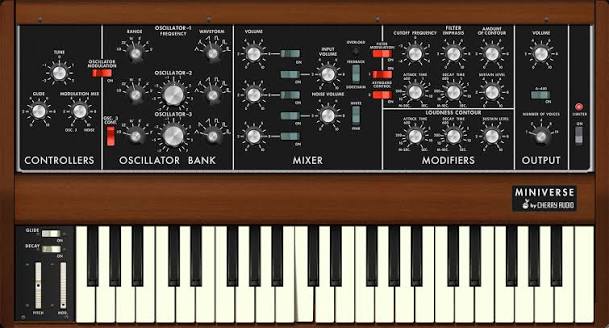
I followed along mainly with Cherry Audio Miniverse, included with CORE and the complete package.
Miniverse is modeled on the classic three-oscillator Minimoog Model D architecture. It’s well suited to exploring the five configuration concepts, and Marinelli explains how the oscillator relationships work and what each contributes to the sound, leaving you with ideas you can adapt to other synthesizers.
This solution helps make Bass DNA accessible to newcomers. Think Like a Synth goes deeper into synthesis fundamentals, and I found it the more demanding of the two. Bass DNA is focused on achieving particular sounds and refining them, with less emphasis on complete technical explanations.
Value: Which Version Should You Buy?
At the time of writing, CORE and EXPRESSION are available separately or as a package. Cherry Audio Miniverse is included with CORE and the complete package, but not with EXPRESSION alone.
Purchases include lifetime access through Teachable, and we recommend checking the website for current pricing. Personally, I’d choose the complete Bass DNA package. The additional value of EXPRESSION is worth it to me because performance, modulation, and processing contribute so much to a good bass line.
For someone new to synthesis, I’d recommend starting with Bass DNA before moving on to Think Like a Synth. The two complement each other well, and a discounted bundle of both would be worth considering if available.
Verdict
Overall, Bass DNA is the more approachable of the two Anthony Marinelli courses I’ve reviewed. The biggest difference is how quickly the lessons get into constructing and working with different bass sounds.
I’d recommend the complete course to producers who want to improve their synth bass programming, including those who already feel comfortable operating a synthesizer but aren’t always sure how to approach a particular sound.
Disclosure: AltWire received complimentary access to Bass DNA for this review.
