
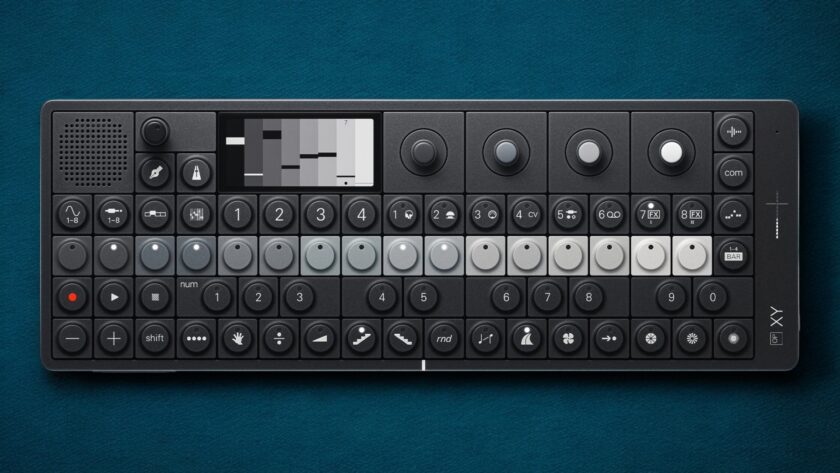
Since launching the game-changing OP-1 in 2014, Teenage Engineering has carved out a reputation for marrying playful design with pro-grade functionality, from the pocket-sized OP-Z to the OP-1 Field workstation. With the OP–XY, they’ve distilled that ethos further, packing a 16-track, 64-step sequencer, eight independent synth engines, and motion-sensing gesture controls into an aluminum chassis you can palm with one hand. It arrives as the natural evolution of their lineup: compact enough for on-the-go creativity, yet robust enough to replace bulky rigs in both lounge sessions and live sets.
OP–XY: Build and First Use
Its 1.9-pound heft gives slight weight, but feels effortless for long sessions, and the matte-black aluminum shell and overall design echo the OP-1 Field’s footprint, while adopting the OP-Z’s workflow logic. It’s a splendid marriage of these two beloved Teenage Engineering favorites, all while forging its own identity as well.
In the box, you get the OP–XY, a USB-C cable, dual velcro back fasteners to help stick the OP–XY to any surface, plus a quick-start guide and warranty card. Teenage Engineering’s one-year warranty covers defects, and service parts are available via their support site.
Front Panel & Display
The front panel features sixty-eight low-profile mechanical keys. The keys offer a delightful metallic click, reminiscent of high-end keyboards, with backlighting for nighttime use. They switch roles between keyboard, drum-kit pads, and menu shortcuts. A subtle grey gradient splits the panel horizontally, spotlighting the sixteen central sequencer buttons.
Above the keys sits a 480 × 220 pixel IPS display. Its monochrome graphics offer crisp, high-contrast visuals that stay legible even in low light. Navigation is simple, and menus are easy to follow via the included encoder knobs or shift functions.
Signal Path & Electrical Performance
Under the hood, each track’s synth engine feeds its own pre-effects bus and two serial effect slots before reaching the main output, while the built-in stereo converters maintain a 100 dB signal-to-noise ratio and a 200 Ω line-level impedance. USB-C delivers eight discrete stereo channels at a fixed 48 kHz/24-bit rate to your DAW.
We tested firmware version 1.0.40 here. Teenage Engineering posts updates roughly every two months, adding features and engine tweaks via their easy updater.
Sound Engines and Effects
The OP–XY’s eight synth engines cover pads, FM, wavetable, noise percussion, and three sampler modes (drum, multi-sample, stretched-synth). Each engine runs independently per track, with full 24-voice polyphony. Lush chords and arpeggios virtually never drop voices, even under heavy delay or reverb tails.
Better yet, Track + M1 opens up a world of possibilities with these engines, randomizing the parameters to create great new presets. One of my favorite things to do is sit there for an hour, and randomize over and over, creating a whole library of saved user presets that make the sound feel truly my own.
Effects include chorus, phaser, distortion, lo-fi, delay, and reverb. Sends are per-track, so you can isolate drums dry while soaking pads in shimmer. Gesture mapping takes seconds: choose the filter cutoff on the Y-axis, set depth, then tilt to sweep. The sensor updates at 200 Hz, yielding smooth parameter ramps rather than stepped jumps.
Sequencing and Workflow
The sixteen-track, 64-step sequencer runs at 1920 PPQN resolution, DAW-level timing you can feel. Song mode chains patterns into full arrangements. Fourteen built-in Step Components add flair:
- Pulse
- Hold
- Multiply
- Velocity
- Ramp Up
- Ramp Down
- Random
- Portamento
- Bend
- Tonality
- Jump
- Skip Parameter Lock
- Skip Step Component
- Skip Trigger
Keeping your hands moving is effortless—Shift + Record undoes your last take in a flash and Shift + Stop rewinds entire loops—while copy, paste, and clear functions sit side by side so pattern drafting feels fluid, not fiddly.
Sampling Strengths and Limits
Capture audio via the onboard mic or 3.5 mm line-in. Drum mode maps one-shots per pad with independent filter and envelope controls. Multi-sample mode spreads up to 24 zones across the keyboard for velocity-layered instruments. Synth Sampler stretches one sample for pad-style textures.
The tape looper records stereo input synced to the project tempo. Limitations remain: there’s no in-unit slice marker or time-stretch. To use a four-bar drum loop at 90 BPM in 120 BPM projects, you must pre-trim or externally time-match it. Sample memory tops out around 20 seconds per sample, so full-length stems fill storage quickly.
Connections and Power
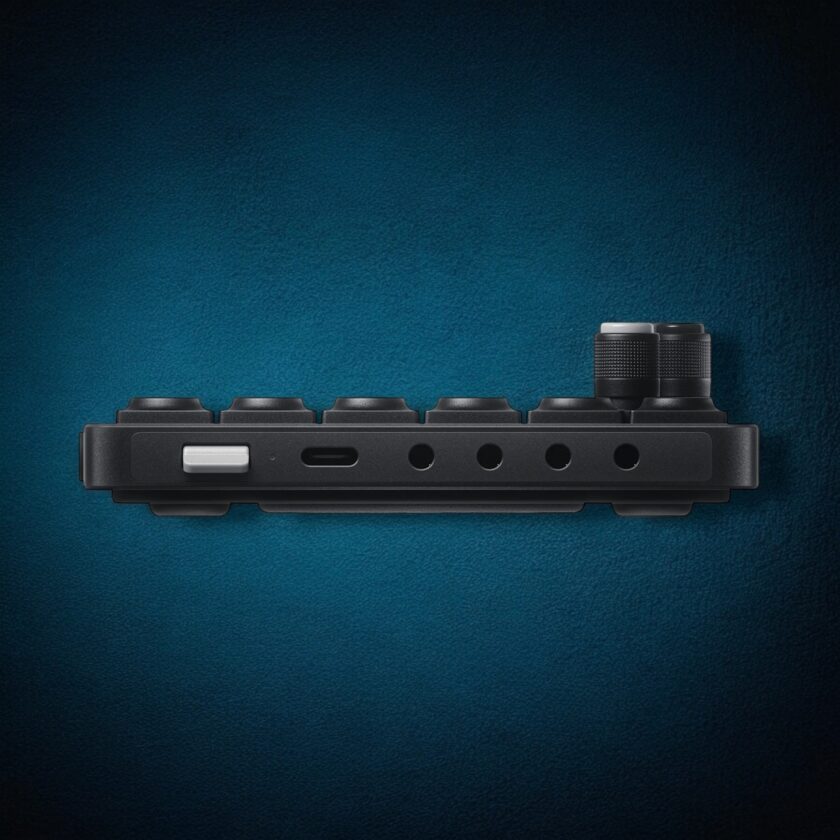
Rear ports include stereo main output, stereo line-in, and MIDI-In. A smart multi-out jack adapts to CV/Gate, clock sync, or extra audio, depending on the TRRS cable tip. USB-C handles both audio and MIDI. Bluetooth LE MIDI pairs in under 30 seconds and remains stable throughout extended testing.
Teenage Engineering rates the internal battery for 16 hours. In mixed-use tests—sequencing, sampling, motion effects—I saw about 10 hours at full backlight. A 4000 mAh Li-ion cell charges from zero to full in roughly 90 minutes over USB-C.
Price, Value, and Ecosystem
At $2,299, the OP–XY sits at the premium end of grooveboxes. There’s no denying that this is a pricey proposition for most musicians. However, it improves on Teenage Engineering’s predecessors in nearly every way.
Alternative standalone samplers or MPCs may offer deeper editing, but at the cost of extra gear and cables. If you prize speed, portability, and simple control, its price aligns with the workflow gains.
Purchasing unlocks firmware updates, downloadable sample packs, and an online manual that’s richer than most hardware guides. Plus, there are already plenty of great content packs to expand the OP–XY online, both free and paid.
Teenage Engineering’s active roadmap suggests the OP–XY will continue strengthening rather than stagnating.
Final Thoughts
The OP–XY serves as a fast-grab idea machine that captures motifs the moment they strike, with a clear UI, robust build, and expressive gesture controls, making it an indispensable companion for mobile musicians on the move.
Check out more hardware reviews here.
