
Introduction
In 2015, Yamaha introduced the Reface DX to make FM synthesis more approachable. It packs a four-operator engine, a Full-Dot LCD, and 37 mini keys. All fit into a chassis the size of a laptop controller. Ten years on, the Reface DX is still in production and has not waned in popularity.
In this review, we revisit this classic to see if it still holds up.
Build and Design
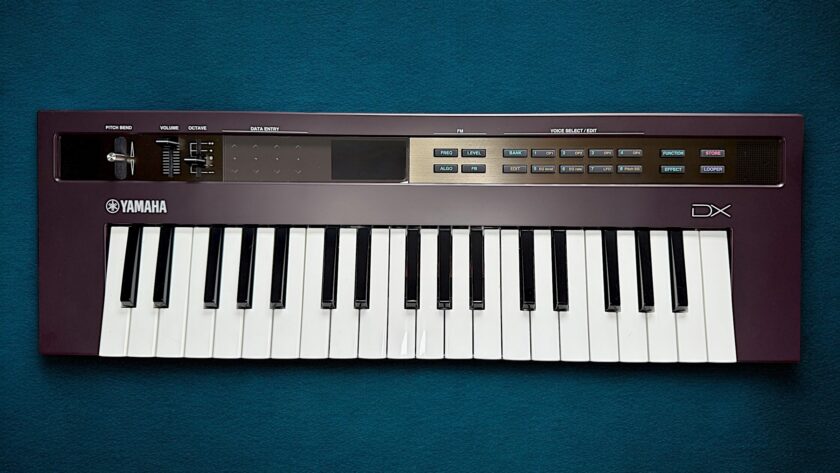
The Reface DX measures 20.9 inches wide, 6.9 inches deep, and 2.4 inches tall. When loaded with six AA batteries, it weighs 4 lb 3 oz. One hand lifts it easily; the shell feels firm enough to survive life in a backpack. A muted purple matte finish frames the keybed, while dark-brass plates and vintage lettering nod to the DX’s 1980s lineage. Four rubber pads stop the board from sliding on glass desks, and rounded corners help it slip beside a laptop without snagging cables.
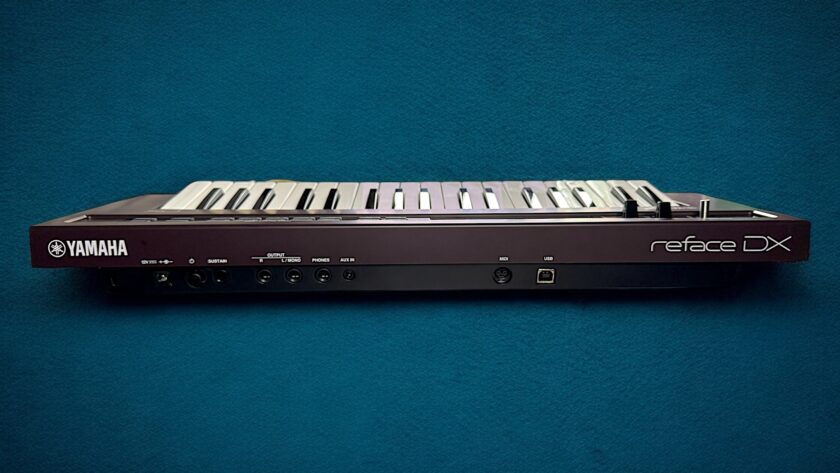
A slim wall adapter handles continuous power, while users report around five hours of play on fresh AAs. Two small built-in speakers render mids and keep highs smooth. Its small speakers roll off low end, so headphones or monitors may suit bass checks.
Buttons give a firm click, slider caps stay steady, and the volume knob turns with gentle resistance. The chassis feels lighter than metal workstations and remains tough enough for daily travel. It is a testament to the build quality Yamaha put into this compact instrument.
Keys and Playing Feel
The HQ mini keybed spans three octaves plus a high C. Travel is shallow yet even, and the springs snap back with confidence. Rapid chords and single-note runs feel stable despite the reduced key width. Velocity response rises smoothly: gentle touches keep pads soft, while firm strikes cut through a dense mix without overshooting. Aftertouch is absent, but not surprising, given it was not a common inclusion in portable boards from this period.
Pitch bends come from a spring-loaded lever that snaps to center when released. Its two-semitone range covers quick slides, but players who prefer slow wheel sweeps may want to link an external controller.
The included eight voices support most pop chords and bass hooks. Long, fading pads can steal notes during dense passages, shortening decay or thinning voicings keep overlapping textures intact.
Interface and Workflow
The Reface DX’s primary appeal is its approachable programming interface. If you missed the 80s, FM menus could feel like algebra. This was especially true when programming the DX7. On the Reface DX, a clear Full-Dot LCD joins four capacitive sliders. When you select an operator, four bars appear, each tied to a frequency ratio. Slide a finger to shift the ratio and brighten the sound in real time. A second press turns the sliders into envelope controls; a third adjusts feedback. This hands-on method makes quick work of turning numbers into tones.
Only the Reface DX has the slider-and-screen interface in the Reface line. It shares thirty-two user slots with its siblings, but alone supports multi-touch editing. The DX uses twelve modulation algorithms and gives each operator its own feedback loop. Low feedback warms the sine waves. High feedback adds a metallic edge that cuts through dense mixes. These loops let you create bold sounds without the complexity of six operators.
Sound and Character
Sound-wise, the Reface DX delivers a clean digital tone. Factory electric pianos shimmer without harsh edges. Small ratio shifts unveil shifting pads that sit behind vocals without muddying mids. Bass presets stay tight and snappy like the classic DX bass tones of old, avoiding sub-frequency smear. Push feedback past halfway to introduce snarling harmonics fit for techno leads.
The Reface DX uses sixteen-bit converters to keep hiss low at normal levels. If you push the operator ratios high, you may hear faint noise in the top octave. That noise fades once you play a full track. Stereo imaging stays clear, and the quarter-inch outputs deliver a healthy line-level signal.
The Reface DX uses four operators, while the DX7 offers six. Four operators can create many sounds, but replicating certain DX7 patches is impossible.
Eight front buttons recall sounds; holding one accesses a second bank layer, revealing all thirty-two user slots.
Effects and Phrase Looper
Seven effects sit in two serial slots: chorus, flanger, phaser, delay, reverb, distortion, and velocity-driven touch-wah. Each block offers two parameters for swift tweaks. Delay times sync to the incoming MIDI clock. Reverb moves from small rooms to medium halls without clouding detail. Distortion paired with elevated feedback shapes gritty bass that stays clear in busy mixes.
A single-button looper records up to 2,000 MIDI events—about ten minutes at 120 BPM. Arm, play, overdub—done. The buffer clears when loading a new patch, positioning the looper as a scratchpad rather than a live arrangement tool.
Limits To Consider
Its most surprising flaw is that it can’t load or support the hundreds of classic DX7 sysex patches available online. This limitation alone would be manageable, and paired with the four-operator ceiling, certain complex tones stay out of reach.
Taken together, these constraints position the Reface DX as a separate FM synth inspired by the DX legacy. It is not a direct recreation of the DX series.
The 32 preset slots also fill up quickly for avid creators. Yamaha softens this limit with Soundmondo, an online hub for saving, loading, and backing up patches.
Réflexions finales
The Reface DX favors simple retro styling over an exact DX7 copy. It has four programmable operators and touch sliders. You get eight-voice polyphony and battery power. Together, these features let you shape FM sounds in seconds.
If you crave glassy electric-piano leads and metallic FM bells… the Reface DX delivers.
Read more hardware reviews ici!
