
Introduction
Le Timetosser MK2 is a compact, button-driven box built to reshape audio in real time. No screens, no saved loops—just rhythm manipulation at your fingertips.
This device focuses on one thing: cutting and rearranging live audio while staying on beat. It’s not a sampler, sequencer, or loop station. It’s built for one job: real-time rhythm control.
What the Timetosser MK2 Does
Timetosser records live audio into a 16-second loop. It splits the sound into rhythm slices—quarter notes, eighths, sixteenths, and triplets. You press the buttons to play and rearrange those slices in real time.
The device handles timing through MIDI clock, gate pulse, or tap input. This flexibility allows for tight integration into just about any kind of rig—DAW-based or DAWless, modular or DJ.
There’s no step-sequencing or pre-recorded loop storage. What you hear is what’s happening right now. It gives you precise, hands-on control over the timing of what’s already playing.
Build and Design
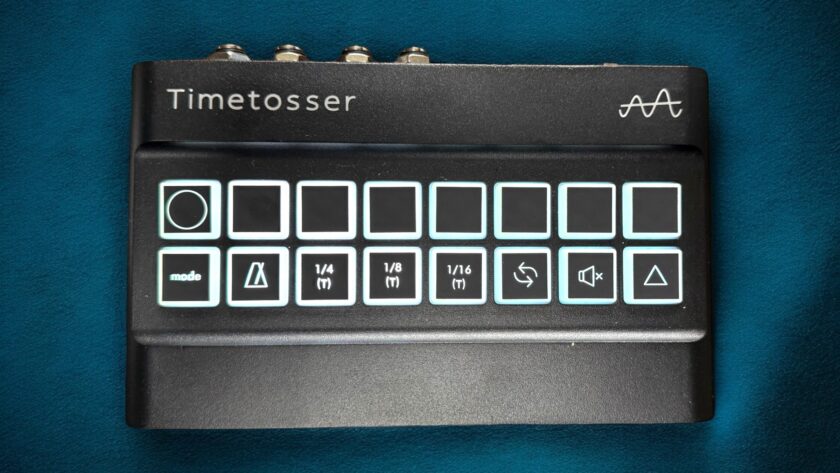
The MK2’s powder-coated aluminum surface both looks and feels wonderful. Its frame has a professional, minimal finish with a matte sheen that avoids and puts the focus on the star of the show, the buttons.
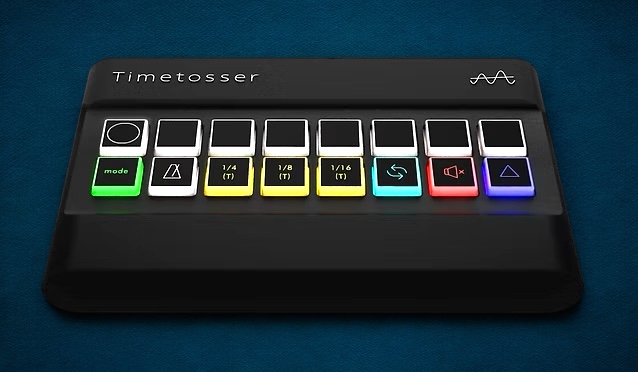
Sixteen RGB-lit buttons span the front. They offer a crisp, mechanical snap with slight resistance, evoking the feel of low-profile keyboard switches. There’s no sponginess or wobble. Each press produces a clean response, and the LEDs beneath each key adapt to time divisions and playback modes.
Textured rubber pads on the underside provide a reliable grip on studio desks and metal tables, even when triggering rapid fills. Its compact size slots between mixers, synths, or drum machines. At just under one kilogram, it feels substantial, anchored during use, yet light enough to travel.
Rear-panel connectivity is clear and complete: stereo audio I/O on ¼” TRS, MIDI in and out via 3.5 mm jacks (DIN adapters included), a gate input for analog sync, and USB-B for power and plugin control.
Interface and Real-Time Workflow
Timetosser’s interface keeps things simple, with no deep menus, just direct control. Each button has a straightforward job. The top row lets you pick rhythmic slices, from 1/4 notes to 1/16T triplets, plus mute and reverse. Hold Shift, and the bottom row shows more slice points later in the timeline.
The Mode key toggles how playback behaves: momentary, latch, or gated. You can hold a slice, tap it once, or sustain it only while pressing. This variety changes how you perform transitions and stutter effects.
Visual feedback comes from LED animations. A white scrolling bar shows the buffer’s position. Slices flash or change color to show selection, timing, or active playback. This becomes second nature with use—no screen required.
Once you get used to it, editing in real time feels natural. You can create fast fills, reverse effects, and quick repeats with ease. The layout encourages muscle memory. Instead of thinking about modes, you focus on phrasing and groove.
Sound and Character
Timetosser operates in the time domain, focusing entirely on rhythm and structure. Audio passes through at 24-bit/96 kHz with no EQ coloration or dynamics processing. This preserves the original signal’s integrity, crucial when routing vocals, drums, or mix stems.
What changes is structure. You can trigger slices as individual hits, rhythmic loops, or sudden reversals. A rapid-fire press of sixteenth notes produces a granular stutter. Triplet subdivisions swing the groove unexpectedly. Reverse breaks act as rhythmic punctuation. All of it lands precisely in sync.
This kind of control works best on drums, vocals, or simple melodic loops. With fewer layers, the timing effects stand out more. A basic two-bar loop can turn into something unexpected with just a few taps.
Even static phrases gain life when you’re chopping them in real time. That’s the core appeal here—turning repetition into variation without leaving the flow.

Connectivity and Setup Scenarios
You can clock Timetosser from MIDI, an analog gate, or a tap. It works as a standalone live processor with no screen or computer needed, or it can serve as a hybrid controller through the companion VST plugin.
In live DJ setups, DJs often place the unit on a send/return loop. You route a deck or loop through the buffer and create on-the-fly breakdowns, fills, or reverses. The system synchronizes everything, and every change is momentary unless latched.
Modular users sync it using a gate signal and send in oscillator mixes, rhythmic patterns, or sequencer outputs. It processes sharp transients with ease and keeps the timing steady.
In the studio, the VST plugin allows control over audio played in your DAW. The plugin is available only in VST format, so Logic users will need to use a VST-compatible DAW to access that functionality. In my testing, I found this to be the only real downfall. As I love using Logic, a native AU plugin would be such a godsend.
Latency is very low, a must for a device of this nature. The device reacts to your input in real time, with no perceptible lag.
Learning Curve and Community Support
Timetosser is easy to learn but takes time to master. Its one-button-per-function layout keeps things clear, and most users can start exploring within minutes.
But getting musical with it—understanding how to land slices at the right time, how to build tension and release—requires practice. It’s a timing instrument more than a programming tool.
Advanced play includes Shift-layered triggers, quick Mode toggles, and slice timing combinations that push beyond basic fills. The learning here is kinesthetic. It lives in your hands.
Alter Audio offers clear support. The website has videos and simple firmware guides. The Discord is active, and updates add real improvements.
Creative Use Cases
Live DJ Performance: Route a single deck or loop through Timetosser. Fire off a sixteenth note slice to create a breakdown. Use reverse at the end of a phrase for emphasis. Drop the mute just before reintroducing the beat.
Hybrid Live Sets: Sequence your drums, then use a Timetosser to change their phrasing in real time. It gives you machine precision with human flexibility.
Modular Integration: Clock it from your rack, send it drums, blips, or basslines. Reshape them without re-patching or losing sync.
Studio Sessions: Use it as an idea generator. Run a dry loop through it and record your improvisations. Pick out happy accidents or use entire passes. The VST makes this even easier.
Value and Market Position
Timetosser MK2 costs about the same as mid-range grooveboxes or small mixers. It’s not a multi-purpose tool. It’s built for one thing—changing live audio in real time.
That focus pays off in speed and reliability. Setup is fast. Integration is painless.
It ships with a travel case, MIDI adapters, and a USB cable included, gear that’s often sold separately by other brands. That detail underscores the product’s plug-and-play readiness.
Limitations and Considerations
The system caps the buffer at 16 seconds. That’s more than enough for drums, vocal cuts, and loops—but artists who work with long ambient textures may hit the ceiling.
There’s no onboard pitch manipulation, filtering, or FX. If you’re hoping to layer or morph sounds, you’ll need to handle that externally. This box edits when things happen, not comment they sound.
Conclusion
Timetosser MK2 gives you control over rhythm in its rawest form. You’re interacting with time itself—catching, shaping, and releasing it in motion. The result is a new kind of phrasing—one born not from planning, but from performance.
It’s built with intention. Its interface is lean. And its possibilities are wide open for anyone willing to meet it halfway.
For DJs, hybrid performers, modular artists, and producers who want immediacy in how they reshape sound, Timetosser offers something unique.
Not a toy. Not a trick. A tool for turning time into texture.
Check out more Hardware Reviews ici!
