
Introduction – What is Ferrous?
Ferrous is a magnetic string resonator built by Landscape.fm in collaboration with artist Victoria Shen. For those unfamiliar with the concept, Ferrous is a compact motorized device that excites steel strings by spinning a disc embedded with neodymium magnets. Guaranteed to be unlike anything you’ve ever used before, it excites strings of certain instruments through resonance caused by magnetic interaction.
You discover unfamiliar sounds via exploration, and the experience itself will help you view music in a new way.
What It Does
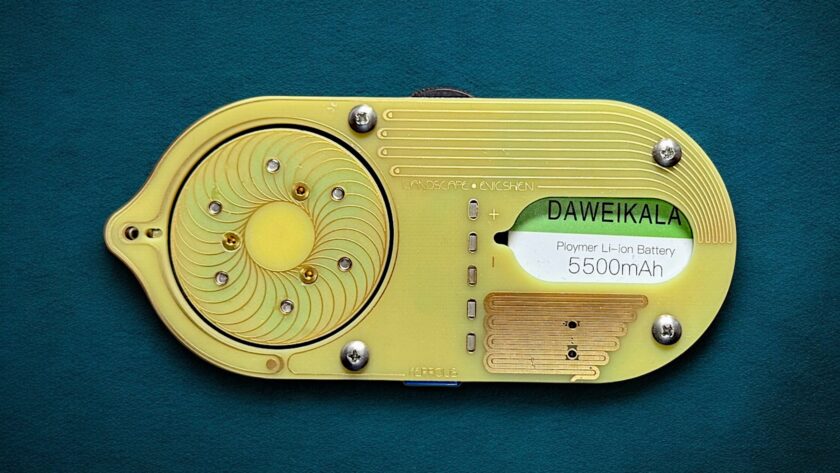
The main part of Ferrous contains a rotating circular disc with six arranged magnets. These include a mix of small and large neodymium magnets. The disc is driven by a brushless motor, and when held above a resonant steel-string instrument, the moving magnets cause the strings to vibrate.
You control the motor speed and interaction using four inputs:
- A thumbwheel for continuous RPM adjustment and power on/off
- A blue pushbutton that “pulses” the RPM.
- A capacitive touch plate that assists with RPM control as well.
- A CV input for external modulation
Because it is a string resonator, and not an audio source itself, Ferrous has no audio output. To hear its results the best, you’ll either need a microphone for non-electric instruments, or for an instrument with pickups, connection to an amp.
Build and Interface
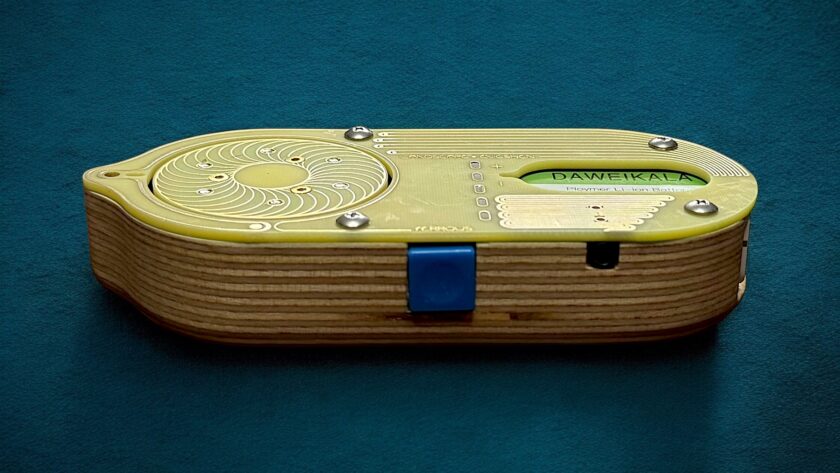
Ferrous is compact, with a focused physical layout. The enclosure is unpainted wood, showing a smooth surface and visible grain. On top sits a gorgeous circuit board like appearance adorned in soft green and gold-like accents. It weighs about half a pound, easy to hold, yet substantial enough to stay put when resting on an instrument.
To charge the Ferrous, just connect via USB; a rechargeable 1300 mAh 9V battery fits inside of the device, ready to provide hours of play.
Once it’s turned on, the controls are straightforward and easy to access. The thumbwheel gives smooth control over speed, and the blue button has a soft tactile click.
Experimenting With Different Instruments
Proper placement takes practice. Ferrous works best when suspended just above the strings: close enough to influence them, but not so close that it collides, scrapes or buzzes – which will happen if you’re not careful, because of the powerful magnets. Once you find the right distance and motor speed, the strings resonate.
Ferrous can be effective on a wide variety of instruments. On a lap steel, zither, or upright piano, it can expose subtle harmonic layers. With a bass, the effect is more subdued, often a steady drone, but as one experiment showed, it gets wild if you combine it with, say, a Chroma Console.
There are also multiple different ways to use the Ferrous. You can hold it by hand or use the included standoffs to make it easier. There’s a threaded rubber standoff to prevent string buzz, and additional rubber standoffs, attachable for stationary usage (pianos, auto-harps, etc.)
What It Sounds Like
Since Ferrous doesn’t pluck or strike, but relies on magnetic rotation to keep strings moving, the resulting tones often resemble sine waves, with no attack and a gradual, evolving body.
You might hear swells in volume or fluttering similar to tremolo. As multiple strings resonate, overtones build into complex pulses.
Adding reverb or delay enhances the result. Even a single chord can stretch into a dense, ambient layer. Ferrous excels at creating long modulated pads or beautiful textures. You can integrate it into sound design, using it to generate drones or underscore ambient scenes.
Creative Applications
With Ferrous, experimenting is part of the fun. What you hear depends on the instrument, tuning, placement, and motor speed. Minor changes can make a big difference in sound. You might spend hours just seeing what it can do.
This interaction supports a slower, more intentional approach to playing. You might settle on one chord and explore how it responds across different speeds. Harmonics fade in and out. Certain strings resonate more prominently than others, depending on how the disc spins and how close Ferrous is to the surface. With this, the technique is less about melodies and more about texture.
There’s also modular flexibility. With CV input, you can modulate RPM using sequencers or LFOs. This adds an automated layer of rhythmic swells or pitch-like motion, depending on how your instrument reacts.
Who It’s Best For
Ferrous is ideal for artists who work with tone and texture. It’s a powerful match for:
- Ambient composers
- Experimental instrumentalists
- Sound designers for film or games
- Players of lap steel, autoharp, piano, zither, harp, or kalimba
It thrives in slow, resonant environments. For shaping sound over time, through motion rather than impact, it excels.
It’s not just for stringed instruments. Once you’ve tried it there, you may find yourself testing it on other metal objects to see what happens. Some users place magnets inside a metal bucket and move Ferrous underneath to create vibration. It invites playful experiments.
Final Thoughts
Our time with Ferrous made us want to try even more devices by the Landscape team. We adore their unique approach to sound, and the concept is so uniquely fun and different from anything we’ve used.
Ferrous is a great fit for musicians who work with ambient textures or slow-moving sounds. In the right setup, it can even feel like part of the instrument. It’s a sound choice for anyone looking for something truly different.
Check out more hardware reviews here!
