
The backstory of one of 2026’s most ambitious synths.
Long before MARS took its current form, Alexander spent years at Vyacheslav Grigoriev’s VG-Line workshop with other people’s synthesizers open on the bench. Roughly fifteen years of repair, restoration, modification, and design work now sit behind MARS, including experience with Soviet machines such as the Polivoks, Aelita, and Alisa alongside Minimoogs, Moog Sources, Jupiter-8s, Prophet-5s, Yamaha CS-80s, and plenty of less famous hardware.
In what Alexander, the developer behind MARS, described as “small engineering investigations,” Alexander learned how different synths were made. Some had more difficult faults requiring Alexander to trace circuits, and follow the interaction between subsystems. Through this Alexander had to work backward through decisions made by engineers decades earlier.
“Over time, it became possible to see not only the technical solutions themselves, but also the philosophy behind them,” Alexander wrote. Some of those ideas held up remarkably well; others became useful examples of what not to repeat in a new instrument.
Fifteen Years of Other People’s Synthesizers
Beyond repairs, VG-Line modified instruments, corrected known design problems, added features, and retrofitted MIDI into hardware built before MIDI existed. Extending an older synthesizer without breaking the parts worth preserving requires a pretty intimate knowledge of its architecture. Modifying a vintage filter or control circuit exposes many of the same design assumptions.
By 2017, those lessons were feeding directly into a vacuum-tube filter project that would take more than a year to complete. The design had to preserve the tube circuit’s nonlinear behavior, and provide a useful tuning range, stable operation, and enough consistency to build it repeatedly.
That work eventually became part of Apparatus.
Apparatus Comes First, Then Came MARS
Apparatus arrived in 2019 with a design built around getting a broad range of sounds from a relatively small number of tubes and controls. Early demonstrations quickly attracted attention, including from Sam Battle of Look Mum No Computer.
MARS was already taking shape in the background. The early MARS-1 prototype paired flexible digital synthesis with an analog signal path, with Alexander citing instruments such as the Nord Lead and Roland JP-8000 as inspiration for its digital oscillator side.
It was still quite different from the MARS being produced now, using a modified Formanta Polivoks filter and an analog three-phase chorus with no tubes in the architecture. Alexander wrote that the project had become too ambitious for a single developer, so MARS-1 took a back seat while Apparatus moved toward production.
When work resumed in 2020, the Apparatus project had already produced a working tube filter, the surrounding signal path, and practical experience getting that hardware into production. The unfinished digital MARS concept could now be paired with tube circuitry that had already survived the move from prototype to manufactured instrument.
Digital Oscillators Through a Tube Signal Path
MARS uses four digital oscillators built around TDA1387 R-2R DACs. Basic, Pulse, Ensemble, and Noise modes cover sine, triangle, sawtooth, and pulse waveforms along with more specialized options.
Their combined output passes into circuitry derived from the earlier Apparatus work, including a second-order voltage-controlled tube filter capable of self-oscillation and overload. The amplifier borrows from tube opto-compressor architecture, with asymmetric triode overdrive also available in the signal path.
MARS can operate in mono, duo, or four-voice modes, although those voices share the tube processing rather than receiving complete independent analog filter and amplifier chains. Anyone reading “four-voice” on the spec sheet and seeing a conventional polysynth is imagining the wrong instrument: the oscillator voices are generated digitally and processed together through the shared tube stages.
Two HADSR envelopes, an LFO, modulation matrix, vibrato, portamento, legato, FM-oriented sounds, noise processing, CV/Gate, MIDI, USB, and external audio input fill out the synthesis and control side.
Because this is a specialty synth, with a specialty price to back it up, we regretfully haven’t had a chance to get our hands on it yet.
If Altwire ever gets the chance, we are stoked to test that external input, since it lets other instruments pass through MARS’s tube audio path without using the internal oscillators. We’d love to hear how that sounds.
Solving the Front Panel
Packing that feature set into a compact rack enclosure limited the interface. A true knob-per-function panel would have needed much more space, while moving everything into a conventional menu system would have concentrated too much interaction on one screen.
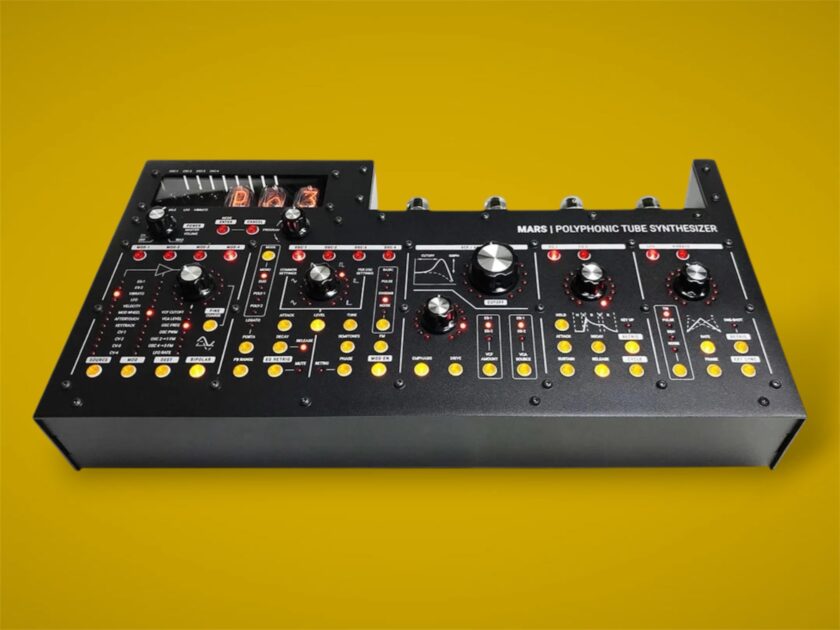
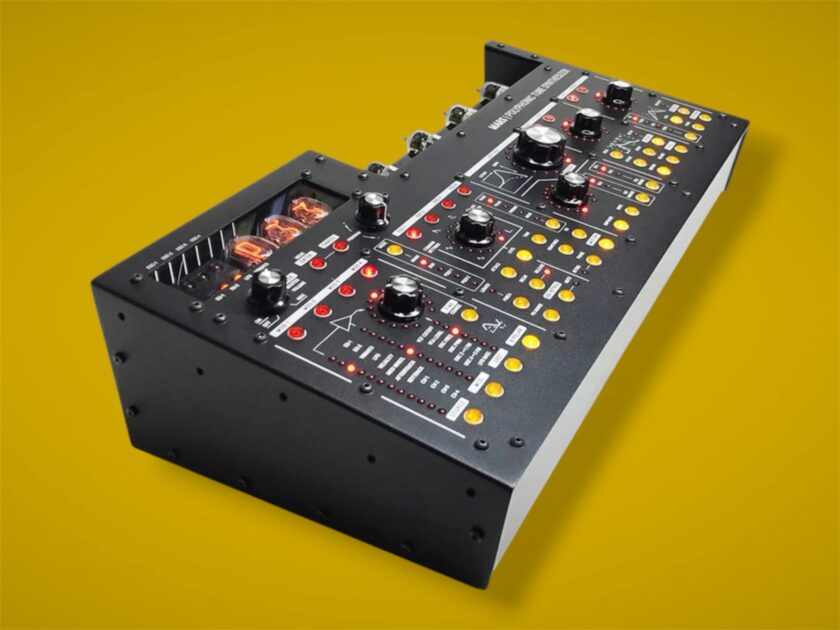
MARS uses separate controls and displays for its synthesis blocks, with dedicated buttons selecting the parameter being edited. Preset recall keeps the stored values reachable even when the physical controls are elsewhere, sidestepping the familiar situation where a knob says one thing while the loaded patch does another.
There are 99 preset locations. After loading one, selecting a parameter brings up its stored value regardless of the physical control position.
The panel also looks gloriously strange. The Nixie display, LED rings, rack format, and exposed tubes make MARS look like something halfway between studio hardware and test equipment.
Living With Tubes
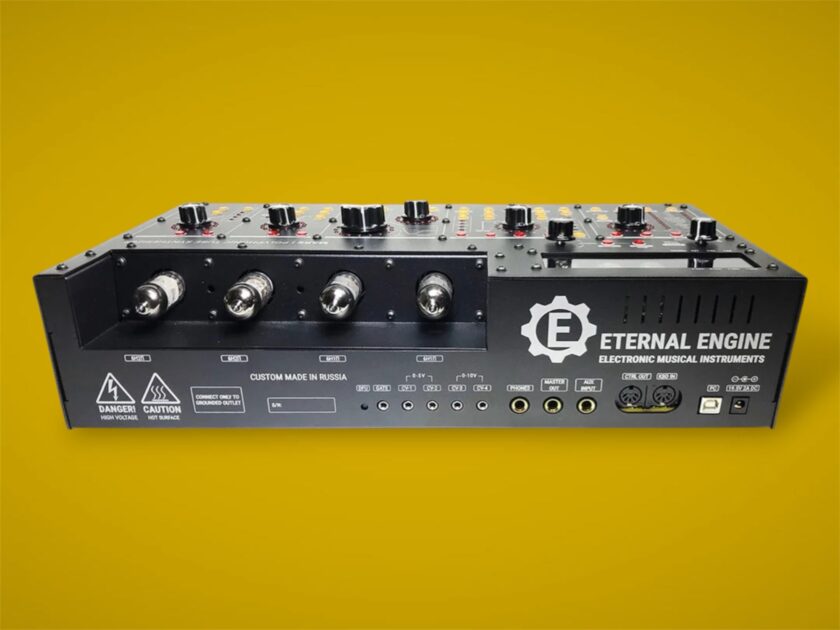
MARS uses two 6N1P and two 6N2P tubes, with spare tubes supplied with the instrument. Its documentation recommends at least 15 minutes of warm-up before the circuitry reaches normal operating conditions, during which some settings and aspects of the sound can still shift.
Owning tube hardware also means dealing with heat, ventilation, high internal voltage, and a little more care during transport. MARS ships with the tubes removed from the chassis for added protection.
Power comes from a 19.5V external supply, while MIDI, USB, CV/Gate, and external audio cover the main connections. CV-1 and CV-2 are optimized for a 0–5V peak-to-peak range, with CV-3 and CV-4 optimized for 0–10V peak-to-peak.
Getting From Prototype to Production
According to Alexander, roughly two years went into refinement after the basic concept settled, followed by more work on production engineering, component selection, and manufacturing preparation.
A Minimoog or CS-80 arriving on a repair bench in the 2010s could easily be pushing forty years of service. After that long, bad design decisions tend to find their way back onto your bench.
A one-off prototype can survive weird workarounds, hard-to-source components, awkward calibration, or decisions only its builder completely understands. A production instrument eventually has to be assembled, calibrated, and repaired by somebody else, which was territory VG-Line already knew very well.
The result of all that knowledge is MARS, a synth backed by almost two decades of experience and one of the most ambitious synths of 2026. We cannot wait to get our hands on it.
Head here to find more great features!
