
Use ALTWIRE at checkout for a 20% discount off the price!
I’ve been watching MIDI Agent grow for the past year. The developer gave me early beta access when it was still very new and an interesting idea, but sometimes had inconsistent execution. The version shipping in 2026 is a different animal, far improved, and this article has been rewritten to reflect our current impressions.
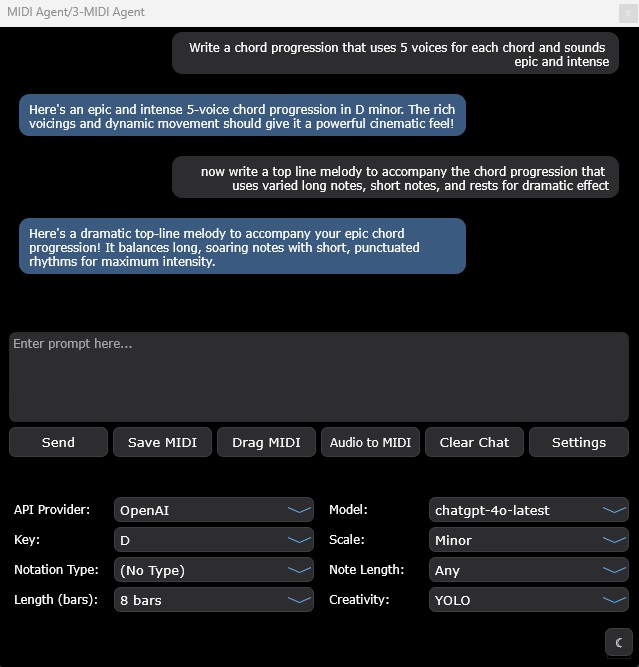
The concept: describe music in plain language, get MIDI back. Typing a desired outcome into the LLM-style chat window, such as “give me a minor-key bass line that drops out after eight bars, then re-enters with a fill.” will result in MIDI Agent processing it and providing a result to drag straight into your DAW. No MIDI programming knowledge required.
As in the original beta, prompt quality determines how closely the final result matches what you’re looking for. Vague prompts (“alternative rock,” “something dark,” “make it moody”) land in the middle of nowhere. The more specific you are about structure, feel, and function, the better the output. A prompt like “16-bar minor key bass progression, root notes only for the first eight bars, add a chromatic approach note on beat 4 of bar 8, resolve back to root on bar 9” will produce something close to your intended result. “Dark bass” will not.
Telling it to hold the bass for four measures before a fill, or to keep a rhythm sparse through a verse and busier through a chorus, it will do exactly as presented. Even with a prompt where there are multiple layers for bass (sub, mid, rolling bass), chords, pads, and a lead, it is completely possible if the prompt is detailed enough, to have it build the whole arrangement for you via MIDI. If you use one of the many AI chat websites available to the general public, the chat interface will mirror what you use daily, and there’s nothing to relearn about how to talk to it. Output takes a few seconds to process.
On the model side, the subscription gives you a menu of AI models running under the hood. Initially, the developer recommended Claude Sonnet and Gemini Pro. MIDI Agent now ships with its own proprietary models as an additional option, and the results are on par with those from the other models.
A brief aside here: With people being incredibly anti-AI in music ala Suno, I can see in some ways where something like that could make people turn their noses up. However, MIDI Agent will not automatically build a whole song. It has to be told in detail what to do. Unlike Suno, it’s not making the whole song with fake vocals, generated synths and drums. It’s just the notes, and you can edit the MIDI by hand. Think of it as a shortcut.
In the end, you still must assign the samples and VSTs. And in the above examples, if you’re putting that much detail into how you’d like the song to be built, you’re not exactly having MIDI Agent do everything for you.
Of course much like with anything of this sort, there are ways, with outside LLM assistance, that it could still be possible to truly cheat. Because MIDI Agent is an LLM, in theory, it may be possible to use ChatGPT or Claude first to flesh out a full structural breakdown and yield even tighter results. That’s really on tú if you want to go that far.
I’m on Ableton Live 12, and dragging MIDI from MIDI Agent directly into a session is as simple as it sounds. When I first demoed MIDI Agent in 2025, I was using Logic and ran into some difficulty. In Logic, the plugin installs as a MIDI FX rather than a standard instrument VST. That’s an Apple architecture quirk. I spent a confused ten minutes restarting Logic before I found it, and honestly, I’ve had so much better success with Ableton on a lot of options that I haven’t used Logic in a good while.
Updates have been consistent since early beta, and the improvements have been substantive. The first beta was, by the developer’s own admission, only 10% of the overall dream for the software. Over a year later, it’s a completely different product. Highly recommended.
MIDI Agent discount code: use ALTWIRE at checkout. Try it aquí.
Consulta más reseñas de complementos aquí!
