

- Desmitifica la teoría musical
- Impresionante herramienta de detección de claves
- Asequible
- La interfaz es un poco intimidante al principio.
Originally published February 2025. Updated June 2026.
Editor’s Note / TLDR: After a year of Escalador 3 being out, it’s where we’d point you. The jump from 2 to 3 is big enough that we updated this piece to reflect it. Pick it up at Plugin Boutique aquí.
If you’re new to the Scaler ecosystem, the question right now is a practical one: Does Escalador 2 still make sense at a lower price point, or should you go straight to version 3, now that it’s been out for quite some time?
I’ve been with Scaler for a while, and I used Scaler 2 a lot when it was the main version, building chord progressions from scratch. Its strength is showing you which chords fit together in a scale, not just offering random options but explaining the logic behind them. If you want to write music with more intention rather than guess, this is really helpful.
Scaler’s Key Detection tool is especially useful. You can drop in a MIDI clip, and Scaler 2 will find the key and show you which chords fit. It won’t write your music, but it helps you keep going when you’re stuck and can’t figure out why a chord doesn’t sound right.
But the honest caveat is, and remains, the learning curve. In both versions of Scaler, this isn’t something you open and immediately understand. Compared to tools like Telepathic Instrument’s Orchid synth, or Polydigm Software’s Klimper, it’s not quite the “press this button and get matching chords” solution everyone might be hoping for. Tutorials help; without them, the tool’s depth works against you early on. But past that initial speedbump is a world of depth that goes farther than either of those two options can provide.
That’s not to say that Scaler doesn’t have the same access to quick inspiration. In fact, once you master it, quick inspiration is the software’s whole premise. Scaler ships with a variety of different sources of inspiration. One example is the Artist Chord Sets. Over 200 sets modeled after musicians like Carl Cox, MJ Cole, and Mike Huckaby give you immediate stylistic context to build from, and the genre-based sets cover ground from cinematic to drum and bass to jazz.
At $59 regular and frequently discounted, that’s a lot of harmonic territory for the price. And it’s giving you genre-appropriate options, vs. simply suggesting which chord progressions may sound good together. Scaler, as a software, is more of a songwriting assistance tool than the “easy road to quick chords” that the other options are. It’s what musicians should aim for if they seek depth and substance.
So, how does Scaler 2 compare now that Scaler 3 is out?
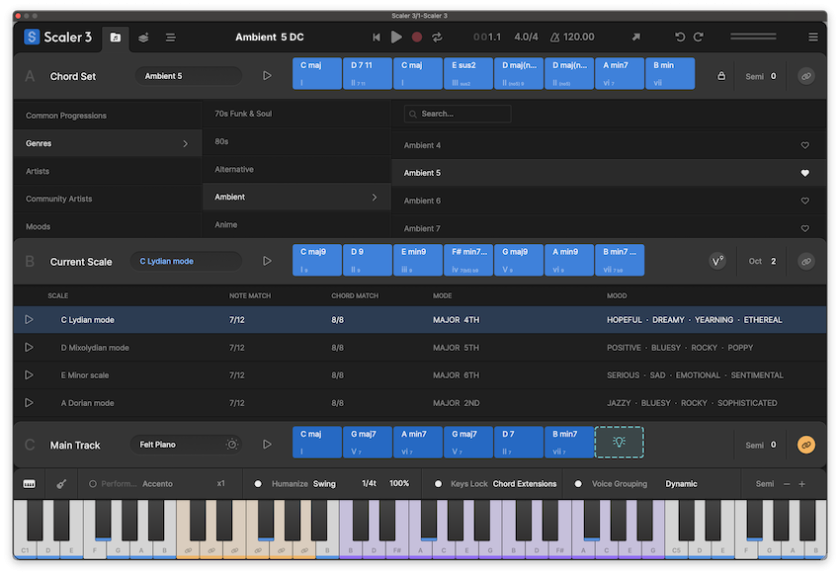
Scaler 3 launched on March 25, 2025, and the upgrades are substantive. The multi-lane timeline lets you write chord, melody, bass, and phrase parts in parallel, which Scaler 2 doesn’t do. Running as a standalone app, it’s no longer tied to a DAW. And with VST/AU plugin hosting built in, MIDI routing becomes optional rather than required. Scaler 2 remains available and continues to do what it always did.
If you find it heavily discounted and are after chord-scale relationships and progression building, it’s not a bad entry point. But at this point, the slight savings on the older version aren’t enough to offset the wealth of benefits you get from going with the latest version. Better yet, if you already own Scaler 2, the $29-$39 upgrade path to version 3 is easy.
Because of this, we recommend Scaler 3 as of 2026.
BUY SCALER 3 AT PLUGIN BOUTIQUE
(Already have Scaler 2? You can upgrade at Plugin Boutique for $29–$39.)
Consulta nuestras otras reseñas de complementos aquí.
