
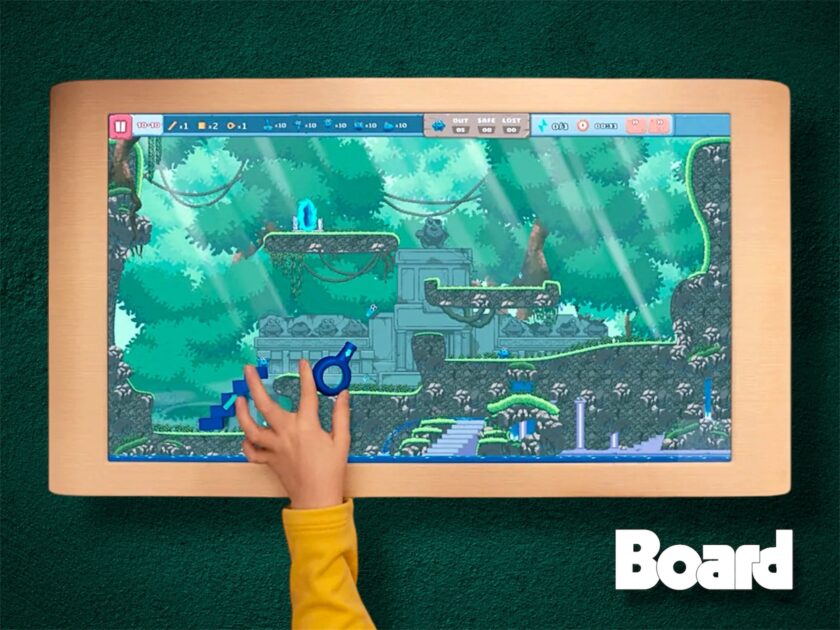
When we aeviewed Brynn Putnam’s Board in December, we said it was a big step forward for gaming. Seeing digital characters interact with real pieces in real time reminded us of those science-fiction holographic tables that, in the past, seemed impossible. We also said we were excited to see what would happen next.
Now, we have a better idea of where things are headed.
Board just announced a $20 million Series A round led by Union Square Ventures. Michael Mignano, a General Partner making his first investment since joining the firm, will join Board’s board of directors. Other new investors include Biz Stone, Elan Lee, Evan Sharp, Jesse Dorogusker, Kayvon Beykpour, Scott Belsky, Tim Ferriss, and the venture fund Haystack.
Board plans to use the funding to accelerate its transition from a gaming console to a full creator platform, starting with the launch of Board Studio. Board Studio will let families, educators, hobbyists, and developers create their own games and custom pieces using easy language prompts and AI tools. The AI is designed to understand what users want and help make game assets, rules, and interactive features. The goal is to help anyone turn an idea into a playable prototype in less than an hour and share it with others.
When we first reviewed Board, we saw its open SDK as a reason to be encouraged about its future. Thousands of people have already downloaded Board’s SDKs to make their own games, drawing apps, educational tools, and storytelling projects. The first game made by the community will launch in July.
New technology often experiences obstacles with public adoption, but Board has done very well so far. Since its launch in October, Board has reached tens of thousands of homes and public spaces in all 50 states, including schools, hospitals, and restaurants. Board’s creators say that 85% of customers use it 30 or more times each month. The company also plans to release 10 new original games this year, which would bring the total to at least 25 titles by the end of the year, along with new accessories and special-edition collectibles.
“Most AI-generated software today lives on phones and laptops,” says Brynn Putnam, “We believe AI creation deserves a new home — one built around shared physical experiences, real objects, and people gathered together around a table.”
We are not yet sure how deeply AI will fit into Board Studio, but this is not Brynn’s first time working with new technology. After her fitness company, Mirror, was bought by Lululemon, Putnam focused on a social problem rather than a technical one: powerful devices were everywhere, but they were pulling people apart. Board was her solution. Board Studio shows that the solution is still evolving, now with $20 million in support.
