
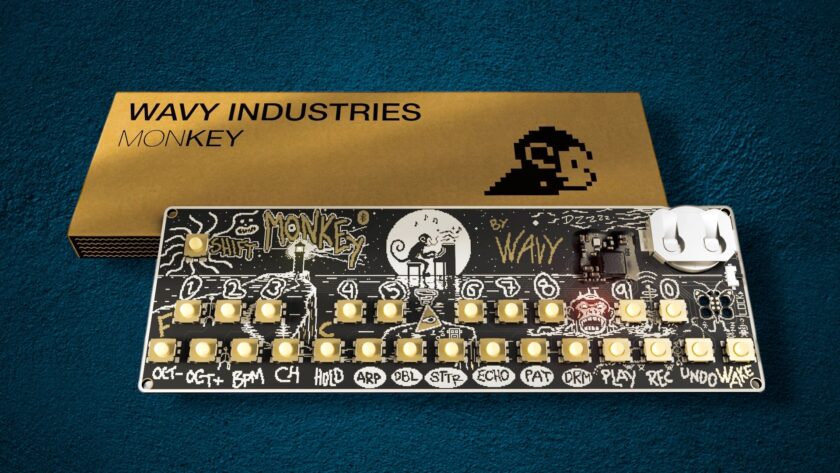
A €59/approx $70 USD (Altwire’s own conversion as of 09/05/25) two-octave BLE MIDI controller, powered by a coin cell, featuring 6 MIDI effects and a 16-beat looper that layers up to 10 instruments.
Quick Take
The MONKEY is a Bluetooth-only MIDI controller designed for maximum portability. Powered by a single CR2032 coin cell, it operates for months and features a 16-beat looper with up to 10 overdubs and six MIDI effects with ten presets each.
At 150 × 50 mm and with a frame no thicker than a circuit board, it is the smallest controller we’ve tested at AltWire. We previously thought that the NM2 and NMSVE by this.NOISE was the limit for the smallest MIDI controller; the MONKEY goes even smaller.
Its compact size makes it practical for on-the-spot ideas or mobile production.
Testing Context
Testing used the standard CR2032 coin cell, with all communication over Bluetooth LE MIDI. Setup was direct: power on, pair with the host, and begin playing.
Build & Hardware
The MONKEY measures just 150 × 50 mm, small enough to slip into a pocket. At first glance, such a tiny footprint might suggest it was built more as a novelty than a practical controller. However, this belief is not only inaccurate, but it also undersells the real value of this tool. In use, we found that the compact form is a benefit, offering excellent portability in a device that is both convenient and fully functional despite the reduced play area.
The surface doubles as both interface and art piece, with hand-drawn illustrations adorning the front: a monkey at a piano under a moon, a pyramid motif, and stylized graphics. Across the top, “MONKEY by Wavy” is printed in bold sketch lettering.
The low-force button keys react quickly, with octave shift and BPM functions marked beneath. A SHIFT key accesses secondary roles, and a circular pressure pad controls modulation. The keyboard spans two octaves beginning on F.
LEDs carry most of the feedback. The light tower blinks once to confirm octave changes and four times when you hit the end of the range. The monkey’s eyes blink in tempo and switch patterns when recording is armed. It’s a compact system, but the cues are clear once you’ve become familiar with them.
A side-mounted lock switch puts the device into low-power mode, extending battery life without a complete shutdown. However, this switch is meant more to help with travel and prevent accidental wakeups. Leaving the controller idle for a short while will also cause it to go to sleep, no switch needed.
Sound / Engine
The MONKEY does not generate sound but processes MIDI data using a fixed set of tools. There are six effects: ARP, DBL, STTR, ECHO, PAT, and DRM, and each includes ten presets.
- ARP: arpeggiator modes
- DBL: note doubling with delay
- STTR: rhythmic stutter patterns
- ECHO: repeating note echoes, some sustained until velocity returns to zero
- PAT: pre-made rhythmic ideas with swing options
- DRM: mapped drum loops and fills
Only one effect can run at a time, but switching between them is quick and seamless. Selection uses SHIFT + effect key followed by a preset number.
Each effect has its own behavior. STTR subdivides held notes into rhythmic grids, adding glitch-style repeats. ECHO sustains until the note velocity returns to zero, allowing phrases to hang over a sequence. PAT bakes in swing variations, shifting patterns off a rigid grid. For the effects, each of them also has 10 presets. After an effect is selected, you can do SHIFT + number to switch the preset.
The looper is locked to 16 beats and can layer up to 10 parts. Polyphony tops out at 20 notes, enough to handle stacked sequences without dropouts.
Workflow & Sequencing
Functions are located on the main surface and are accessible via SHIFT combinations and long presses. LEDs provide confirmation.
The sequencer is a 16-beat loop. Within that space, you can set undo points, erase per channel, and mute channels during playback. Each overdub sets a checkpoint, so UNDO removes only the most recent layer rather than wiping the entire sequence. Holding UNDO clears the channel, while a long press of CH mutes or unmutes parts. Together, they can layer, edit, and thin out patterns without stopping playback.
When pressed with SHIFT, the WAKE button resets the device state, and a long press reboots the unit. Combined with the lock switch, which turns off the keyboard while keeping the device in low-power mode, these shortcuts help keep the controller usable for months without constant cycling on and off.
Tempo defaults to 120 BPM, but you can reset it by pressing SHIFT + BPM plus a numeric input. LEDs confirm octave changes with a single blink, and four blinks mark the limits of the range.
Additionally, in early September 2025, Wavy released firmware version 1.2.0, adding the feature for users to upload their own drum loops through the website: https://wavyindustries.com/blog/20250905_monkey-drum-update/.
Connectivity & Power
Connectivity relies on Bluetooth LE MIDI. It works with macOS, iOS, iPadOS, Android, and hardware that supports BLE input. On macOS, you pair through Audio MIDI Setup or Wavy’s MIDI Connect app, which is quicker. Windows requires third-party tools such as loopMIDI and MIDIBerry.
As mentioned earlier, MONKEY draws power from a single CR2032 coin cell. Wavy rates the cell for several months of use. In practice, it behaves more like a calculator or tuner than a rechargeable device—ready whenever you pick it up. When the coin cell does finally run out, swapping it takes only a few seconds.
Final Verdict
Wavy’s MONKEY delivers on its goal of being a compact controller for quick loops and mobile use. Its small size, long battery life, and straightforward interface make it easy to layer ideas or trigger instruments without cables.
The MONKEY is a direct and effective option for producers who want a practical, pocket-sized controller.
