
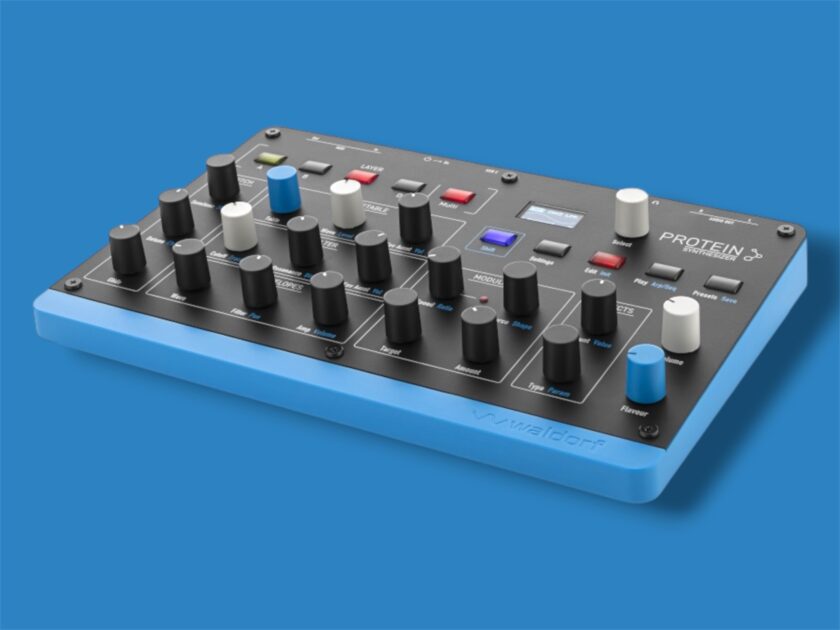
Waldorf used the oscillator research behind its Microwave 1 Plugin as the foundation for a $399 four-layer hardware synth. Is Waldorf’s ’90s-influenced box, the Waldorf Protein worth your time?
Lately, I’ve been obsessed with chasing old digital gear that sounds cheesy and dated, but has a feel most modern hardware synths can’t replicate.
The late 1980s and early 1990s were full of digital gear shaped by limited processing, low-resolution waveforms, early converters, and engineering compromises that cleaner descendants never had to make. Waldorf’s Microwave sits near the top of that pile, carrying the PPG wavetable lineage into a smaller, more affordable rack unit and helping establish Waldorf’s own identity.
As someone who’s been hunting for some wonderful ’90s synths and racks, I’ve also discovered that buying a clean original costs enough to make it a purchase you can’t just wing.
Attempts have been made to deliver that sound for less, and Waldorf’s official Microwave 1 Plugin captures the core concepts and sounds well. But if you’re looking for hardware, this leaves Protein in an interesting middle ground: eight voices, two wavetable oscillators per voice, four layers, MPE, sequencing, effects, and a physical panel for $399, with the oscillator work tracing directly back to Waldorf’s study of the original Microwave 1 ASIC.
The Microwave Connection
PPG’s Wave instruments were expensive and strange. When Waldorf arrived in 1989 with the Microwave, it carried the wavetable idea into a smaller rack unit built around digital oscillators feeding analog Curtis filters.
With Protein, Waldorf takes the oscillator side of that history rather literally: published specifications state that its two oscillators are based on the Microwave ASIC, run internally at 250 kHz to match the original ASIC sampling rate, model the DAC behavior per voice, and include the original Microwave 1 wavetable catalog as bit-identical source material.
That catalog includes the original Microwave wavetables, including algorithmic and speech tables, and covers the harmonic steps, glassy sweeps, vocal shapes, hollow basses, and metallic edges people associate with early Waldorf gear. This is also where the family resemblance starts branching.
Around those oscillators, Protein builds a modern four-layer architecture with MPE, modulation, sequencing, effects, and front-panel control, while the filter stage moves away from the original Microwave’s physical analog circuitry.
The original Microwave combined its ASIC-based digital engine and hardware DACs with physical Curtis filter chips. Protein keeps the ASIC-derived oscillator behavior and models DAC character per voice, but its filter is a digital model of a CEM-style analog filter rather than an actual Curtis circuit.
Waldorf even provides adjustable cutoff and resonance de-calibration to mimic detuned hardware, but the filter itself is still modeled rather than physical. Thankfully, I didn’t hear that difference sanding the character off the oscillators.
It Actually Sounds Old
And that edge is one of the best parts. I’ve recently had an E-MU Proteus FX, Proteus/2 XR and Procussion, an Alesis Quadraverb and 3630, a Yamaha TX81Z and a pile of other old hardware around me, so hearing some of that same period character coming from something released this decade made me ridiculously happy.
Pads carried the clearest version of it, with glassy upper harmonics, grain around the edges, and stepped wavetable movement that immediately put me in 1990s Waldorf territory, but the same engine could turn ugly quickly; harsher tables, resonance, Dirt, and drive pushed several patches toward an angry industrial sound that would sit comfortably beside Nine Inch Nails without much encouragement.
At launch, Dirt already included Static, Crackle, Click, Geiger, and three Burst types. OS 1.0.2 later added Ring Mod as another Dirt type, applying ring modulation between Oscillator 1 and Oscillator 2, which was perfect when a pad or sequence needed grain, transient junk, or outright aggression.
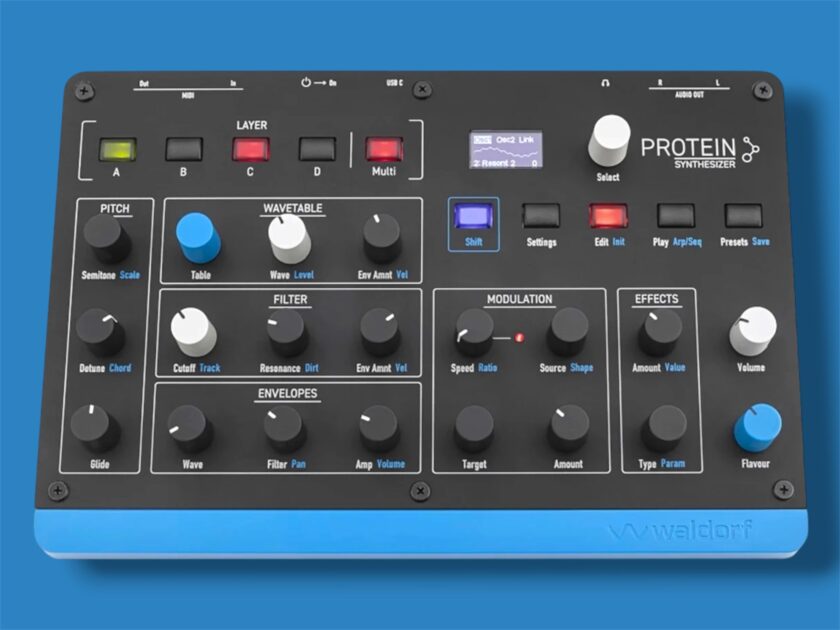
There’s a Flavour control too, adding methodical micro-variations rather than pure randomness; the manual says those variations are primarily in wavetable position and pitch. It wasn’t a headline feature to me, but I noticed the change, occasionally preferred it, and then usually moved on.
Four Layers, Eight Voices
All of these choices share an eight-voice pool across four layers. In Layered mode, stacking all four layers means a two-note chord can consume every available voice. Eight voices can become restrictive when several layers are active, although it mattered less in the trance and techno material I made. Monophonic basslines, single-note arpeggios, and mono leads left more room than dense chords or sustained layered pads would. Round Robin and Random Robin can also cycle or randomly select active layers across incoming notes, which works particularly well for repeated patterns and percussion.
In MIDI Split mode, the four layers can respond on consecutive MIDI channels, allowing Protein to operate as a compact four-part sound source.
Protein’s Interface Takes a Minute
I enjoyed my time with Protein, but its UI is certainly a bit hit or miss. The Protein took a little time to click because the display encoder selects the ADSR stage, and each of the three envelope knobs edits the selected stage for its corresponding envelope. I had to learn that behavior before patch building stopped feeling slightly backward, but once it became automatic, I could work quickly enough that the screen itself never turned into the problem some people make it out to be.
It is 2026; screens on hardware synths do not bother me when the important controls remain physical, and Protein keeps wavetable position, filtering, envelopes, modulation, effects, and layer access on the panel while using the display for deeper parameters and configuration. My main visibility complaint was the dark chassis with blue secondary labels, which looks good under normal light but gets hard to read in a dim room.
Preset browsing was the other small irritation that stuck around after the learning curve. Having to click the encoder to confirm every selection sounds trivial until you start moving through a large factory bank and realize that extra click will follow you dozens of times through preset browsing.
MPE, Sequencing, and the Rest
Once I was past those front-panel quirks, the deeper performance side was far more rewarding. Three envelopes, two LFOs, and an eight-slot modulation matrix sit alongside poly-aftertouch and MPE sources, chord and scale modes, an arpeggiator, and the step sequencer. Protein supports per-note pitch bend directly in MPE mode, while MPE Y and polyphonic aftertouch are available as modulation-matrix sources. Those sources can be routed to wavetable position, oscillator pitch, filter cutoff, or other destinations, allowing individual notes inside a chord to move without forcing every voice through the same gesture.
The onboard sequencer runs up to 32 steps and is enough for short note patterns, while MIDI input, USB MIDI, and four-part addressing make external sequencing the obvious choice once an arrangement grows beyond the box. I ended up caring more about the effects than the sequencer. The two global slots offer reverb, delay, chorus, phaser, flanger, drive, EQ, compressor, and tremolo, giving the engine a useful set of finishing tools. Each layer can stay dry, use FX 2 alone, or pass through FX 1 and FX 2 in series.
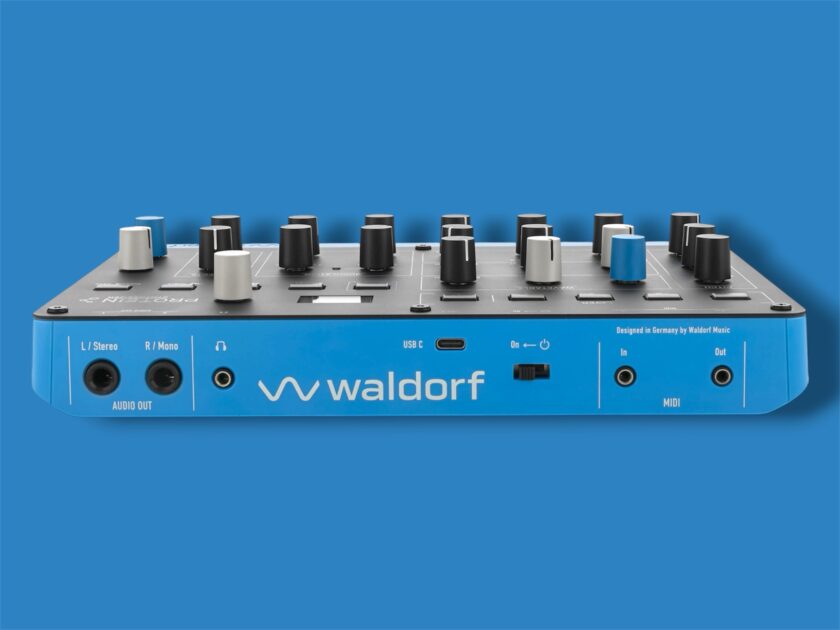
All four Multi parts ultimately leave through the same stereo output pair. USB-C carries power and MIDI rather than audio, so the rear panel stays simple: 3.5mm TRS Type A MIDI in and out, two 6.35mm main outputs, and a 3.5mm headphone output, with two TRS-to-DIN MIDI adapters included. On something this portable, I would have liked USB audio.
The $399 Route to ’90s Waldorf
By the end of my time with the loaned Protein, I was still spending most of it on pads, which tells you a lot about what this is best used for. String Me has this gorgeous glassy string character that made the old-digital Waldorf connection click. Lunare is grittier and shows why low-resolution wavetable movement still has appeal.
Some of its sharper digital textures reminded me of the Microwave XT, although Protein’s direct technical lineage is the Microwave 1. It is also a much simpler synth, and I would never call it a one-to-one replacement for either one. What I hear is enough family resemblance to make $399 feel aggressive for current hardware, especially now that vintage digital racks carry a nostalgia tax.
That price also explains Protein’s place in Waldorf’s own lineup. Quantum, Iridium, and M sit far above it in price, while Blofeld comes from a different generation and design philosophy. Protein is the small, focused hardware option for somebody who wants a physical Waldorf wavetable box without paying collector money for vintage hardware.
The pads are excellent, the effects fit the character, and Protein gets surprisingly close to the feel that makes old Waldorf hardware interesting. For a trance synth below $400, that is not a bad call at all.
Read more reviews here.
