
If recent reviews and demo videos on AltWire haven’t already made this clear, I’m a massive fan of acid-style music. Its sounds, its subgenres, and the numerous 303 hardware clones, tributes, and VSTs that emulate them. I found Trap Door Electronics’ Active Acid because I thought this was a 303-inspired guitar pedal. It’s got “acid” in the name. The letter that comes with it talks about acid house and techno. The designer comes from Death By Audio, a brand recognized for its unhinged sounds. But after months with it, the Active Acid is something else entirely: hints of acid flavor, but a lot more going on.
What Active Acid’s “Acid” Actually Means Here
Rather than a TB-303 emulation in a guitar pedal, the Active Acid is a four-pole low-pass filter from the late-70s polysynth tradition. Where a 303 is sharp and snappy, this pedal is smoother, with a filter that isn’t quite aggressive at first interaction. Unlike the Gamechanger Motor Pedal, Active Acid’s footswitch isn’t an instant chaos button. At neutral settings, it adds a gentle musical swirl to whatever you’re running through it. I was able to create squelchy sounds at high resonance, but that’s where the similarities end.
The Active Acid features the same SSM filter architecture found in legendary synths like the early Prophet-5 revisions. This lineage is prized for its lush, creamy character, standing in contrast to the brighter, thinner-sounding Curtis chips found in later 80s designs. What this means is that the pedal is essentially a synthesizer that uses your instrument as an oscillator. Active Acid’s four-pole analog low-pass filter spans 0 Hz to 13.5 kHz. With the correct settings, it can get loud, even rude if you push it, but it has enough silk at moments to assist with ambient music composition as well.
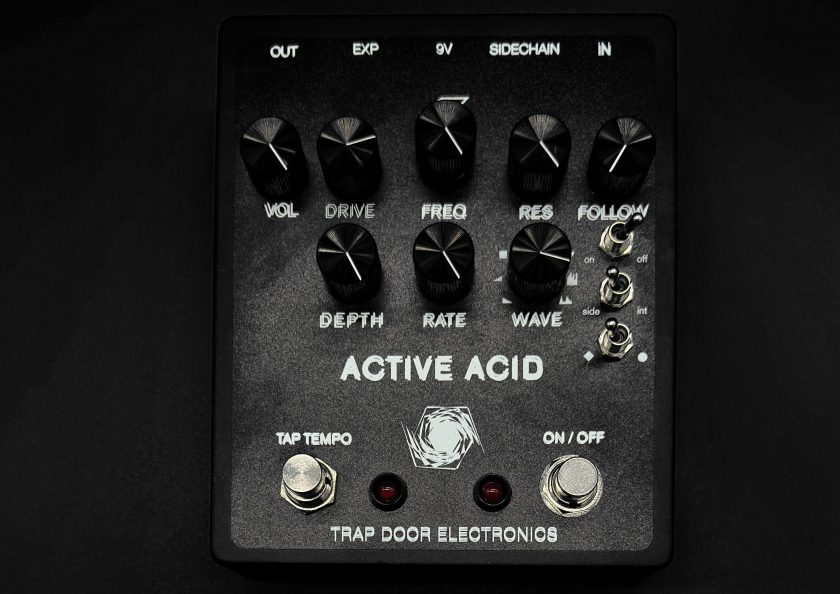
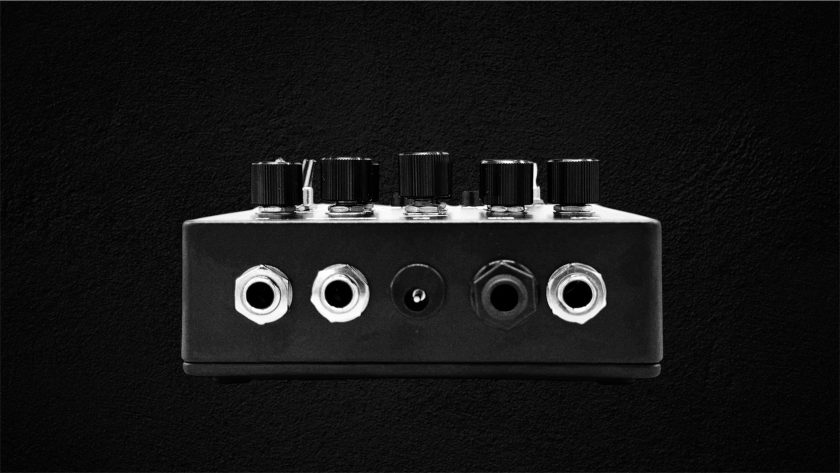
The Active Acid pedal runs on your standard 9V center-negative power. Eight controls define the top row: volume, drive, frequency, and resonance. Two footswitches: bypass and tap tempo. Then, there is an LFO section with depth, rate, and a wave selector offering eight shapes (ramp down, ramp up, square, triangle, sine, scoop, sample-and-hold, and random slopes).
An envelope follower section adds intensity and sensitivity control, with three toggles for on/off, internal versus sidechain source, and response type so that you can choose between a sharp, fast attack and a mellower, more gradual response. If you want to get even more creative, the pedal also has an expression pedal input and a sidechain jack for triggering the envelope from an external source.
The Build and Testing Context
Travis Johnson, formerly of Death By Audio, built this, and his prior lineage shows: the enclosure is solid black with white text and graphics, and a red light indicates the LFO speed.
The best part about working with a pedal that acts like a synthesizer is that virtually any instrument you run through it will sound good. My heavy, all-wooden Korean Fender knockoff from the 1980s, which I got at an auction with cigarette burns already on the body; an Aeroband MIDI guitar; a 5 String Ibanez SR534; and a Waldorf Iridium Core, all sounded incredible when paired with the Acid.
How It Sounds
The filter movement is transparent. No staircase artifacts. No zipper noise. When self-oscillating, the resonance stays controlled; it doesn’t shatter into harsh upper harmonics the way cheaper filters do. It takes on this whistling, almost sine-wave quality that tracks the cutoff. With careful adjustment, you can tune the resonance against incoming material and get pitched tones, reinforcement effects, low-end rumbles, and nasty textures.
It constantly adds movement when left on, which makes sense when you realize everything can modulate everything else simultaneously. LFO, envelope follower, and expression pedal can all hit the filter cutoff at once. These modulation sources don’t operate independently. They sum. All of them contribute simultaneously to the cutoff movement.
Small changes in dynamics or depth produce noticeable shifts in timbre. You have to learn where the usable zones are; the learning curve resembles that of boutique makers like Chase Bliss or Meris, where deep control sets reward time spent under the hood.
It’s at its best as a continual presence: always-on movement, slow pulse, subtle filter drift, an envelope response that softens the front edge of complex attacks. The expression input is clearly a priority; Johnson has spoken about his obsession with expression control in interviews, and the pedal is designed for a foot-operated expression pedal while you play.
Of note: Mid-production, Johnson expanded the LFO’s low end at the request of a Tortoise member, stretching the slowest rate to roughly four times what earlier units could manage. This collaboration makes sense. In an interview with Future Music, Johnson cited the filter sounds on Tortoise’s TNT as a teenage obsession that partly inspired the Active Acid’s design. He also tweaked the envelope follower sensitivity to handle higher input volumes before the filter maxes out.
The Sidechain
Usually, the envelope follower responds to the dynamics of your primary input. In sidechain mode, it bypasses the main input and reacts only to whatever you feed the sidechain jack.
In laypeople’s terms, it means you can send a trigger from a drum machine into the sidechain while playing a MIDI sequence from my synth through the main input. The filter movement will lock to the trigger rhythm immediately. If you flip the toggle to sidechain mode without anything plugged into the sidechain jack, the envelope follower will appear dead. Nothing’s broken, there’s just no control signal coming in.
Speaking of MIDI, the pedal does not include this tech. Johnson has acknowledged that omitting MIDI was a painful compromise. Keeping the enclosure compact and the price under $300 meant certain features had to go. However, trust us when we say that with the amount of control this pedal gives you, you don’t honestly miss it.
Verdict
The Active Acid is a good filter to add to your arsenal, truly worth the price for all that it accomplishes, and is a standout in Trap Door’s already creative lineup. I enjoy any pedal that doesn’t feel like the next “Johnny Come Lately” in a crowded world of effects, and the decision to adopt the SSM lineage is an inspired one that opens up plenty of creative possibilities. Highly recommended.
