

Unit provided by Tentij Instruments for review.
The Tentij Instruments ORB MK1 weighs under 7 pounds and sounds like a 56-pound 1960s Wurlitzer. That sentence shouldn’t make sense, but by God, they’ve done it.
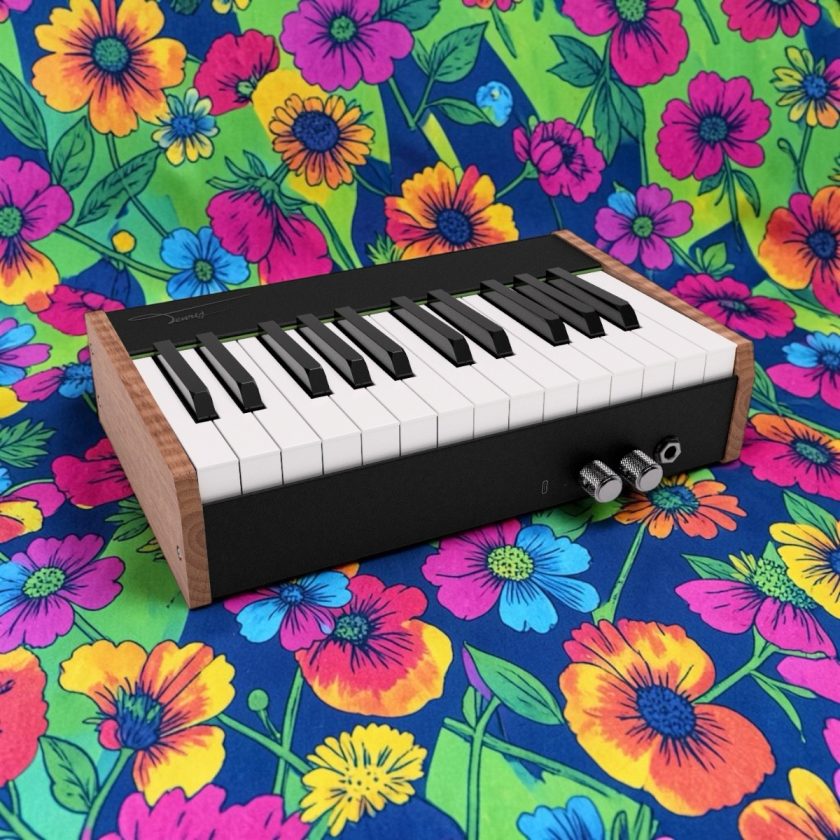
It’s a two-octave analog bass piano with carbon fiber reeds and optical pickups, handmade in the Netherlands. At €1,499, it’s chasing a 60s reed tone without the weight or the maintenance.
As a bass instrument, the ORB MK1 sits like one in the mix. The overall tone is very Wurlitzer and lacks the warm, bell-like roundedness found in a Rhodes. It’s sharper, more immediate, and contains a sawtooth-like edge, landing in that reedy, aggressive space you associate with 60s and 70s Wurlitzers. When you turn up the treble, it can sound bright and gritty; when you roll off the high frequencies, it can sound fuller and more growly.
Put it to work, and bass lines like “Superstition,” “She’s a Bad Mama Jama,” and “You Dropped a Bomb on Me” fall under your fingers naturally and sound right at home. There’s an authentic, analog quality to the tone that feels vintage, even though it’s brand new. The action is smooth and provides confidence with fast passages, repeated notes, and funk bass lines. All 25 keys respond consistently, with dynamics tied to how hard you hit them. No dead spots, no inconsistent responses.
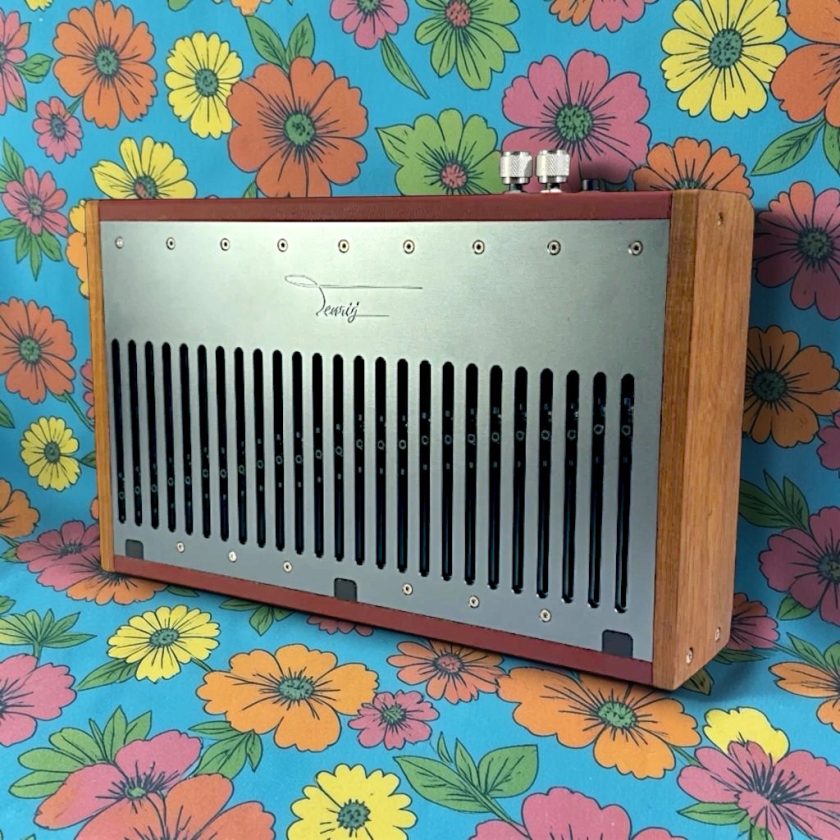
It’s a gorgeous instrument. The exterior is Tolex over a wood frame, the same material you’d find on a Fender amp or vintage keyboard case. The wooden sides and the solid metal underside, with accessible tuning screws, combine into something worth looking at. You can one-handedly carry the ORB MK1 anywhere.

Playing The ORB MK1 & What’s Inside
Open it up, and you’ll see the work. Inside, 3D-printed precision parts hold the carbon fiber reeds with their weighted tips, felt dampers, and the optical sensor array that makes a big difference in the sound. Unscrewing just the front screws lets you open the piano via hinges to access the action, reeds, and more for deeper adjustments.
Where you set the reed relative to the optical pickup changes the voicing character. With the flat underside of the reed above the sensor, you get a brighter, more organ-like sound, like the tone in Ray Charles’ “What’d I Say.” Lower it, and you get something more muted and sine-like. Two distinct sounds from the same instrument.
Roll the tone knob, and it shifts from crunchy and present down to darker, more sub-like territory. While it doesn’t let you surgically tweak the lows, mids, and highs, the tone knob, combined with the reed positioning, offers plenty of sound customization before it ever hits an effects pedal.
Its extensive tuning range permits lowering the lowest note to A0. And because the tuning screws sit on the exterior, adjustment is quick. No opening the instrument, no specialized tools beyond the included screwdriver. I haven’t needed to re-tune across multiple sessions over several days.
Some individuals might hesitate because of the lack of MIDI and the limited key count, but neither of these affected how I used it. If your workflow depends on MIDI sequencing or a larger keybed, know that Tentij is already working on a version that addresses these gaps, with plans to make a 61-key version once the ORB MK1 sells enough to fund development.
Recording the ORB MK1
When connected to an interface, the optical pickup system successfully delivers on its promise of having no electromagnetic interference. The ORB records with no noticeable noise or hum, and no issues near computers or monitors.
Through pedals, it responds well. Phase shifters and echo/reverb effects sound great with it. Compared to my Moog Subsequent 25, another bass synth/piano, the ORB is a different beast. The Sub 25 has that thick, creamy ladder filter sound. The ORB is gritty and reedy.
Verdict
It makes sense for someone who wants a physical, character-driven bass instrument with a vintage lean, without going digital. It fits funk, soul, lo-fi, and similar styles. Turn it on, and you’re already in that pocket. No patch building, no menu diving.
It doesn’t replace a real Wurlitzer if you’re chasing the full experience. But it gets you into that tonal space at a fourth of the price, with a fraction of the weight, and with a bass-focused design that makes it feel like its own instrument. The €1,499 feels justified. You’re getting real woodworking, real mechanical action, carbon-fiber reeds, optical pickups, and a Tolex-wrapped housing with no cut corners. There’s a real mechanical system inside, and that comes through in both the feel and the sound.
This thing is funky as hell.
Demo:
