
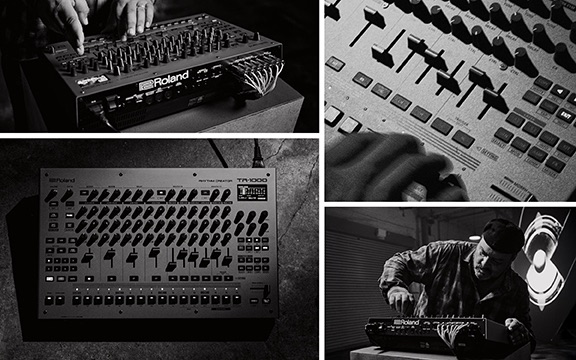
Roland has announced the TR-1000 Rhythm Creator, a new drum machine that combines analog circuitry, digital sound engines, and integrated sampling in a performance-focused instrument. Priced at $2,699.99 USD, the TR-1000 is available now, continuing Roland’s storied and beloved lineage with analog drum machines..
Returning Analog to the TR Line
The TR-1000 is the first Roland drum machine in four decades to feature actual analog voices. At its core are 16 circuits from the classic TR-808 and TR-909, recreated using modern components from the original designs. These elements are intended to reproduce the sound and character of the instruments that helped define electronic rhythm in the early 1980s. Whether it was the Beastie Boys expressing their love for 808s in ‘Body Movin’, or the complete dominance the TR-909 had on Trance in the 1990s, chances are, you’ve heard a Roland drum machine in one of your favorite tracks.
Digital Engines and Expanded Sound Sources
In addition to analog circuitry, the TR-1000 incorporates a range of digital options. The instrument includes 21 circuit-bent models of the TR-808 and TR-909 built with Analog Circuit Behavior (ACB) technology, as well as FM percussion, virtual analog tones, and a large PCM library. Together, these engines broaden the available sound palette and allow for layered textures beyond the original TR voices.
Integrated Sampling
Sampling is fully integrated into the workflow. Users can capture and manipulate sounds with stereo sampling and resampling, BPM sync, time-stretching, and non-destructive slice editing. The TR-1000 features 64 GB of onboard memory, accompanied by a curated library of 2,000 pre-installed samples. Of this capacity, 46 GB remains available for user recordings, edits, and imported material.
Effects and Sound Shaping Tools
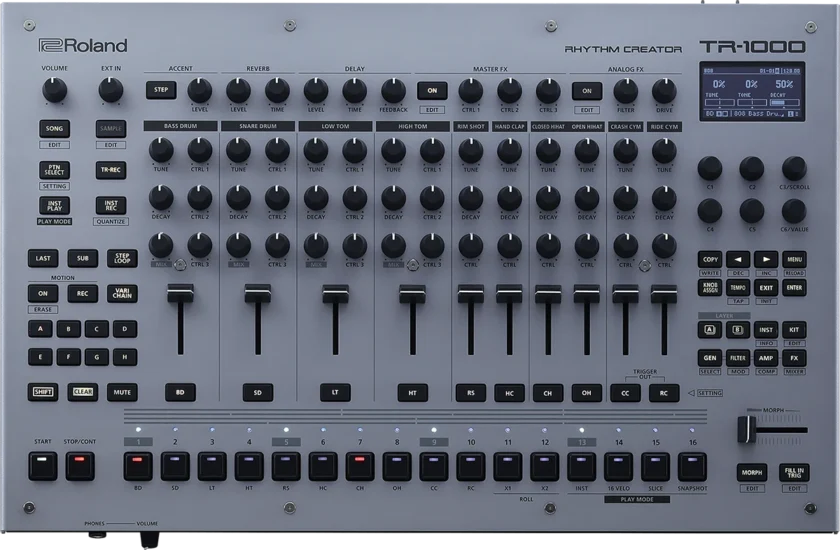
The TR-1000 provides multiple ways to shape sounds once they are created or imported. Each track features a sound generator, compressor, multimode filter or four-band EQ, and envelope controls. Four of the available tracks can host two generators each, which may be layered or programmed separately. These tracks also allow per-track effects, sidechaining, output routing, and modulation through three-target LFOs.
For additional processing, the instrument offers both analog and digital effects. These include a new analog state-variable filter (SVF) inspired by Roland’s vintage OTA designs, a dedicated analog drive circuit, and a wide selection of digital processors. This combination gives users tactile control over tone and dynamics across individual tracks and the overall mix.
Sequencer and Performance Features
Building on the established TR workflow, the TR-1000’s sequencer has been designed with a focus on flexibility and real-time performance. Patterns can be programmed step by step or shaped interactively, with the option to move sounds off-grid for more nuanced timing.
The hardware interface supports these features with high-grip knobs and smooth, responsive faders. Two new functions expand performance possibilities: the Morph slider, which enables broad sound transformations with a single control movement, and the snapshot feature, which allows users to save and recall knob positions instantly during a performance.
Connectivity and Software Integration
The TR-1000 is equipped with multiple inputs and outputs to accommodate different setups, whether in modular systems, hybrid studio environments, or live rigs. Routing flexibility makes it possible to customize signal paths and integrate the machine into larger workflows.
Finally, Roland has also developed a dedicated TR-1000 App to extend control from a computer. The app provides a larger graphical interface for real-time parameter editing, a librarian function for organizing sounds, and additional tools to manage the instrument’s content. While the 808 and 909 cemented their place in music history, it will be interesting to see where Roland’s latest offering takes music next.
The Roland TR-1000 Rhythm Creator is available now through authorized dealers at a price of $2,699.99 USD.
