
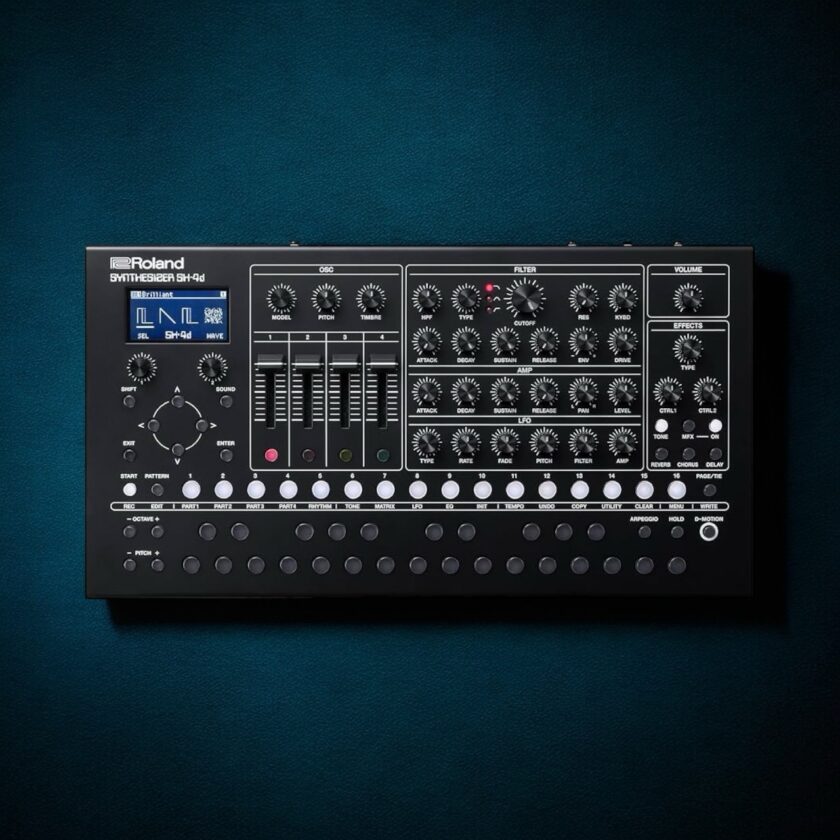
Roland calls it a synthesizer, but the SH-4d’s four synth parts, rhythm track, and sequencer give it a groovebox-like workflow. Four synth parts, a rhythm track, per-part effects, and a multitimbral sequencer enable you to sketch and chain layered parts within the unit to craft a complete arrangement. Within this, you can build a beat, bass, chords, and a lead, then chain sections into a finished idea.
Quick take
SH-4d is small, fast, and song-capable. Thirteen oscillator models, per-part MFX with shared time effects, and pattern chaining make it feel like a groovebox in practice. Class-compliant stereo or 12-channel driver-based multitrack keeps capture simple. If you write beat-first tracks, it moves you from loop to structure quickly.
Testing context
Our team conducted this review on the latest v2.0 firmware. Monitoring alternated between neutral nearfields and V-MODA M-100 PRO headphones. For details on those headphones, see the V-MODA M-100 PRO review, which covers comfort, fold, and tuning.
What changed for the SH-4d in v2.0?
V2.0 is the turning point. It adds the Harmonic and Step oscillator models, Pattern Chain, Quick Overwrite with undo and redo (up to ten levels), and a Generic USB mode for class-compliant stereo capture. Time effects can now run system-wide, allowing chained patterns to share the same space, and the Sub Step grid receives finer placement. Together, these changes push the SH-4d from ‘synth’ toward a compact groovebox that can complete songs.
Layout and workflow
Speed is the theme. Filter, Amp, and LFO controls stay fixed, while the oscillator section remaps to the model you load, so the parameters you see are the ones you need.
The sequencer supports TR-REC and real-time input along with probability, sub-steps, list editing, motion recording, and ten levels of undo and redo. Quick Overwrite allows you to save progress without interrupting your momentum.
In day-to-day use, the most natural path starts on Rhythm for kick and hat, then moves to bass on Part 1, pads on Part 2, keys or stabs on Part 3, and a lead or texture on Part 4. Because each part has its own MFX, you can tighten the bass, widen pads with Chorus, and push leads forward. However, all parts share the main stereo bus.
System-wide chorus, delay, and reverb keep parts in a shared space, and chaining patterns preserves that consistency across sections.
Sonic character
The SH-4d reads recognizably Roland. The virtual-analog engines provide a rounded low end and a stable midrange, allowing basses to sit with the kick rather than against it, and pads to carry space without softening the arrangement.
Switching to FM or wavetable lifts the spectrum. Upper mids show finer harmonic detail, transients have more definition, and leads cut without turning abrasive when filters stay modest. The built-in Chorus opens the stereo field while the center remains anchored, allowing chords to broaden without swallowing the vocal lane.
Each model has a clear role. SH-4d and SH-3D cover bread-and-butter duties with bass, keys, and pads that respond predictably to filter and envelope moves. SH-101 focuses on tight, single-oscillator bass and lead; moderate resonance and a restrained filter keep it clear, rather than harsh.
The JUNO-106 is the bed maker, where a slow attack, medium release, and gentle high-cut produce supportive, chorused layers. Cross FM and Wavetable bring brighter textures, from bells and glassy keys to metallic plucks and animated motion, and they remain articulate when paired with short, synced delays and a measured top end.
The v2.0 additions expand this palette in specific ways. Step bakes tempo-locked movement at the oscillator level, allowing for forward motion without extra routing, while Harmonic behaves like drawbars for chimes, clean organs, and layered basses that retain their shape under reverb.
At higher registers, FM and Wavetable can present brighter edges; a modest low-pass, a slight high-shelf dip above 10 kHz, or light pre-FX saturation smooths partials without dulling them. PCM hats can read hot in dense arrangements and respond well to a slight upper-mid trim or shorter decay. Chorus placed before a long reverb can haze the upper mids, so balancing depth against tail length keeps the image clear.
Drum engine, effects, and layering
The Rhythm part carries contemporary kits with straightforward control. Synth layers provide a taut body for kicks and claps, while PCM layers add a polished top for hats and rides. Each rhythm instrument offers editing parameters, including basic EQ for shaping balance. The system EQ and compression shape the overall mix, and synth parts use their own MFX.
A slight motion on decay or pitch turns straight loops into grooves. By default, drums read dry and defined; placing a short global room on the pattern brings them into the same space as the musical parts without obscuring timing.
Effects behave like a streamlined mix toolkit: per-part MFX for local tone, plus shared EQ, compression, chorus, delay, and reverb for glue. Chorus adds width and flatters Juno-style pads and mid-bass lines that need size.
The delay engine syncs tightly, and short times add articulation to leads without stepping on lyrics. Rooms and small halls cooperate best, and a moderate pre-delay keeps attacks articulate. Using one reverb across chained patterns maintains a consistent space as you move through the arrangement.
A clear layering plan makes the instrument feel larger than it is. Keep the bass centered and dry to preserve focus. Let the pad carry width with Chorus and place it behind the rhythm section in a small hall. Keep leads forward with a short synced delay and minimal reverb.
When you want texture, tuck FM or Wavetable parts under pads with low resonance, slow scans, and a short room so detail remains audible without poking holes in the vocal range.
For quick results, start with a basic 101-style bass: one oscillator, short note length, and a touch of drive for weight. Add a Juno-style pad with a slow fade-in, medium release, gentle chorus, and a slight room reverb to sit behind the vocals. Use a step-based lead for built-in motion, then give it a short, eighth-note delay to keep it clear at tempo. For drums, build a modern kit with a tight synth kick, a crisp clap, and a short-decay hi-hat, plus a hint of room to glue it together.
Workflow and use
Each pattern spans 1–64 steps; longer phrases are formed by chaining multiple patterns together. The instrument rewards a part-by-part approach. Start on Rhythm, drop in a bass on Part 1, build pads on Part 2, and save with Quick Overwrite so you can commit without friction.
Add motion recording on filters and sends and link sections with Pattern Chain into verse and chorus. For capture, the generic stereo mode is quick for sketches. With Roland’s driver, you can record up to 12 discrete channels (stereo pair per part) directly into your DAW.
Programming kicks and bass translated cleanly to the V-MODA M-100 PRO at cue levels, which made tempo and balance decisions obvious before a DAW pass. If you are pairing SH-4d with club-leaning headphones, the M-100 PRO review covers comfort, fold, and tuning that complement this workflow.
Connectivity and power
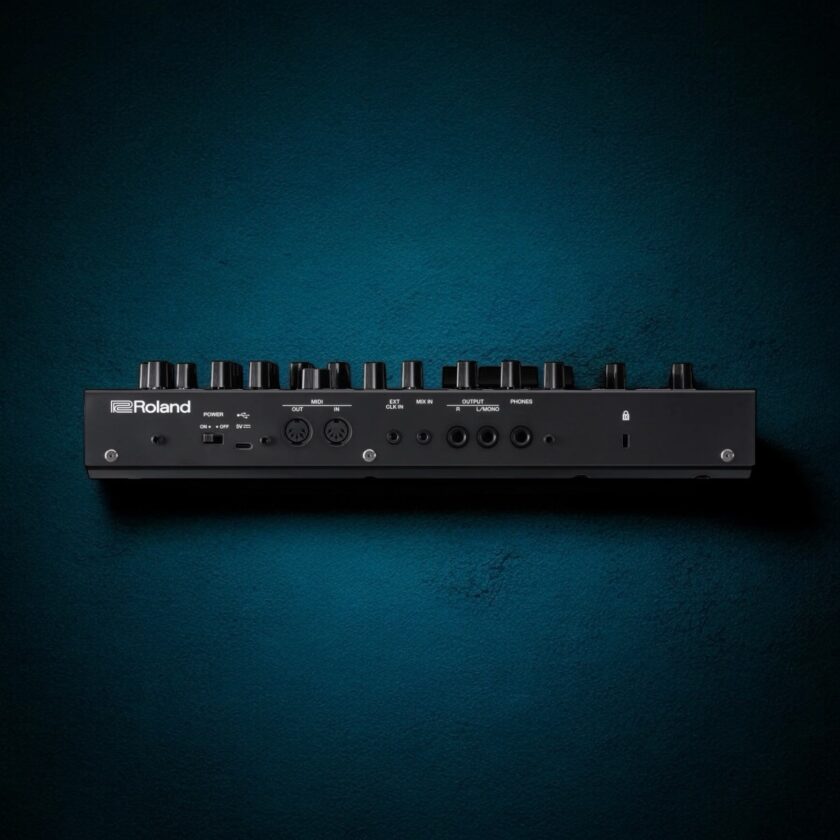
SH-4d’s back panel covers studio and portable needs. You get stereo quarter-inch outputs, a quarter-inch headphone jack, a 3.5 mm mix-in, five-pin MIDI in and out, clock in, and USB-C for both audio and MIDI. In generic mode, the unit presents a simple stereo interface for computers and mobile devices.
Install Roland’s driver when you want 12-channel multitrack capture with individual channels so parts land on their own tracks in the DAW. MIX IN is a pass-through only. Internal filters and effects do not process external audio. There are no additional assignable analog outputs beyond the main stereo pair, so stage rigs that rely on multiple physical outs will still route stems over USB or an external mixer. Power is available from USB-C or four AA batteries.
Who it is for
Creators who want to write and arrange on hardware and crave a DAWless setup.
Who it is not for
If your process centers on user-sample import for drums, a sample-centric device may be a better fit for you.
Pros
- Broad sound palette across 13 oscillator models, from classic Roland (SH-101, JUNO-106) to modern digital (Cross FM, Wavetable, Harmonic, Step)
- Four synth parts plus a dedicated rhythm track with a multitimbral sequencer for in-box arrangements
- Hands-on flow: TR-REC and real-time input, probability, sub-steps, motion, list edit, and Quick Overwrite with ten levels of undo/redo
- Per-part MFX with shared chorus/delay/reverb and a system-wide option for time effects across chained patterns
- Flexible USB audio: class-compliant stereo for sketches or 12-channel multitrack via Roland’s driver for stems
- Portable power via USB-C or AA in a compact footprint
Cons
- There’s no user sample or waveform import, though the Rhythm part combines preset PCM and synth layers for kit building.
SH-4d Final verdict
What stands out after living with SH-4d is how quickly it turns intent into structure. You sketch a rhythm, commit a bass, paint a pad, and the box invites you to keep moving instead of second-guessing.
Roland’s v2.0 additions made that philosophy feel complete, from chaining sections to committing ideas without friction. It is a compact instrument that facilitates decisions and gets out of the way. If your priority is finishing more music with fewer detours, this is a compact instrument that earns its place.
