
Quick take
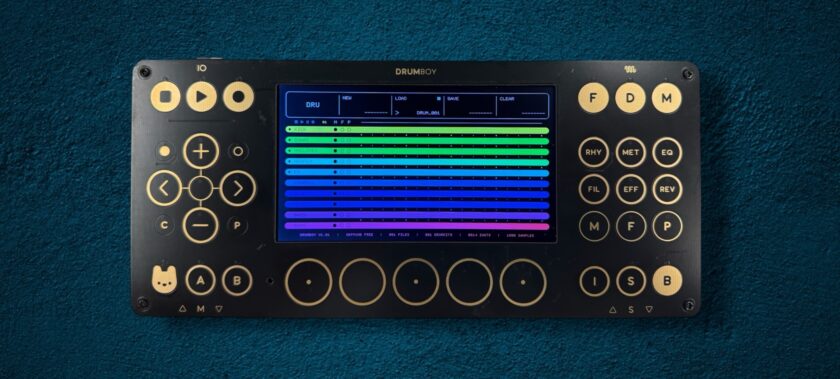
DrumBoy is a handheld, sample-based drum machine featuring a five-inch color screen, touch-sensitive pads surrounding the display, 24-bit audio, and ten layers. The sequencer reaches 1/64, and each layer features a parametric EQ, dual multi-mode filters, two multi-FX units, and a separate reverb. It runs on an ARM Cortex‑M7, stores projects on an SD card, and draws power over a USB-C port. Firmware and hardware are open‑source on STM32.
Testing context
Receiving the Drumboy was a fun experience, as this was my first complete DIY kit rather than a pre‑assembled unit. I took it slow, using small metal tweezers for the ribbon cables and the tiny fasteners; the whole build took about 15 minutes. The illustrated step‑by‑step guide never left me guessing, and the included SD card meant there was no pause between assembly and play. Shipping was quick, and everything arrived as described.
I monitored on V‑MODA M‑100 PRO headphones and powered the unit from a USB‑C dock. At normal listening levels, I heard no hiss.
Around 60-75 percent of the master volume felt right for longer sessions. For a quick stress check, I pushed the master to 100 percent on the M-100 PROs and on a budget pair of Insignia in-ears; I did not hear any audible distortion. Boot to ready takes around ten seconds. Loading a factory kit is instant, under two seconds from tap to sound.
What it is
DrumBoy replaces pads and knobs with capacitive touch keys arranged around a bright, high‑contrast display. The SD card stores projects and samples, while the main screen displays the firmware version, currently v1.01 (FW_1_01). The UI favors short menus, clear labels, and direct toggles for sync and MIDI. Setup remains quick, even if you haven’t used it recently.
Build and set up
The hardware reflects a small-maker ethos but does not feel disposable. Using a stacked, multi-panel design (top, middle, bottom), four corner screws and nuts secure the chassis, with the screen housed in a 3D-printed frame.
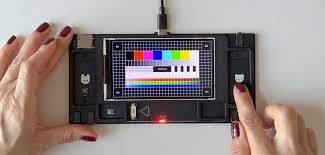
The manual’s service steps guide you through loosening the ribbon-connector locks and triggering an LCD test after reassembly. Tweezers help with the tiny hardware and ribbon locks; once seated, nothing fights back. From first power to a loaded kit, the system is fast, and the menu structure is predictable, so you are not hunting for basics.
Workflow and sequencing
You can finger‑drum a beat live and capture the pass, or record each track. I started with a standard four‑on‑the‑floor loop at 125–130 BPM. The pads responded to light taps and felt immediate. I missed the occasional hit, which I chalk up to timing rather than latency.
I worked with a four-bar, sixteen-step feel, but the system supports up to eight bars by eight measures with a smallest quantize of 1/64. If a hit lands off the grid, there is no post‑record move or auto‑quantize yet, so you will need to delete and retry. Randomwaves support states that nudge and related edits are in development for a future update (personal communication, September 11, 2025).
Sound
Factory kits are crisp. Hats and claps have quick, clean transients. Some sets lean into longer kick tails for more low‑end weight; others feel a little crunchy. You can get a usable loop with no processing, or you can sculpt. Each layer offers a parametric EQ with a low shelf, four peaking bands, and a high shelf.
Dual filters cover low-pass, high-pass, band-pass, and notch filters with adjustable resonance and slope. Two effect slots handle time and dynamics, and a dedicated reverb provides size, decay, and pre‑delay. On my unit, a handful of kick samples kept coming back into rotation: Saturn_2, Pegasus_1, Nova_3, Neptune_3, as labeled, plus Galileo_2, Electra_3, Cosmos_2, and Apollo_3. At the output, the headphone stage translated cleanly across both my usual cans and inexpensive in‑ears.
Storage and file handling
All storage is handled via the SD card, and save and load screens use DRUM_### and FILE_### naming, which keeps the library tidy and easy to scan. Kit changes are near‑instant, so trying different flavors while a pattern loops feels natural.
Power and portability
There is no internal battery. A USB‑C dock powered the Drumboy in my sessions. Randomwaves recommends a power bank for mobile use, as it provides a cleaner supply than some wall adapters, which can interfere with capacitive touch. I would still prefer an internal pack for true grab‑and‑go, but a compact power bank makes the setup practical.
Screen and controls
The fonts on the screen may appear small, but with high contrast and a somewhat larger screen, the interface remains readable indoors, featuring clear icons and labels. Touch targets reward light taps and feel predictable once you settle into a rhythm.
Sync and I/O
The main menu exposes MIDI IN, MIDI OUT, SYNC IN, and SYNC OUT as simple on/off toggles. Setup stays quick whether you plan to clock from a DAW or another box.
Stability
Across longer sessions, I saw no crashes, freezes, or UI glitches. The touch felt immediate, and the audio remained clean. The firmware version is displayed on the main screen; my unit reports version 1.01 (FW_1_01).
Open‑source and hacking
Drumboy’s open-source ethos is the difference maker. The repositories are public and MIT‑licensed. There is an official SWD path for developers, and the Hacker Edition includes an ST‑LINK/V2 programmer and cables. Providing this level of openness in its fixes and features from outside the company gives the device room to grow beyond its launch feature set.
Pricing and availability
Randomwaves sells units directly, offering a higher-priced Hacker Edition and bundle options with Synthgirl. Availability is current, and the pricing keeps DrumBoy within reach for producers who want an open box to explore.
Verdict
DrumBoy boots and loads kits fast, and sounds better than the price suggests. The open design sets it apart; if the community leans in, the potential is endless. Get the Drumboy if you value hackability and want a small box for quick loops.
