

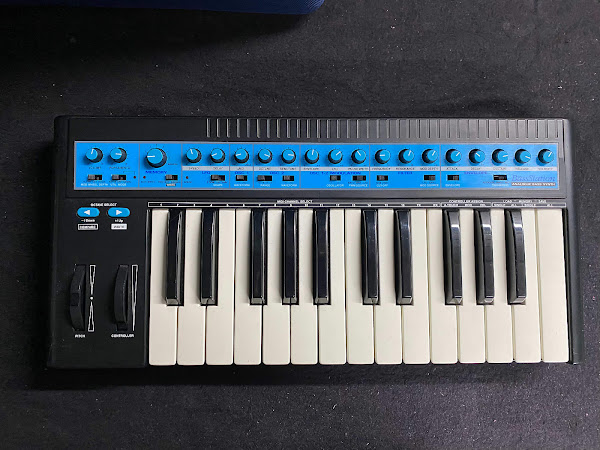
When Novation released the first Bass Station in 1993, it landed at the right time. Producers wanted something small, affordable, and analog to sit alongside samplers and drum machines. Designed by Chris Huggett, the mind behind the Wasp and OSCar, the Bass Station delivered that. Two oscillators, a 12/24 dB filter, MIDI, and stable tuning gave musicians the grit of classic synths without the headaches of vintage gear.
The Bass Station answered this call by offering hands-on analog control with the modern conveniences of MIDI, making it easy to integrate into a DAW-based setup. Novation’s balance of immediacy and modern connectivity put it in the hands of many artists working across dance, techno, and house scenes. The Bass Station became a studio staple for anyone seeking a sharp, resonant bass without breaking the bank.
By the early 90s, most new instruments arriving in music shops were digital workstations or ROMplers, with banks of presets but little real-time control. The Bass Station stood apart by bringing back hands-on analog design at a price anyone could afford. Huggett’s design philosophy was always to make synthesis approachable while staying forward-looking, and the Bass Station embodied that balance.
With this, the original Bass Station proved that a compact, affordable instrument could hold its own against icons like the TB-303 or SH-101. It became part of a (then) recent wave of dance music and helped democratize analog synthesis when it was fading. Rack and Super Bass Station versions added storage, distortion, and other upgrades, but the spirit remained: a small synth that worked hard.
The 2013 Rebirth
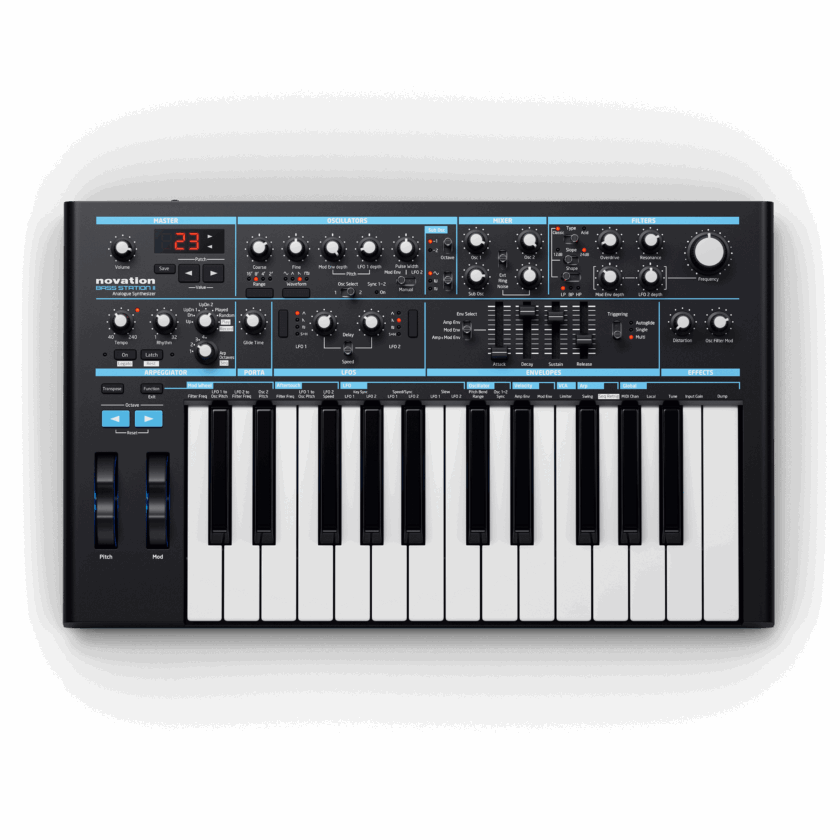
Twenty years later, Novation revived the idea with the Bass Station II. On the surface, it looked like a reboot. It added features that expanded the architecture well beyond the original. The BSII kept the two-octave layout but packed in far more power. Two oscillators and a sub-oscillator add a deep low end beyond what the first Bass Station could deliver. A Noise/Ring/Ext input mix allows players to blend in noise, ring modulation, or an external signal, broadening the palette from bass duties to leads, effects, and metallic tones.
One of its most underrated strengths is the sub-oscillator. Setting it one or two octaves below Oscillator 1, or detuned, allows bass patches to thicken.
The filter section marked the most significant leap. Players can choose the Classic multi-mode filter, which offers low-pass, band-pass, or high-pass modes at 12 or 24 dB, or the Acid diode-ladder filter, designed to capture the growl of a 303. A pre-filter drive and post-filter distortion (pre-VCA) further expand the tone. This compact keyboard can shift from smooth bass tones to biting acid character, making it one of the most flexible filter sections on a budget analog synth.
Other additions round out the package: two ADSR envelopes, two LFOs with multiple shapes, oscillator-to-filter FM, an arpeggiator, and a 32-step sequencer. For the first time, users could save and recall 128 presets. At launch in 2013, this was no small thing. Competing affordable analogs, such as the original Arturia MiniBrute, lacked patch memory, so the BSII stood out as a more practical studio tool.
Oscillators, filters, envelopes, and LFOs each have their own space. A large cutoff knob sits at the top, perfect for sweeps. Most functions have a knob or a slider. Pressing the shift key loads the secondary settings, and the panel displays their secondary features.
Firmware as a Second Life
Despite being well over a decade old, the BSII remains a standout in 2025, as Novation continues to refine it. In 2018, a firmware update added paraphonic mode, letting players trigger two notes simultaneously by assigning each oscillator to a different key. With this, Novation turned the BSII from a strict monosynth into a machine capable of simple chords, harmonies, and layered textures.
The same update introduced microtuning, an oscillator error function to mimic analog drift, and more flexible envelope and filter behavior. Combined with microtuning, this feature tapped into a wider wave of interest in alternative tuning systems and non-Western scales, giving experimental producers a reason to revisit the BSII. For a five-year-old synth, this free update gave it fresh creative tools that extended its lifespan.
In 2019, Novation released firmware v4.14, introducing AFX Mode.
The idea originated from Aphex Twin, who requested a method to assign different synthesis parameters to individual keys on the BSII’s 25-note keyboard. These could be subtle variations of a base patch or unique sounds, allowing one setup to place a bass in the lows, drum hits in the mids, and experimental effects at the top. Novation engineers rebuilt part of the BSII’s mapping architecture to make this possible.
AFX Mode combines multiple sounds into a single patch. You can build a drum kit across the keyboard, assign timbral variations note by note, or use overlays to create changing textures. Each overlay bank can store up to 25 variations, allowing the BSII to hold an entire kit or timbral palette within a single patch.
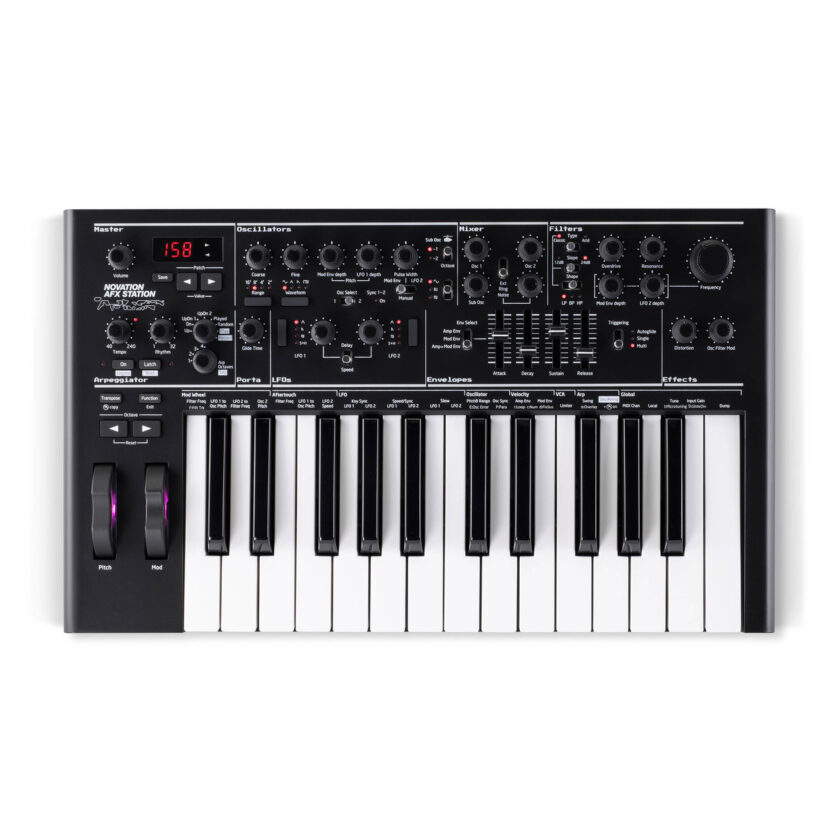
When Novation later released the AFX Station in 2020, they pre-installed this firmware. They gave the synth a darker cosmetic design, underlining how central AFX Mode had become to the BSII’s identity. This level of flexibility was remarkable for a monosynth in the $500–600 range.
The feature opened new options for live use, allowing one keyboard to cover bass, drums, leads, and ambient textures in a single performance—roles that once required multiple units in many setups.
These updates show why the BSII remains a sound choice for newcomers and seasoned players. Novation did not treat it as a disposable product. Few instruments in this price range have received such thoughtful long-term care.
Design, Sound, and Workflow
The BSII’s two-octave keyboard is small but responsive. It has velocity and aftertouch, making it more expressive than many budget synths. The keyboard is full-size rather than mini, which makes it more comfortable for serious playing than many compact synths in its class.
The interface is direct: oscillators, filters, mixers, envelopes, and LFOs have dedicated controls. New players can learn subtractive synthesis without diving into menus, while experienced users get immediate access to shaping tools.
The modulation system is deeper than the panel suggests. You can route two envelopes to filter, oscillator pitch, or other destinations. LFOs run from slow sweeps to audio rates, making them usable for FM-style effects. Synced to tempo, this feature caters to producers working in DAWs or live with clocked gear. The LFOs can also reach the audio range, acting like additional oscillators for FM-style tones, metallic edges, or extreme vibrato.
The sound goes far beyond bass. Lows are heavy yet clear with the sub engaged, and leads are bright. Switch to the Acid filter, and you get classic squelch that slices through a mix. The Classic filter leans smoother and rounder, ideal for pads or less aggressive tones. Overdrive and distortion add dirt without harsh clipping. It will not give you Moog-style weight. Instead, it offers a sharper, more flexible voice with its own identity.
The signal path places drive and distortion in different positions: drive pushes the signal into the filter to add harmonics, while distortion sits after the filter and before the VCA, creating a dirtier, more saturated edge. Together, you can blend them to achieve two distinct flavors of grit.
The sequencer and arpeggiator are basic but adequate, featuring real-time recording, timing variations, and gate options. The sequencer supports up to 32 steps, and although it does not have Elektron-style parameter locks, modulation routing allows patches to grow. Gate length tricks and pattern chaining add movement with little effort. You can latch an arp, sweep the filter, and capture something worth keeping in minutes.
You can power it via USB on your computer or use the included 9V adapter, providing flexibility for studio and live setups. USB power is convenient for quick sessions and eliminates extra cables.
Connectivity is straightforward but effective. Alongside the main outs and headphones, an audio input allows you to route external sounds through the BSII’s filter and effects path, turning it into a compact filter box for drum machines or other synthesizers. MIDI is available over 5-pin DIN and USB, making it easy to sync with modern and vintage setups.
It’s Still a Must-Buy in 2025
The first Bass Station helped kick off the analog revival of the ’90s. The BSII honored that history in 2013 by modernizing it. Twelve years later, it still feels relevant. Novation’s updates turned it from a capable monosynth into something far more flexible, keeping it in line with current workflows.
For under $600, you get dual filters, paraphonic mode, deep modulation,
Aphex Twin’s AFX Mode, and a design that is approachable and deep. Few synths in this bracket have aged this well. The instrument’s longevity also reflects Novation’s rare commitment to long-term updates. Many synths lose support within only a few years, but the Bass Station II continues to develop more than a decade later. It was also one of the last major projects from Chris Huggett, giving it added significance in the lineage of modern analog design.
Instead of a product that shows its age, the Bass Station II has continued to stay relevant through frequent updates. In 2025, it remains as much of a masterpiece as it was at its release, and if you don’t own it yet, it deserves a place in your setup.
