
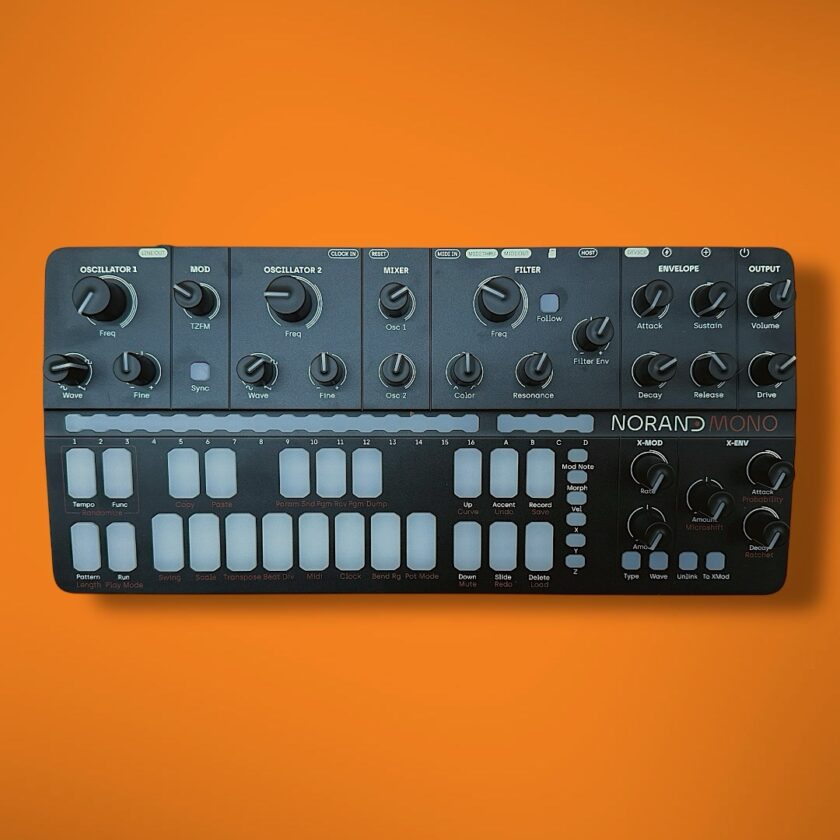
Norand hasn’t been around as long as the big Japanese or American brands, but their path is already pretty clear. The company is based in France and started with its first release, the original Mono, released in 2020.
The original Mono arrived as an analog monosynth featuring two VCOs, a deep sequencer, and an advanced modulation system. While it could deliver 303-like sounds, its approach to modulation and sequencing moved it beyond mere cloning, making it suitable for techno production.
In 2022, Norand followed with Morphos, a Eurorack module built around dual analog oscillators and 3D morphing touch strips. It took the same idea of “give every parameter its own modulation path” and placed it into a format where you morph between states in three dimensions with your fingers. It did not introduce a new engine, but instead reframed the same core concepts in a different way.
Norand’s Mono MK2, announced in 2023, is the next turn in that idea. It keeps the analog core, refines the hardware, and adds a 3D-sensing mini keyboard and pressure-sensitive sequencer strip that can send velocity, aftertouch, pitch bend, and vertical modulation.
The MK2 is a compact analog synth with an FPGA-based modulation engine. Its modulation capability surpasses what is usually found in small instruments, approaching the depth of larger models.
The Build
Early adopters of Norand products will notice that the MK2’s enclosure is a significant upgrade over the MK1. The previous version used hard plastic, while the MK2 features a machined aluminum chassis. It feels more premium and robust, and we love it when companies spend the extra dollar to do a more premium enclosure.
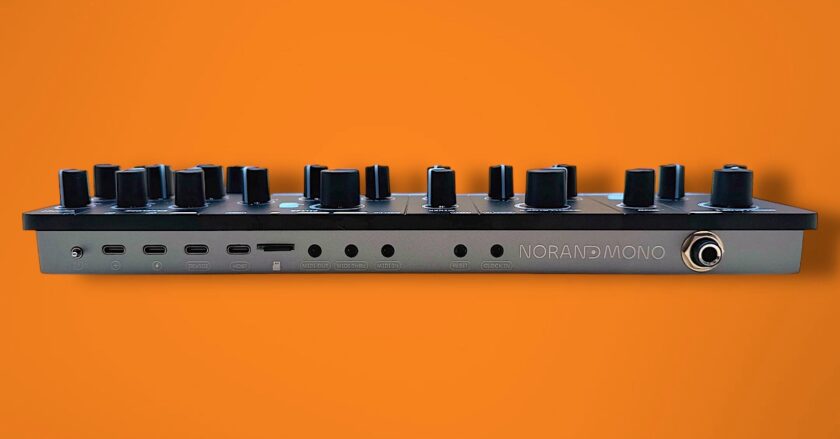
The rear panel features MIDI in, out, and thru ports on 3.5 mm TRS connectors. USB-C carries MIDI and power. Eurorack clock and reset inputs sit alongside a dual mono (Tip and Ring in phase) output, perfect for headphone use during on-the-go sound design!
Most studio setups should find the available connections sufficient. The absence of CV or gate outputs means the MK2 functions more as a MIDI- or clock-driven voice in a modular environment than as a central sequencer.
The MK2 does not have a screen. Instead, users rely on encoder LED rings, a touch strip, and a row of buttons for feedback. Accessing system functions requires key combinations. While this system is learnable, a screen would have improved workflow by making parameter access more intuitive, a limitation even noted by Norand’s manual.
Architecture: Simple Audio Path, Heavy Modulation
Underneath the panel, the Mono MK2’s core voice architecture looks familiar. It is a single-voice analog synth, and although certain MIDI behaviors can produce two-note interactions, the MK2 is not designed as a duophonic instrument. Two discrete analog VCOs feed a three-pole state-variable filter. The audio path is intentionally uncluttered, and most of the variation comes from modulation.
The modulation system is powered by an FPGA and resembles the control found on larger performance synths. There is a primary ADSR envelope for amplitude, along with thirteen additional AD envelopes and twenty assignable modulators. Each parameter receives dedicated X-Mod and X-Env slots, allowing truly independent modulation curves across controls rather than a shared set of sources.
Both oscillators are fully analog and continuously variable, enabling smooth transitions from sine through triangle, square, and saw waves. Through-zero FM and hard sync between oscillators add complexity and edge. The three-pole multimode filter offers low-pass, band-pass, and high-pass options, followed by a soft overdrive stage for adjustable grit and gain.
A digital sequencer records parameter movements at 1024 PPQN on top of the analog signal path. This high resolution keeps automation smooth and continuous, even when multiple parameters, such as cutoff and resonance, are modulated simultaneously.
Because each parameter follows its own curve, a basic pattern develops multiple overlapping motions at once. A 16-step line can evolve organically through changes in animation while preserving its timing. The sequencer allows patterns up to 64 steps, which helps when building longer lines or variations when needed.
Sound: Solid, Controlled, and Built for Movement
The oscillators carry a firm low-mid presence, and slight detuning between the VCOs creates width without blurring pitch. When FM or sync is pushed, the tone moves into more complex, sometimes metallic territory, but it stays controlled enough to remain usable rather than collapsing into unfocused noise.
The three-pole filter has a large influence on the overall character. Compared to a typical four-pole ladder design, it has a gentler slope and feels less heavy when resonance rises. Acid-oriented lines are straightforward to dial in, and pushing the post-filter drive stage makes the sound more abrasive and saturated. A classic 303-leaning squelch is available, but the filter does not confine the instrument to that style.
One test sequence began as a familiar Chicago-influenced pattern. It used short notes, moderate resonance, and regular accents. After assigning a secondary envelope to the filter that moved out of sync with the gate, adding slow waveform modulation, and adjusting FM amounts, the same pattern became far less predictable.
Bass is the most obvious role, yet the MK2 also handles bright leads, clipped percussive figures, and mid-range sequences with confidence.
Interface and Workflow: Screenless, but Coherent
Twenty-three RGB-lit encoders with LED rings sit at the top, while a matrix of buttons and a 25-key mini keyboard occupy the lower half. Controls for tuning, waveshape, filter cutoff, and resonance are always accessible, and envelope settings are straightforward. The LED rings show current control values. Building patches by ear is fast, with basic functions always handy and no hidden menu layers.
Advanced settings introduce some friction. Selecting the MIDI channel, configuring sync, or handling patterns requires memorizing button combinations and LED meanings. During initial use, the manual remained close by to confirm correct operations.
After learning the essentials, the workflow becomes more predictable. The sequencer is central, and it cleanly captures encoder changes. Per-step features such as ratcheting, probability, micro-timing, slide, and swing are accessible without menu diving. The touch strip allows quick movement through a pattern or real-time step adjustment.
Additionally, and this is quite fun, a duophonic note mode was added in a later firmware update. The mode is not active by default and must be enabled manually. Pressing FUNC + SWING, then selecting PAGE B, switches the unit into duophonic operation. PAGE A returns it to single-note mode. When duophonic mode is active, each oscillator can follow a separate pitch.
Two notes held on the small keyboard define the interval, and duophonic steps can be entered on the sequencer switches by holding one pitch, then the other, and assigning them to a step. The process also works in reverse order. This mode does not alter the rest of the signal path, but it changes how the oscillators respond to note input and how short intervals behave within patterns.
The MK2 is physically built for regular use. Encoders turn smoothly and feel solid. The mini keyboard uses a rubber surface, yet it detects velocity, aftertouch, and vertical movement for added modulation. Routing the vertical sensor introduces expressive control to playing.
Power draw is around 7 watts, and the option to power it over USB is helpful for laptop-based or compact live setups.
Two studio configurations worked well. In one, the MK2 acted as an external instrument in Ableton Live, driven by a Max for Live patch such as STING 2 to generate evolving acid and techno patterns with very little manual programming. In the other, the MK2 ran its onboard sequencer while locked to an external clock, producing tight, repeatable patterns that were manually animated in real time by turning encoders.
Make Sure You Update the Firmware
It is important to stress that our experience with the MK2 has been bug-free, and the instrument behaved reliably throughout testing. We update every review unit to the latest firmware before using it musically, and every owner should do the same. Our research uncovered quirks in earlier firmware, so we approached testing with those reports in mind. After updating, we did not encounter any issues.
Verdict
If you seek acid-style mono synth lines with expanded modulation and motion, the Mono MK2 is a flexible, modern option. It offers much more shaping control than a standard 303-style workflow and appeals to users who want broader sound design possibilities.
At a price between 650 and 750 dollars, the Mono MK2 lands between simple acid machines and more complex monosynths. It provides a robust metal chassis, a rich analog tone with strong low-mids, and a modulation and sequencing system that keeps patterns evolving long after a basic loop would become repetitive.
In the roles where it fits naturally, such as acid lines, shifting sequences, and animated bass, the MK2 proves trustworthy. Overall, it is a very fun little synth for the price.
