
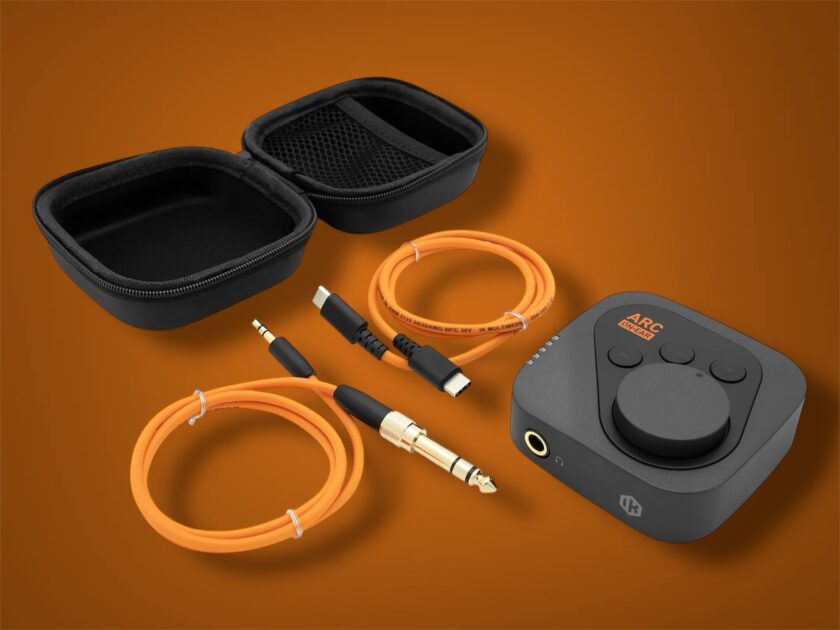
Headphones are often the most practical monitoring option, but they rarely replicate a full-room sound. They isolate each ear, eliminate acoustic blending between channels, and remove the cues created by speakers interacting with a space. This exaggerates stereo width and alters how depth and balance are perceived, which makes midrange and low-end decisions less reliable. As a result, mixes that seem stable on headphones often shift the moment playback moves to another system.
ARC On-Ear is built for this exact gap. It integrates calibration, spatial shaping, and translation profiles into a compact hardware device, eliminating the need for DAW plugins or system-wide routing. The reference becomes portable and behaves consistently across environments that would normally present very different monitoring conditions.
ARC On-Ear can sit between an audio interface and headphones or operate as a standalone unit, which makes it compatible with everything from a fixed studio to a lightweight travel setup. For users who work in multiple spaces, this creates continuity that software calibration alone does not always maintain.
By giving the monitoring chain a defined tonal center and predictable stereo behavior, ARC On-Ear reduces the adjustments engineers often make to compensate for headphone variability. It supports a workflow in which reference checks, balance decisions, and translation tests happen quickly and without additional routing.
ARC On-Ear: A Calibration-First Device
ARC On-Ear’s architecture revolves around calibration. It functions as a DAC, an amp, and a DSP stage, but its primary purpose is to ensure a consistent, predictable headphone response. It uses the same correction approach as IK Multimedia’s ARC System, only implemented in hardware. This removes the dependency on plugin formats, DAW versions, or operating system changes, since the processing occurs before the signal reaches the computer or leaves the interface. Once a profile is stored, it becomes part of the monitoring chain regardless of the device feeding it.
Most studio headphones show measurable irregularities in the low mids and upper lows due to driver behavior and cup geometry, which can shift perceived energy in the fundamentals and low harmonics. These deviations can obscure vocals, alter bass relationships, or make it more difficult to maintain balance across sessions. ARC On-Ear reduces these inconsistencies, resulting in a more coherent tonal center. Even with headphones considered neutral, the reduction in deviation supports more stable tonal judgment across longer work periods and different listening conditions.
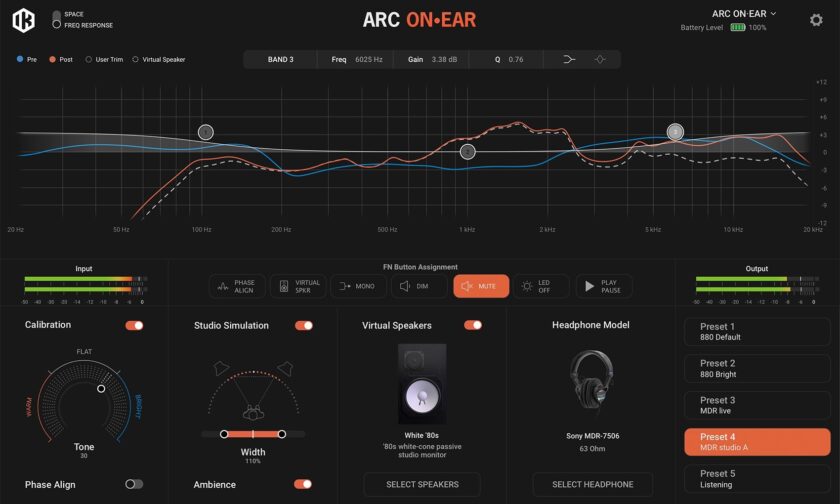
Spatial modeling builds on the calibrated foundation through ARC On-Ear’s studio simulation algorithm. Rather than simple stereo blending, it uses DSP-based physical modeling to reconstruct the spatial relationships of ideal studio monitors, without introducing room coloration or reverb artifacts.
The simulation reconstructs how sound from each virtual speaker reaches both ears, restoring spatial cues that are normally absent in headphone listening. This restores some of the spatial information that is normally lost when the left and right channels remain fully isolated on headphones. While this does not turn headphones into monitors, it reshapes the stereo presentation into a perspective that behaves more like speakers, making panning, depth, and balance decisions easier to judge. An optional ambience layer adds subtle depth to the simulation and can be disabled when working with extremely dry or percussive material.
Profiles for phones, televisions, and compact speakers expand ARC On-Ear’s role beyond neutral monitoring. Each profile emphasizes the bandwidth limits and midrange shaping that characterize portable playback systems. They are not tuned to specific brands or models. Instead, they highlight the constraints that commonly reveal masking, congestion, or excessive energy in certain ranges. Because these perspectives shift immediately within the same monitoring chain, issues can be identified and corrected without leaving the session or preparing a bounce. This convenience encourages more frequent translation checks, which leads to more reliable results.
ARC On-Ear’s DSP environment also supports multiple monitor and device profiles, level management, and reference adjustments within the app, providing a broader toolkit than simple EQ-based correction alone.
Hardware That Stays Out of the Way
ARC On-Ear is designed for portability and straightforward operation. Its aluminum enclosure houses a minimal control layout comprising a single-volume knob and three buttons. CAL activates the headphone correction profile. STUDIO engages the studio simulation algorithm, activating speaker modeling and spatial reconstruction intended to approximate a control-room monitoring perspective.
The device can run on its internal battery for mobile sessions or on USB power for extended use. Both USB-C and analog line-in feed the DSP stage, which allows ARC On-Ear to operate with laptops, interfaces, mixers, and handheld recorders. Latency is low enough for real-time monitoring during typical production tasks, as the DSP stage operates only on the monitoring path and adds minimal processing overhead.
Preset management is intentionally simple. Once a preset is written to memory, it remains active until changed in the app. The device recalls the stored preset at power-on and does not require the software during normal operation. And as another plus, you can switch presets by holding FN and pressing the CAL button. This eliminates the need to constantly go back to the software to change presets, as you can load multiple on the device and switch between.
Setup Without the Overhead
Setup involves selecting your headphones from the library, choosing the monitor and device profiles you want immediate access to, and saving them to a memory slot. ARC On-Ear then operates either as a class-compliant USB device or as a correction stage feeding an analog chain.
Software calibration solutions often require managing plugin order, ensuring that only the monitoring path is corrected, avoiding double-processing, and bypassing calibration before export. ARC On-Ear avoids these issues because its processing takes place outside the DAW and OS. The corrected signal is heard only through the headphones, and the exported audio remains untouched. Behavior stays consistent across computers, which is useful for users who move between machines or collaborate across different setups.
ARC On-Ear occupies the space between several established approaches. Full-room simulations rely on proprietary hardware and more complex DSP environments. Software-only calibration introduces routing considerations and device dependency. Portable DAC and amp units improve clarity but do not offer built-in correction or translation tools. ARC On-Ear brings these elements together into a single device that behaves predictably across different environments and setups.
Verdict
ARC On-Ear benefits users who rely heavily on headphones for monitoring. Producers working in untreated rooms, students developing mixing skills in shared environments, musicians who travel frequently, and engineers who alternate between speakers and headphones all gain a more stable reference point. It provides an anchor when moving between spaces with different acoustics and helps maintain continuity in judgment.
At $249.99, ARC On-Ear sits between portable DAC and amp units and software-based calibration suites. Its value lies in combining headphone correction, spatial refinement, and translation tools in a compact hardware format that remains consistent across systems. It addresses instability, which is a central challenge of headphone mixing, and reduces the need to re-evaluate decisions when the listening environment changes
For users who depend on headphones as a primary or frequent monitoring method, ARC On-Ear provides a stable, portable reference that supports clear, repeatable decision-making across sessions and environments.
