
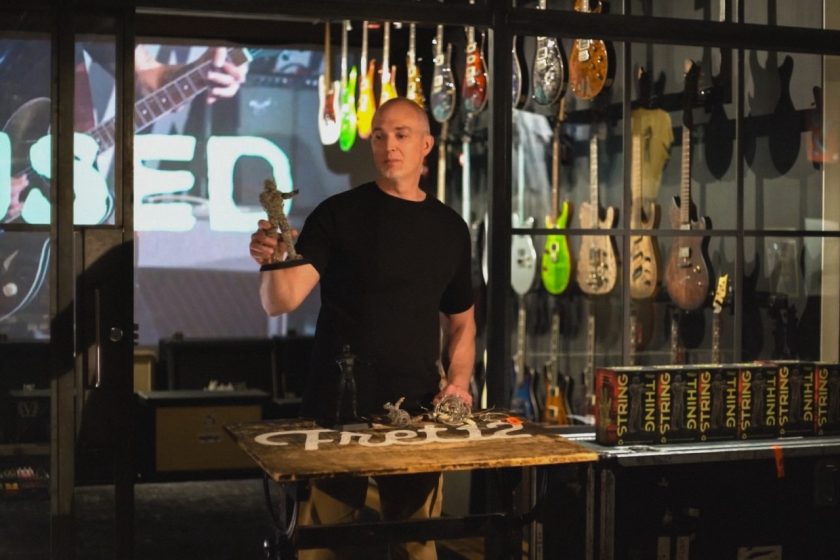
While most guitar shops are built to sell you something, Fret 12 is built to make you stay.
Housed inside of a Chicago music venue, the soundcheck bleeds into the sales floor, and the people walking in already care about why any of this exists. But the space is only part of it. Fret 12 has spent the last two decades turning itself inside out, shifting from a DVD project into a record label and a retailer, and now into something closer to a culture hub that happens to sell guitars.
Dan Tremonti has been behind it all since 2005. While his brother Mark Tremonti built a career on stage, Dan paid attention to everything around it: the gear, the people, the work that never gets seen. That perspective shows up everywhere: in the way the store is laid out, in the way products are made, and in the decision to double down on human craft at a time when much of the industry is moving in the other direction.
Altwire recently caught up with Dan to discuss why human craft and connection are so valuable in the age of AI. Read our interview below:
Derek Oswald [Altwire]: What does Fret 12 do that you wish some music shops would have done when you were growing up?
Dan Tremonti [Fret 12]: Well, you know, Fret 12 does what music shops and skateboard shops and all the things I loved when I was growing up did, I think. So much of the gear business has gone online and become decontextualized, and so much of the retail experience has become commoditized. I think there’s a generation now that doesn’t even remember what it was like.
When I was a kid, going to record stores or skateboard shops, we’d go there without even any money because we wanted to hang out with other people in our genre. I wanted to be around other metalheads or in the skate shop with other skaters. It was very much driven by community and discovery. You formed a relationship with the person behind the counter, and they’d turn you on to the next great band or whatnot.
A big part of what we’re trying to do with Fret 12 is get people connected again and really build that community and that connection. We’ve been doing that online for a while, but we have a store now that we opened in 2022, and it’s really experiential. It’s about getting people together to hang out and just celebrate music.
Altwire: What are some of the local music stores that may not be around anymore that you grew up with that inspired Fret 12?
Dan Tremonti [Fret 12]: God, I have to think back because I moved around a lot as a kid. In Detroit, there was a place, I think it was Harmony House, and I think they even had a subscription thing tied to it. That was the big record store we would go to to check out records.
Here in Chicago, I think it was Gand Music from a gear standpoint. It was kind of up north, we were in the suburbs.
But honestly, I was a big skateboard kid and a huge music person. A lot of my musical upbringing was going to skate shops like Tom Thumb in Evanston. We’d go with a boombox, listen to music, pick up tapes and play them. It was less about gear and guitar and more just music-oriented.
We’d be like “ma, take us to the shop” and in Evanston there’s a record shop that’s been around forever. I don’t even remember the namem. It’s right next door to where Tom Thumb was, and it’s still hanging on. They’re still selling records, and I don’t know how [Editor’s Note: It’s called Vintage Vinyl]. I look in there all the time and there aren’t many people, but it’s still there.
Altwire: You grew up in a musical family and have a brother who is a musician. What was it like seeing that take off?
Dan Tremonti [Fret 12]: Well, I guess I’ll put it out there first that it could happen. All those kids out there in their room playing guitar and wanting to get to the big stages, that’s what he was. So whether he had made it or not, it’s what he would still be doing.
Growing up around it, it was amazing to see someone so dedicated to something and so in love with something where they would literally stay awake all night practicing and doing things.
The cool part about all of it for me, is I’ve always been an artist and he’s always been a musician. I introduced him to music. I played him “Creeping Death” from Metallica, and that got him into it. He took his first guitar lesson because he bought a guitar from a garage sale, and he was like, I don’t want to play “Mary Had a Little Lamb,” I want to play “Creeping Death.” From there, he taught himself.
I think the biggest difference about him is that he was never really a guy that was trying to be technical. He didn’t aspire to be like a Steve Vai or something. He was a songwriter. So he was always just focused on the melody and focused on writing, and then the guitar became more of support in his writing.
Fast-forwarding through it all, it’s kind of how Fret 12 started. When it did take off, and it literally took off pretty much overnight, about a year earlier we were at Florida State’s campus [with Creed] playing “My Own Prison” in a muffin shop as the house band, in a place where there were two old people and us and our gaggle of 20-something friends. It was weird seeing it go from that to getting put on Underground Lounge on a radio station there. Then they started getting shows, and then it kind of took off, and they were touring.
But I always said to him, I’ve watched you all these years teach yourself, and now you can go to Best Buy, you can buy your CD, you can see yourself at a big concert stage or on the radio. Why doesn’t a guy like you, in the middle of his career, stop and let people in? Here’s how I’m writing, here’s how I’m approaching things, here’s what the business is doing to me. Peel back the curtain so that it’s really relevant and inspiring to other people in your situation that haven’t made it yet.
And so we started a thing called The Sound and the Story. It was part documentary and part tutorial.
Then people started rallying around what we were doing, just with the love of music and meeting people and meeting up before concerts. We started a thing called the Army of 12, doing things before shows. It really became more about the shared love of live music and guitar.
But, this whole time, I’ve always been doing album covers and merchandise, and I’ve been backstage seeing what techs do. I’m more excited when the trusses are going up, and the buses are rolling, and all the things behind the scenes.
People only see about 20% of what actually goes into being a big musician and a performer, from improvised practice spaces to all the stuff that makes the show go on, and the shows that almost don’t happen. The patina of the beat-up road cases that have been around the world a hundred times. The big wads of strings and cables running across the stage.
That’s what really inspires our aesthetic, and part of what we try to let people in on is that whole behind-the-scenes thing.

Altwire: You’ve reinvented Fret 12 multiple times. Was there anything that almost didn’t work?
Dan Tremonti [Fret 12]: I do other things, so I’m able to kind of keep my baby alive, which has always been Fret 12. So we’ve done things over the years that we’ve just done because we wanted to do them, for fans and for music, or to support bands.
So mostly it’s been that we’ve maybe gotten out over our skis a little bit. Right now, there’s a band being filmed at our shop, and we don’t make any money on that. We just want to champion bands and help them. It’s mostly been maybe overextending ourselves a little, trying to do too much, trying to help other people in the business. But that’s kind of what we’re here for.
I didn’t think in a million years someone would buy a $3,000 guitar online. I thought people would buy the $500 or $600 import kind of things, but a Maryland-made USA core model? Would I buy one of those without checking it out in person and holding it? And we started selling a ton of the USA-made ones because we were buying the right ones. So we’ve just learned over the years.
There are so many people to compete with now, between the big boxes and the exchanges online and all of that. That’s really not our thing. So we’ve experimented, we’ve learned, and we’ve kind of landed now where we really want to be. What our strength is, is really doing that storytelling, creating access, getting people together, and then making products that are an expression of the love of music.
Altwire: Everyone seems to be moving toward AI. With Fret 12, you’re going the other way. Why?
Dan Tremonti [Fret 12]: Well, I’ve been thinking about this for a long time. We bought, and we haven’t launched it yet, but I bought a URL called backtocraft.com that we’re about to launch.
When we got into the guitar stuff, there were things that were more mass-manufactured, and then there were these craftsmen making these beautiful things where every inch of wood, every inlay, every wiring of the pickups is so detailed. It made me wonder, is this stuff going to go away someday?
I really love the idea of craftsmanship and craftspeople. Someone for whom it takes six months to apprentice just to be able to do a finish on a guitar. I’ve always been very aware of where things are going and the idea that we need to teach the next generations. I love the imperfectly perfect, the imperfections of handwork, the nuance of that kind of thing.
My kid is in college right now. He’s never picked up a book in his life. I saw him reading a book, and I almost tripped. People are literally putting down phones, and it’s not even like a super conscious thing. There’s just a movement toward doing things, using your head, getting together, whether it’s getting back into going to the schoolyard, playing sports, or doing whatever.
I think people are getting off devices to a degree. People are really getting back into ritual. Obviously, we’ve seen it in music. It’s crazy that vinyl sells the way it does. We’re doing a lot of stuff around that. Literally the word “analog” on a shirt, or “I miss my old stereo,” just doing our part to capture what we think is not AI counterculture, but just an appreciation for craft and human interaction.
In the shop, it’s fun because someone comes in and they see that shirt and they’re like, man, I miss my old stereo. So I think there’s a fork in the road, a hard fork in the road, that’s already happening in pieces and parts.
Again, not against technology. I use AI myself to write or do things. It has its place, but it doesn’t have its place so much in the arts. Obviously, making a guitar, CNC machines, and technology are very useful. But I’m a big believer that people believe in craftsmanship. They believe in the human hand and touch, and in using your mind.
You even see it in the alcohol space now. Younger audiences are drinking less because they want to have meaningful connections. Maybe something happened through the pandemic where people changed their mindset. You were pulled away and spent so much time on technology, and now you have this chance to be with people again and do things.
I’m betting on the opposite of AI. It has its place, but at the end of the day, people will always be making things and will appreciate that.

Altwire: How did the String Thing come about?
Dan Tremonti [Fret 12]: So I was side stage talking to a tech at a show, I think I was in Detroit. He opened up the bottom drawer of his tech case, and there were all these neatly coiled sets of used strings. They had a piece of gaff tape on them that said the venue and the date.
I was like, whoa, what’s all that? He said it’s kind of his thing. He collects the strings, and it’s also a big no-no to have string waste on a stage, because it can get wound up in a road case wheel or something. And he just didn’t like throwing them away.
Right away I thought that was a great thing. First, that he’s being responsible about doing this, but also the idea that those were strings from real shows, from real players. That’d be pretty cool. So I asked if I could take a few.
They went into my junk drawer when I got home. Later, I was going through that drawer, and there was a random action figure in there with them. I just started wrapping it in the guitar strings, and I was like, this is actually pretty cool. I made this little mummy, photographed it, turned it into a t-shirt, and that became the String Thing.
That kind of inspired me. If you zoom in on a guitar string, it has a really cool industrial look. I’m an artist, so I started photographing them in different compositions. It’s intricate, and depending on how it catches the light, it’s always different. People have always really loved it.
People don’t really think about it. It’s something that wears out, so you throw it away. But really, it represents your time as a musician. I thought, can I make this into something instead of it going into a landfill? It was actually really hard to figure out how to make it work.
We get asked all the time if we’re going to make another shape, like a skull or something. I’ve wrapped everything you can imagine. But there’s something about how this one stands that just works. It’s become our mascot.
We’ve also done collaborations. We did the Hoof fuzz pedal with Earthquaker Devices, and that has the String Thing artwork on it. The goal is to really change that mindset of holding onto these things. Put it on your shelf, put it in your studio, build an army of them.
Altwire: Is there gear in your shop you really push people toward?
Dan Tremonti [Fret 12]: We try to highlight smaller builders. When you go to NAMM, the big brands are upstairs, but downstairs, there are all these independent luthiers doing amazing work.
It’s like Spotify. There’s so much of it. Finding the real gems is the challenge. We’re working with a local builder, John Furlan. He makes Furlan Guitars and can build almost anything. He’s a true craftsman.
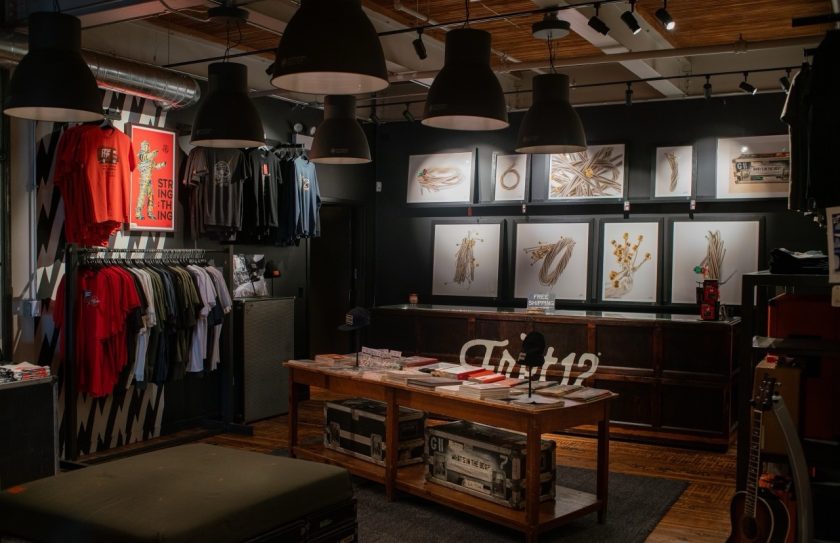
Being inside a music venue helps. Artists walk in, see something they’ve never heard of, and get curious. We can connect them directly with the builder, host events, and create content around it. We sell PRS as well because of the craftsmanship, but supporting local makers is a big part of what we do.
Altwire: Do you want every Fret 12 store to be inside a venue?
Dan Tremonti [Fret 12]: When I first talked about it, people thought I was crazy. They’d ask if concertgoers even want to shop. But where else are you going to find people who care about music this much?
The space we’re in has history. You can feel it. Even if you took everything out, it would still be a cool place.
I don’t know if every location would be a venue, but I’d always look for spaces with that kind of character. Old clubs, places with history. If we ever had something like the Double Door in Chicago, I’d want to put a stage back in it. Let local bands play, let people hang out, make it part shop, part community space.
Altwire: What’s next for Fret 12?
Dan Tremonti [Fret 12]: We’ve got a bunch of things going on behind the scenes with the String Thing and some collaborations. We did a beer last year with Hoplature, so we’re exploring things in that space too.
A big focus right now is doing sessions with bands and helping promote local artists. We’re creating a lot of that content.
We’ve also built our own manufacturing to hand-cut and sew clothing in Chicago, in our shop. It’s really hard work, from sourcing textiles to actually producing everything. We’re making clothing that feels like it belongs on the road. Something you’d wear on a bus or backstage. It’s not just merch anymore.
So now it’s gear, clothing, art, collectibles, all tied back to the same idea. Just expressing a love of music in different ways.
Fret 12 is based in Chicago, Illinois. You can find them at fret12.com.
