
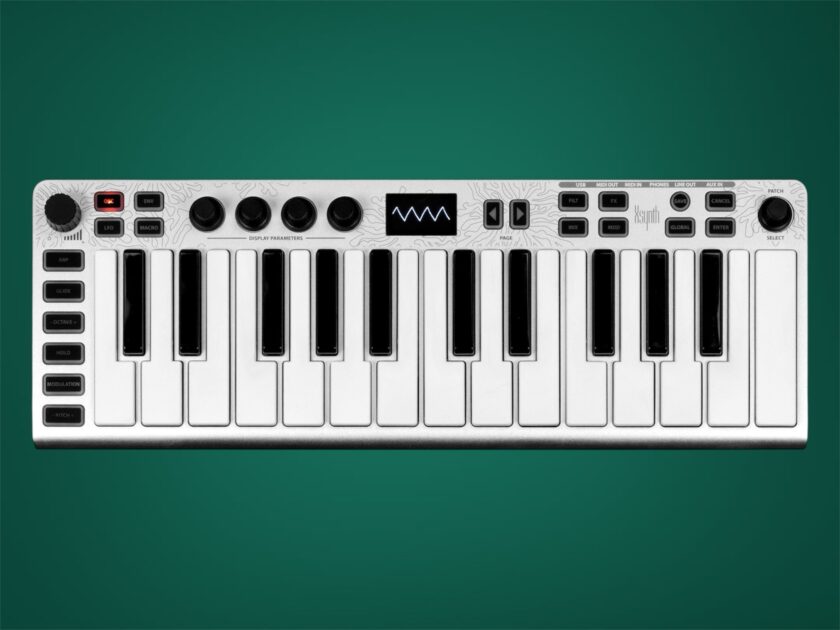
I first saw the XSynth on Instagram and had to get my hands on it. At 387×148×27 mm and 634 grams, this is the iPhone Air of the synth world, with a size that suggests a MIDI controller, because that’s all something this thin should be.
Except ESI crammed an entire polyphonic synthesizer in here. Under the hood is a complete virtual-analog subtractive engine built on ROM-based waveforms, with three oscillators per voice, ten-voice polyphony, a sixteen-slot modulation matrix, a multimode filter, three envelopes, three LFOs, and effects processors. The works. It’s absurd.
Think about what this would’ve looked like thirty years ago. The analog synths these emulate took up entire rooms, and sometimes broke your back with their weight. The 90s rave synths? Rack modules and workstations. And now it’s all in something thin enough to slide into a laptop bag without a second thought. Even before our hands-on experience, the spec sheet was impressive for something this tiny. We’ve come a long way.
The Build and Portability in Practice
The aluminum chassis feels solid despite the thinness. No flex in the body, no sense that it’s fragile. The low-profile encoders and buttons won’t snag or break off in a backpack.
At 634 grams, it’s light. Super light, actually.
The Sounds Have Way More Character Than Expected
But here’s where it gets interesting. ESI hasn’t always been a synth company; before this, they made budget audio interfaces and MIDI controllers. The XSynth is their first synthesizer, and the variety of sounds included is impressive.
There are ‘90s rave stabs in here fresh out of Eurodance. Juno-style warmth that doesn’t feel like a bad impression. Distorted basses that genuinely sound nasty in a good way. Moody atmospheric stuff. Drum kits. FM-style bells. You can even layer a trance PWM patch as a melody, an arp, and a bass, and you have an excellent foundation for a trance track.
A former Waldorf engineer apparently led development, and you can hear it. The three-oscillator engine supports pulse-width modulation on Oscillator 1, oscillator sync between Oscillators 2 and 3, and audio-rate FM, with Oscillator 3 modulating Oscillator 1. The oscillators pull from ROM waves that include standard shapes, sampled field recordings, and stranger digital material. It ships with 128 factory sounds and 512 total patch slots arranged as four banks of 128. That leaves you plenty of room to build your own library.
The modulation matrix is where things get deep. Sixteen slots mean you can route multiple sources to practically any parameter. Aftertouch, LFOs, envelopes, and velocity can be connected however you want. Want aftertouch to control filter cutoff while an LFO modulates pulse width and an envelope shapes the amplitude? Done.
Three dedicated effects processors, plus a master EQ that covers reverb, delay, chorus, and other algorithms like modulation and distortion. Quality is excellent, and it sits next to Modal’s digital synths. The only thing we found in our testing and recording demos is that some patches run quietly, so you might need to adjust gain staging depending on what you’re working with.
And Because It’s This Thin, Setup Is Stupid Simple
USB-C cable for power and audio. 3.5mm line out. TRS MIDI if you’re running a sequence. That’s all it takes to get started.
The XSynth has a built-in 24-bit/96kHz audio interface. It’s class-compliant on Mac and iPad (plug-and-play). Windows users get ASIO driver support. The unit draws so little power that it’ll run off a phone power bank, which musicians will need for true portability, since it doesn’t have an internal rechargeable battery.
The MIDI I/O bridges to USB, too. Connect external hardware to those 3.5mm TRS jacks and the XSynth routes MIDI to your computer or iPad. It’s functioning as a MIDI hub. So you can sequence the internal synth from your DAW while simultaneously using those MIDI ports to control other hardware. Everything flows through one USB connection.
The simplicity is why I often use it for pedal demos. Small profile, minimal cables, it’s perfect.

The Keys Though
The keys feel like a laptop keyboard. Shallow travel, minimal resistance. It’s the CME Xkey mechanism that ESI acquired, with a full-size key width but almost no vertical throw.
However, it’s hard to imagine how they would’ve managed to have Reface DX-style keys while keeping the skinny frame. The good news is that they’re playable. The polyphonic aftertouch becomes your expressive control instead of traditional key action. You get a dynamic response to the pressure from your fingers once the key bottoms out, and you have to train yourself to apply different pressure than you do on standard keys.
The mechanism is consistent across all 25 keys, and the XSynth’s response is uniform. Once you dial that in, aftertouch compensates for the shallow action. Route it to filter or vibrato in the mod matrix, and you’re shaping sound through pressure.
It’s one of the few instruments this size to offer per-note polyphonic expression. That’s not a common feature in portable synths. Most give you channel aftertouch at best, which applies the same pressure value across all notes. With poly-AT, you can press one key harder to bring out a lead line while keeping the rest of the chord subtle.
The Screen Is Tiny, and the Interface Takes Learning
The OLED is small. Readable, but definitely small enough that you’ll have to squint a little if your eyesight is poor. Parameter names are legible if you’re staring directly at them.
Parameters appear organized into pages that you scroll through using dedicated buttons. The four knobs beneath the screen adjust the currently displayed parameters (filter cutoff, resonance, envelope times, LFO rates, or whatever page you’re on). The far-right encoder handles patch browsing, which almost instantly appears when you select a new sound.
Functions like the arpeggiator, portamento, octave transpose, and hold are directly accessible via one-touch panel buttons. Deeper sound design (working with the modulation matrix, editing oscillator waveforms, tweaking effect parameters) requires navigating the page system on the small screen.
The plus is that ESI includes a free companion editor for Mac, Windows, and iPad. Building patches from scratch is much better in the app, where you can see everything at once and drag modulation routings visually.
The pitch and mod controls are pressure-sensitive buttons instead of wheels, presumably to maintain the slim profile. If you’re heavy on pitch bends, you’ll need to adjust your playing technique.
Who This Is For
The XSynth is brilliant if you need a synth where full-size gear isn’t practical. Situations where you’d typically compromise on what gear you bring because the logistics don’t work.
At $429, this is more interesting than most portable synths from established manufacturers. ESI’s first synth delivers on my initial curiosity sparked by the Instagram post. Yes, I would’ve preferred a rechargeable battery, and the keys take adjustment. The screen requires focus. But it’s a real polyphonic synthesizer with character, expressive polyphonic aftertouch, and integrated audio/MIDI I/O, at a fraction of the size of similarly featured synths. With the MicroFreak being one of the few equally feature-rich synths in this price range, it’s difficult to say no. Highly recommended.
