
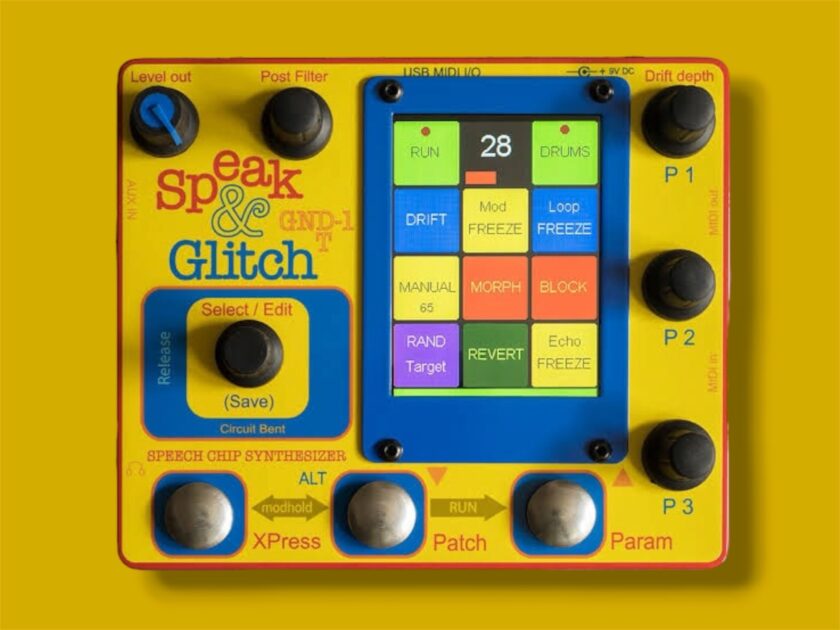
Le GND-1T is a strange beast, and trying to summarize its sound feels a little like opening a dictionary and deciding to use every word in one very long sentence. Or, better yet, borrowing an Oscar-winning title: it is Everything Everywhere All at Once – speech machine, bass synth, algorithmic drum generator, ambient box, glitch instrument, and sound-design workstation – and after several months with it, the sounds I remember most are thick, rubbery basses and slow reverberant pads with tiny metallic details that reminded me of water trickling across metal.
Richard van Hoesel built all of that around what he describes as a faithful emulation of the Texas Instruments speech technology behind the classic Speak & Spell, with Joe Manton contributing heavily to the ideas that shaped the instrument during development. The part that makes the GND-1T difficult to reduce to a nostalgic speech box is everything Richard then wrapped around that core: modulation, filtering, drums, Morph, Drift, expression control, effects, and a modern MIDI implementation that lets the old speech idea leak into parts of the instrument where it has no business being.
Speech, Bass, and Water on Metal
E.T. figured out decades ago that a Speak & Spell could be repurposed for something much stranger than spelling, and the GND-1T starts from the same impulse before taking it much farther. I stretched, bent, looped, pitched, and distorted recognizable words until pronunciation broke apart. Starting from INIT, selecting a word, and dialing in Glitch variations quickly reaches the classic hardware bend sounds. Still, the Bends pages can go much further because the software can manipulate what is happening inside the emulated speech system itself.
That freedom is probably why browsing presets kept dropping me into sounds I would never have grouped together if I heard them blind. Some bass patches have enough rounded sub weight and slight distortion to remind me of classic Minimoog bass – Carl Carlton’s “She’s a Bad Mama Jama” kept coming to mind because of that creamy, almost warbling quality – while another turn through the same box lands on slow pads and drones where the speech origin gets so buried that only small vocal or metallic details are left hanging inside the reverb.
I like that those ambient sounds never completely sand themselves smooth; there is usually some little digital droplet, warped vowel, or metallic edge left inside the pad, and that same speech activity can be turned into rhythm rather than texture. Calling the drum section a sequencer is therefore accurate and wrong at the same time, because there is no ordinary row of steps waiting for a kick on one and a snare on five – the events can be generated from activity inside the speech engine itself.
Drums Without a Grid
The trigger source can follow updates from the speech ROM or a steadier internal/external MIDI clock, and the free-running synth audio can be mixed into that source as well, which is why the same drum setup could stay polite at sensible sensitivity and rate settings or suddenly turn into something resembling a chaotic breakbeat when I pushed it harder. There is a point where too many events pile into the same stretch of time, but with at least 40 built-in kits feeding the generator, I could move from a basic backbeat to a pattern that barely held together without changing instruments.
Steel, Screen, and the Rest of the I/O
All of that chaos lives in a box that feels much more serious than the premise might suggest. The metal enclosure reminds me of a very well-made guitar pedal scaled around a large color touchscreen; the encoders and metal controls feel solid, and nothing on the chassis gave me a durability concern; the I/O is similarly overqualified, with stereo analog and 44 kHz USB audio, AUX and headphones, USB host, MIDI over USB and five-pin DIN, internal/external clocking, parameter control, channel-10 drum triggering, and drum-note output to external gear.
Learning the GND-1T’s Control Language
With that much packed into the GND-1T, Richard’s warning before it arrived – spend real time with it before the deeper functions make sense – turned out to be accurate. Short and long presses do different jobs, PATCH opens alternate functions, the endless encoder moves through pages and values, the touchscreen is active rather than decorative, and five groups of P1/P2/P3 assignments provide 30 virtual encoder positions, while XPRESS adds yet another layer of touch-sensitive control alongside velocity, aftertouch, breath, mod wheel, and XPlfo.
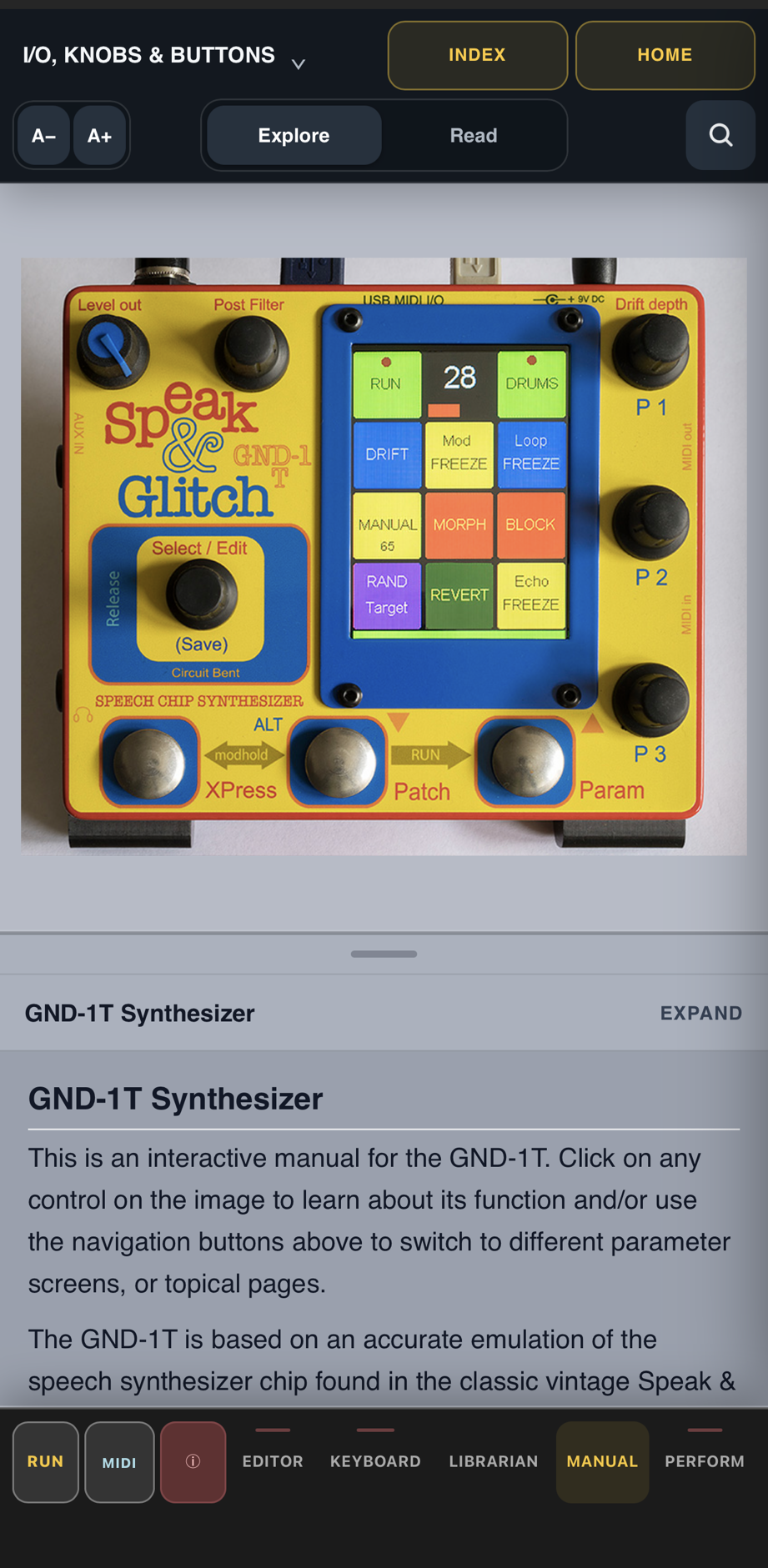
None of those ideas is particularly difficult alone; the density comes from learning them all at once, which is why Joe Manton’s third-party companion app feels essential. Its interactive manual provides a hands-on way to learn the GND-1T inside the software, while the editor offers far more granular control than the front panel alone. It also combines patch management and custom control surfaces in the same place. The app is still in development, but I highly recommend that future owners install it once it is widely available. Even with that help, the cleanest route into building my own sounds was still INIT – and INIT is also the slow route when this many parameters are waiting for you.
Morph, Drift, and Scenes
That is why Morph became my favorite shortcut once I had two sounds worth keeping. Instead of building every relationship from scratch, I could move between the full parameter states and listen for the moment the result stopped resembling either endpoint; because the internal rates, loops, and modulation of the two patches may be completely different, those in-between positions sometimes speed up or drag behind like a tape machine starting or stopping, which immediately made me hear long techno transitions rather than a simple preset crossfade.
Drift takes the same appetite for unintended states in another direction. It leaves the underlying patch values alone while creating slowly varying offsets that can be frozen into a Drift Buffer, scaled harder or softer in real time, saved, recalled, and applied to another patch, which means I can spend fifteen minutes finding out whether a sound gets better or worse and still return to an earlier state without reconstructing anything by hand. A double tap of DRIFT can also generate a random Drift Buffer instantly.
Up to 1,000 Drift Buffers can be stored, and the Step Block can sequence through them while the Drift Scaler changes how strongly each stored offset affects the current patch; Morph and Drift can run together as well, so the sound can move between two patches while the parameter offsets keep changing underneath. Once I found a larger combination worth keeping, Scenes became the natural next step because they save nearly the entire device state, not just a single patch.
A Scene stores nearly the entire current device configuration, including the current patch, Morph setup, active Drift Buffer, and most global variables. One source-and-target patch pairing can contain many sounds worth keeping at different positions of the Morph control. I can save that larger configuration as a Scene, reload it later, and regain the same Morph relationship to explore again. Up to 1,000 Scene locations are available.
Modulation and the Expression Matrix
Scenes save the larger state; modulation is what keeps that state moving. Many key synth parameters have dedicated modulation blocks that mix two modulation signals. Each source can be selected from more than 40 waveforms or taken from the output of another modulation block, allowing cross-linked modulation and feedback structures.
Almost every parameter, more than 150 of them, has five individual scalers determining how strongly it responds to mod wheel, breath control, velocity, aftertouch, and XPlfo, a dedicated expression modulator. Those scalers reach parameters well beyond pitch or filter cutoff, including drum pitch and tape-echo time.
XPlfo can even drive the Morph control itself, making the position between two patches a modulation destination. Driving Morph this way can produce rhythmic movement while the rest of the modulation system, and even Drift, continues changing the sound around it.
To Me, The GND-1T’s Price Is Too Low
After all of that, the price surprised me. Richard currently sells the GND-1T for AUD $829, with worldwide express shipping included.
For the amount of control and the range I’ve actually used, AUD $829 feels surprisingly conservative. The memory covers up to 1,000 patch locations, 1,000 Drift Buffers, and 1,000 Scenes, with around 150 real-time parameters behind the front panel.
The GND-1T has become one of the most exciting synthesizers I’ve used recently for experimental audio.
I keep thinking about the engineers who originally worked on the Speak & Spell speech technology. I have no idea what future uses they imagined for it, but I’d be amazed if thick Minimoog-like bass, algorithmic techno drums, scalable Drift Buffers, cross-linked modulation feedback, and tape-stop morphs were anywhere on the whiteboard.
More than four decades later, that technology ended up here, bastardized in so many delicious ways.
Read more reviews ici.
