
When Bob Coover first pitched me on the 3rd Wave 8M in mid-September 2025, he said something I probably filed under sales optimism at first: “You can make any sound you want with this thing.” Bob was clearly proud of the 8M, and he had the résumé to back it up. Bob came up through Sequential as a DSP engineer, working alongside Dave Smith, and he co-founded Groove Synthesis with one obvious target: build a faithful, modern successor to the PPG Wave.
I believed him, but when I tried the factory presets and heard some glassy, shimmering, unmistakably PPG sounds, I figured “any sound” really meant “any sound within a very beautiful, very specific PPG-flavored universe.”
A few months later, with the 8M in my hands, I vibe-coded a CC randomizer and decided the 8M would be my first test. With full chaos in control of the parameters, Bob’s claim finally clicked when I made a sound I never expected from the 8M. I could practically see Bob giving the same grin he wears in half of Groove Synthesis’s social videos, while saying, “I told you so.”
The $15,000 Problem
The PPG Wave 2.2 and 2.3 were West German synthesizers built by Wolfgang Palm between 1981 and 1987: hybrid instruments that ran digital wavetable oscillators with per-voice analog filters. David Bowie and Gary Numan were notable PPG Wave users. Alan Wilder has said Depeche Mode used a PPG Wave 2/2.2 in the studio from A Broken Frame onward for a couple of years.
Loved by many, OG’s are also extraordinarily expensive, increasingly fragile, and require specialist maintenance to keep running. Clean PPG Waves regularly live deep in five-figure territory, and restored examples can climb past $15,000. Most of us can’t justify paying car money for a synth, even a legendary one.
Groove Synthesis built the 3rd Wave line directly into that gap: digital wavetable oscillators, per-voice analog SSI 2140 filters, current manufacturing, active firmware development, and pricing that does not require vintage-synth insanity. While the flagship models still cost thousands of dollars, a more affordable option, the 8M, arrived at $1,999 in the U.S. Announced in May 2025, it began shipping on September 1, 2025.
The 8M is where that same 3rd Wave sound gets more accessible for most working musicians. It has fewer voices, fewer front-panel controls, two-part multitimbrality instead of four, and a much lower price. It is not the full flagship experience, but for many players, it may be the smarter buy.
What Groove Synthesis Actually Built
The 3rd Wave 8M is hybrid in the literal signal-path sense. Each voice has three high-resolution digital oscillators that feed an analog SSI 2140 filter and an analog output stage. This split shapes the 8M’s character. The digital side gives it range: legacy PPG-style wavetables, high-resolution modern wavetables, virtual analog waveforms, linear FM, and sample playback. The analog SSI 2140 filter keeps that range from turning sterile when patches get bright, glassy, or aggressive.
The 8M uses Groove Synthesis’s Dave Rossum-designed 2140 analog low-pass filter alongside a secondary SEM-style digital state-variable filter. The manual describes the analog filter as a classic 4-pole, 24dB/octave resonant low-pass design with resonance compensation. The state-variable filter is zero-delay, 2-pole, and 12dB/octave, with continuous movement between low-pass, notch, and high-pass modes, plus selectable band-pass. The two filters run in series, with the state-variable filter first and the low-pass filter second. The digital oscillators can sound digital on their own, but the filter rounds off the harsh edges without flattening the wavetable movement.
That’s why the 8M never felt like a digital synth trying to fake analog. Its oscillators can sound glassy, brittle, or strange, but the filter pulls them back toward something more physical. The SSI 2140 is what keeps the 8M from turning into a bright, vintage-branded wavetable box.
Groove Synthesis set out to build a faithful successor to the PPG. They did. Then they kept going.
The oscillator section is where the 8M begins to move beyond “PPG revival.” Legacy PPG 8-bit wavetables sit alongside modern 96kHz high-resolution tables, virtual-analog waveforms, DX-style linear FM, and sample playback, added in OS 1.8. Each of the three oscillators per voice can be running a different mode simultaneously. Four ADSR envelopes per part, each with an additional delay parameter, four LFOs per part, a user-assignable modulation matrix, and three 6-stage loopable wave envelopes designed specifically for wavetable position sweeping.
Then there’s the detail buried in the manual that I don’t feel gets enough attention: the 8M natively accepts Serum-format wavetables, as in, it identifies them as such. Load a Serum wavetable, and the 8M recognizes it as Serum material. Sweep through the table with the mod wheel, audition it in real time, then hit “make waves.” It’s now saved as 3rd Wave user-wavetable material, ready for the Wave Envelope, filters, and modulation system.
My best advice to a new buyer is boring but serious: read the manual before you judge the presets. The 8M hides much of its best material in plain sight. Skip the manual, and you’ll still enjoy the 8M. Read it, and you start finding the weird stuff that makes the synth worth writing about.
The Interface Tradeoff
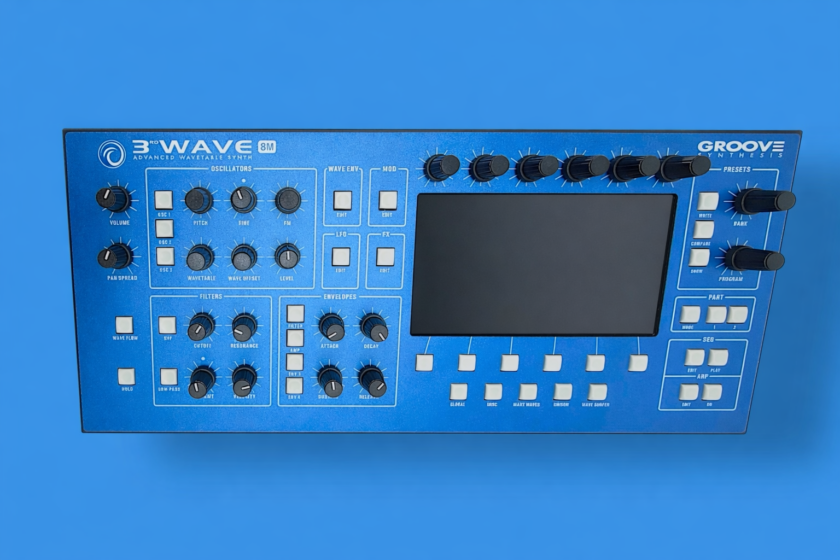
The full-size 3rd Wave keyboard is, among synthesizer control panels, something close to a nuclear power plant: 77 knobs, 39 buttons, a parameter for virtually every function within immediate physical reach. For a certain type of player, it is tailor-made for the “what does this button do?” crowd. The 8M has far fewer dedicated front-panel controls, and the workflow that replaced them is built around a 7-inch color LCD touchscreen with six context-sensitive soft encoders.
The screen is solid. While many synths or drum machines still come with postage stamp displays that are hard to read (looking at you, Roland, I love you though), the 8M’s 7-inch panel is sharp, responsive, and refreshes quickly. It shows what is happening at a glance without turning the UI into a mess.
If you haven’t used the keyboard version, the 8M probably won’t feel as menu-heavy as you might think. Most settings are just one or two layers deep, and the main sound controls are still on the panel. The first few sessions are about learning where everything is, so keep the manual handy. Once you get used to the layout, you stop missing the extra controls. The “Show” button, which displays all parameter values without changing anything, is a small but helpful feature, especially when opening patches you didn’t create.
If you’re used to the keyboard version, you might miss the Wave Surfer knob, which lets you sweep the wavetable position directly. On the 8M, this is handled by a soft knob. It works, but it doesn’t feel as immediate as having a dedicated control.
Booting up takes under a minute, and you’re greeted with a loading screen with the Groove Synthesis logo while you wait.
The Eight-Voice Question
Eight voices are the easiest thing to worry about before you play the 8M. On paper, that looks like a steep drop from the flagship keyboard’s 24. With long-release sounds, dense chords, or bi-timbral operation, you can run into voice stealing. In a normal two-part setup, the 8M divides its eight voices into four per part, while splits and sequenced parts can allocate voices dynamically.
Many patches from the larger models still work well here, and Groove has noted in its videos that some patches were adjusted to accommodate the smaller voice count. Even though the factory bank includes patches from the 24-voice models, some of which use dual layers and halve the polyphony, it doesn’t feel like a “downgraded” version.
If you like stacking long releases or using both parts a lot, you’ll hit the voice limit sooner. For ambient music with dense, long-release layers, the 24M is a safer bet and probably worth the extra $1,500. But if you mostly use single-layer mode, stop stressing over the eight voices and save yourself enough money to buy another synth.
Any Sound Means…Any Sound.
I was wrong about something.
I came into this review expecting the 8M to do what the PPG Wave does: deliver those iconic glassy textures, those shimmering digital-analog pads, those unmistakably 80s tones that defined Bowie’s “Heroes” era, Numan’s machine-age alienation, the cold melodic pulse of early Depeche Mode. And it does all of that, faithfully. If that’s what you’re after, you will not be disappointed.
But as I found over a few months of playing around, that line of thinking is, in many ways, selling short what this line of synths is intended to do. With five synthesis techniques (including multi-samples) and 2 parts with 3 oscillators, as Bob said, “you can make anything you can dream up.”
This became even clearer the moment I built a CC randomizer.
It’s a basic tool, vibe-coded and still rough, that randomly assigns values to 44+ CC parameters simultaneously. I pointed it at the 8M to see what happened. The screen started paging through parameter updates at something close to hyperspeed, refreshing values faster than the eye could track, and the synth, to its credit, did not choke. Forty-four simultaneous CC streams and no stuttering, no dropout, no protest. The engine absorbed it cleanly.
When I found a result I liked, I understood what Bob meant. Low drones with sub-register weight. Dark atmospheric pads punctuated by static pulses. Blips and bleeps with a brittle, fractured quality. Detuned chords sitting in textural territory that felt less like 1983 and more like 2003. Less Gary Numan, more industrial.
Some results were unusable, as you’d expect when you let chaos take over. But more than one result made me stop and think: I would not have deliberately patched my way to that. The engine has enough doors in it that even a dumb randomizer could stumble into rooms I would not have found on purpose. Running the 8M through the Xenodrive pulls it even further away from polite vintage worship.
The Practical Stuff
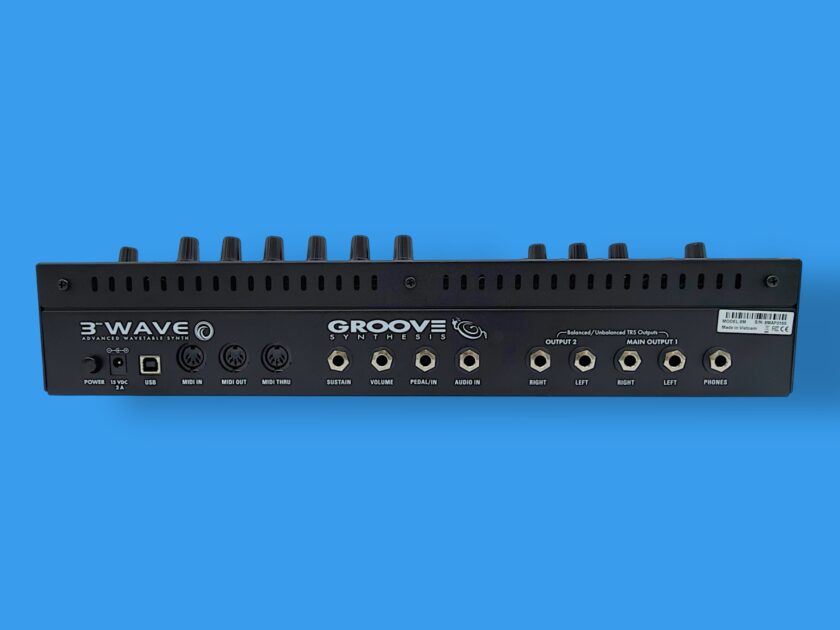
The 8M comes with 19-inch rack ears, so you can rack it right away. It has four quarter-inch outputs set up as two stereo pairs, one for each part, and Groove Synthesis lists them as balanced. There’s also a mono audio input, which the manual documents for creating custom wavetables through the Wave Maker or for making multi-part samples.
The effects section covers delay, modulation, distortion, ring modulation, rotating speaker, and reverb types across two slots per part. The effects work fine, but I wouldn’t buy the 8M just for them. For bigger or more polished sounds, I still preferred using external effects.
USB is only for MIDI and file transfers, and there’s no audio streaming. It does not run on USB power. You’ll need a separate interface to connect it to your DAW. None of the 3rd Wave models has CV/Gate, so modular users shouldn’t expect it to work like a semi-modular hub. The external power supply is a 15V DC wall wart with interchangeable plug adapters.
The factory programs load into user-rewritable memory across five banks. Patch compatibility with the 24-voice models is supported, within the 8M’s smaller voice and part limits.
As for wavetable storage, the 8M ships with 56 of the 64 user wavetable slots filled, but all 64 slots are available. It also comes with 36 PPG-type wavetables across 48 slots, and all 48 can be overwritten. You can save and load wavetables and samples within a program, and any PPG or User wavetable can always be reloaded. Factory defaults are available for download on the support page. So if you want to load every Serum wavetable you find online into the user slots, you can swap them in and out as needed, making this synth highly customizable.
The chassis is metal and feels sturdy, and that blue front panel is a nice visual nod to the original PPG Wave.
The Librarian Question
In a recent Groove Synthesis Instagram reel from Superbooth 2026, Bob said an incoming unofficial community-built librarian by Pedro Camacho and another company, MonkeyC, with waveform-redrawing capability, should arrive within the next few months, further customizing the device’s wavetable functionality.
Until then, owners have workarounds. Laser Mammoth, a free browser-based SysEx librarian at f0f7.net, is the tool many owners seem to rely on for patch management. ThirdWaveLibrarian on macOS handles bank reordering and renaming, and Groove Synthesis provides a basic Python bank arranger on their support page.
The Verdict
Bob Coover told me I could make any sound I wanted with this. I spent two months believing him within limits I’d set for myself, then spent one afternoon with a CC randomizer learning that the limits were mine, not the instrument’s.
The 8M’s real trick is that it doesn’t make the vintage PPG market irrelevant, but it does make the sound feel accessible without buying into vintage-synth chaos. It uses the same core engine and analog filter circuit as the larger 3rd Wave models. It is the 3rd Wave for people who wanted the sound before they could justify the keyboard’s price. The trade is simple: fewer voices, fewer knobs, a larger screen, and a price that makes the whole idea easier to justify.
Eight voices can bite if you stack long releases or use both parts heavily, sure. But in the same vein, it’s very similar to how the original PPG Waves operated. We’re used and spoiled by polyphony now, but the original PPG 2.2 or 2.3 also had 8 voices, and they were usually used in dual 4-voice mode. In an ironic way, the 8M is the closest to the original experience, in that fashion, even without the keyboard.
The screen-forward workflow gives up some immediacy, but not enough to make the 8M feel compromised.
This is the first loaner synth in this price range that I’ve ever bought at the end of the review period, rather than sending it back. Hell yes, I’d buy this again.
Groove Synthesis 3rd Wave 8M
$1,999 USD; regional pricing varies
See more reviews ici.
