
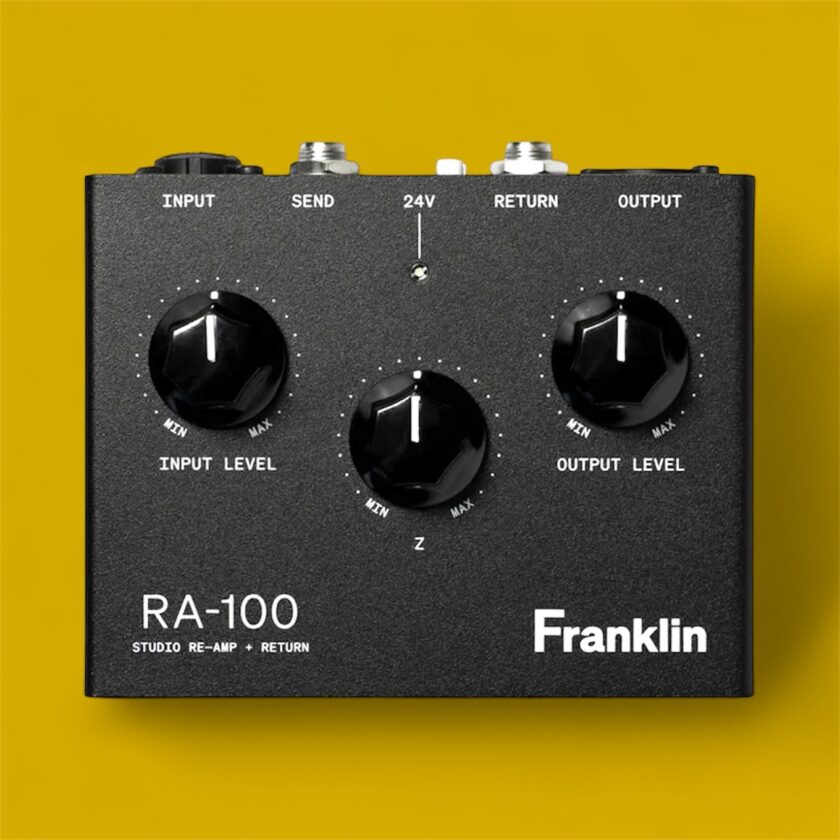
Purchase the RA-100 aquí and use code ALTWIRE to get 5% off the Franklin Audio RA-100!
Noise and level mismatches can derail a session before it starts. Hand-built in Sydney, the Franklin Audio RA-100 addresses this issue by providing engineers with a clean, isolated connection between studio hardware and instrument-level gear. It’s a small box that quietly handles one of the most common challenges in hybrid studios.
Design
The RA-100 uses two complementary paths: a passive, transformer-balanced reamp send that attenuates line-level signals down to instrument level, and an active, transformer-balanced return that provides up to 26 dB of clean gain. This design allows line-level and instrument-level devices to interface correctly, with impedance values matched for both circuits (10 kΩ reamp input, 1 MΩ return input) to minimize hum and ground noise.
The reamp section converts a balanced +4 dBu output from an interface into an instrument-level signal, allowing pedals and amplifiers to react as they would to a direct guitar or bass input. The return stage then boosts the processed signal back to line level for recording or further routing.
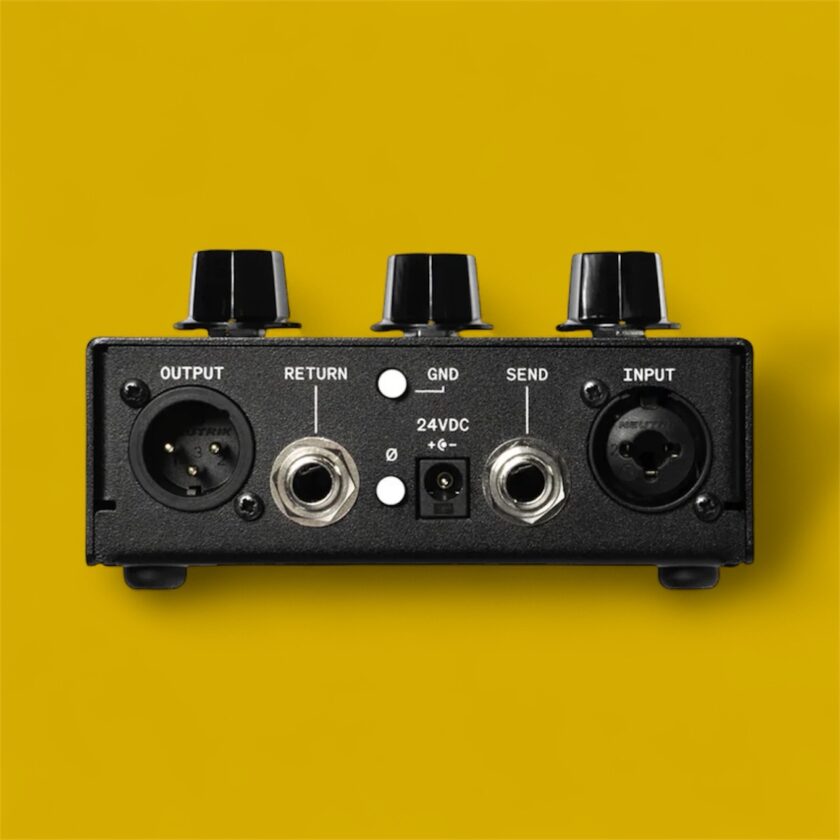
Franklin lists up to 26 dB of gain, an 85 dB signal-to-noise ratio, a 20 Hz – 30 kHz frequency range (± 0.3 dB), and THD ≤ 0.0014 %. Ground-lift and polarity switches correct phase and hum. Transformer isolation maintains electrical separation in complex studio setups, ensuring quiet signals even when multiple power domains are involved.
In our tests, the setup was straightforward. The passive send carried interface outputs directly to pedals, and the return brought them back at the right level on the first attempt. The RA-100 seamlessly integrates into our workflow, requiring no additional calibration or gain adjustments.
Build
The enclosure is made from 1.5 mm folded steel and feels solid for its size.
The RA-100 receives power from a 24 V DC centre-negative adapter, which Franklin specifies for full headroom and the lowest possible noise. In our sessions, the RA-100 stayed quiet, even with older analog pedals known to hum. The higher voltage supply provided generous headroom, allowing it to handle strong signal peaks without distortion.
Each part of the build shows care. Connectors lock firmly, switches feel precise, and labels remain visible in dim light. Prioritizing simplicity over excessive flash, RA-100’s design is perfect for day-to-day studio work.
Workflow
In a hybrid studio, the RA-100 acts as a bridge between digital and analog systems. The passive send routes DAW outputs to pedals or amplifiers. The active return captures the processed signal at the balanced line level for re-recording or mixing.
Once patched in, it quickly changed how we worked. Sending tracks to pedals in real time encouraged fast, hands-on tone shaping and removed the friction of constant re-recording. The process became an integral part of the creative flow rather than a technical chore.
The adjustable return gain also turns the RA-100 into a direct instrument input. We recorded guitars, basses, and mono synths through our interface’s line inputs without needing a separate DI box. Combining both paths in a single unit shortened the signal chain and simplified routing.
Applications
The RA-100 fits naturally into a variety of studio roles. It works well for reamping clean tracks through pedals or amplifiers, allowing producers to revisit performances and shape tone after recording. It also integrates hardware instruments such as drum machines and synthesizers into analog effects chains, maintaining proper levels on both sides of the connection.
In mix sessions, the unit handles parallel routing with ease. Engineers can send a copy of a signal through external processors and blend it back into the mix without worrying about level shifts or added noise.
Its transformer isolation is beneficial when computers, interfaces, and rack gear share different ground paths, stopping hum at the source and maintaining stable levels from one pass to the next.
When we compared it with other reamps and DI setups, the RA-100 needed less gain adjustment and produced lower noise. It behaved predictably with every instrument and interface we tried, making it easy to trust during live patching.
The layout is clear and purposeful. Every control serves a function, and nothing feels redundant. After several weeks in our rack, the RA-100 proved consistent and dependable. It simply works every time we reach for it.
Apoyo
Franklin Audio offers documentation and technical support via hello[at]franklinaud.io, with manuals and specifications accessible on its website.
There were a few moments during the review period when I had some questions regarding its operation. Despite the significant time zone difference (US vs Australia), the Franklin Audio team was always swift to respond and incredibly helpful. From questions about a quirky synth with both a “Master” and “Synth” Volume to inquiries on proper connections, the team was thorough, helpful, and patient.
Verdict
The Franklin Audio RA-100 is a compact, transformer-balanced reamp and return interface for studios that blend hardware and software instruments. It handles both reamping and instrument-to-line conversion cleanly, with low noise and ample headroom.
In our experience, it worked exactly as described: quick to set up, quiet in operation, and transparent enough to be virtually invisible in the signal path. It’s a small utility that makes sessions smoother simply by being reliable whenever it’s powered on.
It’s remarkable how much this little box has made recording easier for us and we are grateful to the Franklin Audio crew for letting us try it out.
