
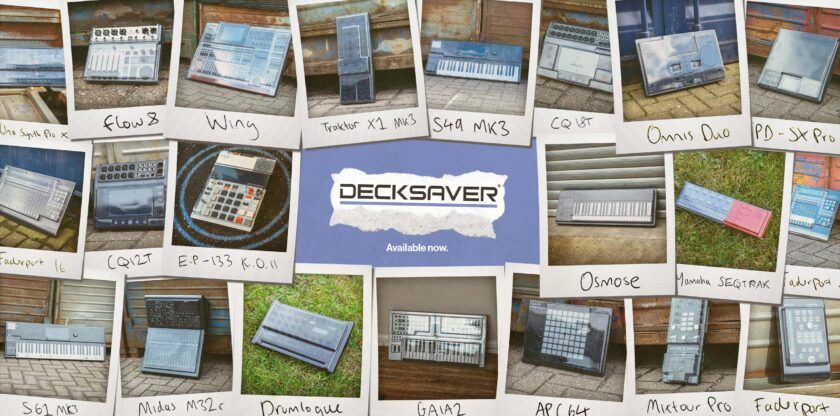
Get 10% off with the Decksaver discount code ALTWIRE by going aquí.
“****, I Broke Something On My Synth, Now What?”
…words you hope you never have to say!
For any person who has ever lost a knob because of being a klutz, watched a synth gather dust between sessions, or wiped off cat hair from their Reface DX, you already know the case for gear protection. However, not all covers are equal. Some fit poorly, some are nothing more than bags, and others feel like they’ll crack on impact. However, Decksaver covers meet the need for form-fitting covers and sturdy protection.
Founded in the UK, Decksaver has spent over a decade producing rigid polycarbonate covers tailored to the dimensions of hundreds of synths, mixers, drum machines, and DJ setups. They are transparent shields that feel impact-resistant, designed to save but not hide your beautiful gear.
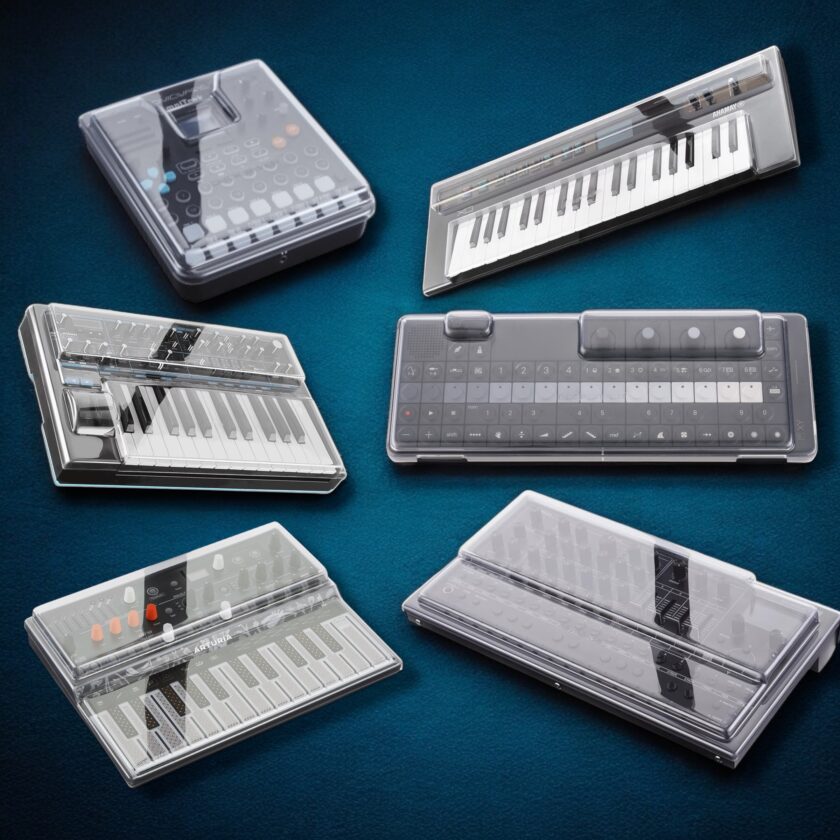
I tested ten of them: covers for the Teenage Engineering KO II/EP-1320, Teenage Engineering OP-XY, Sonicware Smpltrek, Novation Circuit Tracks, Yamaha SEQTRAK, Yamaha Reface DX, Novation Bass Station II, Roland SH-4d, Maschine MK3, and Arturia Microfreak. And while each piece of gear differs in size, function, and design, the Decksavers all share the same DNA: precise fit, tough material, and an almost invisible profile.
This feature isn’t about the individual covers in isolation. Instead, it’s about the bigger picture: what sets them apart, and whether the cost makes sense once you’ve used one (or seven).
Decksaver Design & Build Quality
Every Decksaver cover uses injection-molded polycarbonate, the same material used in safety goggles and riot shields. When held in your hands prior to application, they feel lightweight, but dense. Rigid, but not brittle. The result is a plastic shell that holds up against scratches, light impacts, and the knocks that would damage knobs or buttons on exposed gear.
Across all ten covers, the uniform build quality stood out. They felt solid; the edges were smooth and rounded, and their surfaces had a subtle smoked tint that Decksaver claims is proprietary to their covers. The tint toned down reflections but remained transparent enough to show off the interfaces underneath. In our studio full of synths of different shapes, colors, and sizes, the Decksavers helped to give everything a bit of uniformity.
Fit & Compatibility
This is where Decksaver sets itself apart: precision.
Each cover is vacuum formed and molded for the device it protects. This means no generic keyboard sleeves or one-size-fits-most nonsense. For the Microfreak, the cover followed the overall shape and contours of the synth rather than hugging each individual control. There was enough clearance above the encoders and knobs to prevent any contact, ensuring the lid absorbs the impact, not the gear itself. For the SmplTrek, the shape followed the sampler’s layout, considering its screen and other fragile items. It fitted without effort. With their precision molding, putting on each Decksaver is a case of “set it and forget it”.
Protection & Real-World Use
The most significant hazard faced by synths within studios stems from many sources. There’s dust, items falling from above, the occasional drink, curious pets and more. Decksaver feels made to cover all that. The rigid polycarbonate formed a literal barrier, and has kept my synths looking clean and free from dust.
Because I didn’t have duplicates of each one on hand, I didn’t try to break the covers (although here’s someone legitimately running them over with a giant construction vehicle, with zero damage). Still, their rigidity feels firmer than some official covers released by manufacturers. For example, I have an official plastic cover for my RodeCaster Pro 1 that is not a Decksaver. Stacked up against these bad boys, it feels much thinner and potentially less durable in comparison, enough so that I’ll soon be replacing it with one from Decksaver.
Travel wise, these should stay put if the devices are lying flat. If I were traveling and putting these in a bag, I would consider using a band to secure them around the device, to keep them in place when applied to costly, delicate equipment like the OPXY.
Weeks prior to getting these, I had a knob on my SeqTrak pop off while moving around inside a bookbag. While the knob snapped back on just fine, these kinds of accidents always worry me, making cases like these invaluable.
Studio vs. Travel Use
Decksaver covers pull double duty in both stationary and mobile setups.
In the studio, they offer passive but essential protection. Dust buildup can be a bitch to clean off for sliders, rotary encoders, and membrane buttons. These covers eliminate that problem. They’re also low-profile enough that you can stack gear, or leave it on a synth on a crowded desktop without worrying about something getting nudged out of alignment.
The rigidity doesn’t add much bulk or weight, which means when packing up your DJ controller, the cover doesn’t change your packing routine, just your peace of mind. For gigging musicians, this can be huge. However, do note that it will only cover the surface area of the instrument. Still, they’re precious in helping seal your gear with a shield that only weighs a few ounces.
Value & Pricing
Decksavers aren’t inferior quality, and their pricing reflects that, but they’re not overpriced either. The cost scales with the gear they protect. Most covers fall between $50 and $100, with larger units, like mixers or all-in-one DJ setups, pushing toward $150. For example, the cover for a Behringer X32, a full 40-channel mixer, retails for around $200. That’s a fraction of the mixer’s $1,500+ price tag, to give yourself peace of mind.
The same logic holds across the board. A $60 cover for a $300–$500 synth makes more sense when you consider the cost of repairs, or the resale hit from cosmetic damage. Even when nothing breaks, keeping your gear clean and untouched can preserve its value long-term.
Redditors sometimes argue over whether they approve of the price, but from our experience, they’re priced reasonably for what they offer: form-fitted, rigid protection that helps extend your gear’s lifespan.
Who Should Consider It?
Decksaver covers make the most sense for:
- Needing to transport your gear around town
- Working in a shared studio space or at home with kids/pets
- Protecting expensive synths, controllers, or mixers
- Avoiding dust buildup and lessening time spent cleaning knobs and screens
They’re also a good fit for producers who keep gear set up 24/7 but want a fast way to seal it off after a session.
If your setup includes anything over $300, and you plan to keep it, it’s a smart investment. If you often use, move, or leave your gear unattended in busy environments, you can rely on Decksavers.
Limitations
There are very few downsides. The only limitation is available covers for certain equipment. Decksaver adds large numbers of new covers in batches, and while Decksaver supports hundreds of models, the occasional niche or brand-new gear sometimes won’t have a cover available on the site. You can request new models through their contact form, but production depends on demand.
Decksavers feel designed for studio environments, and even though you could still put them on a synth while transporting it, we recommend using a flight case or more insulating options if you’re going to travel a lot, because the cover protects the top and controls, not the entire chassis.
Reflexiones finales
If you care about your gear, and especially if you rely on it to perform, record, or make a living, Decksaver covers are one of the simplest ways to keep it safe, clean, and ready to go. Having these in my studio makes me thankful after testing several Decksaver units across a varied mix of gear.
Within their category, Decksavers are about as purpose-built as it gets. If you own supported gear, it’s a simple decision: get these.
Decksaver Discount Code: Get 10% off with the Decksaver discount code ALTWIRE by going aquí.
Check out more hardware reviews aquí.
