
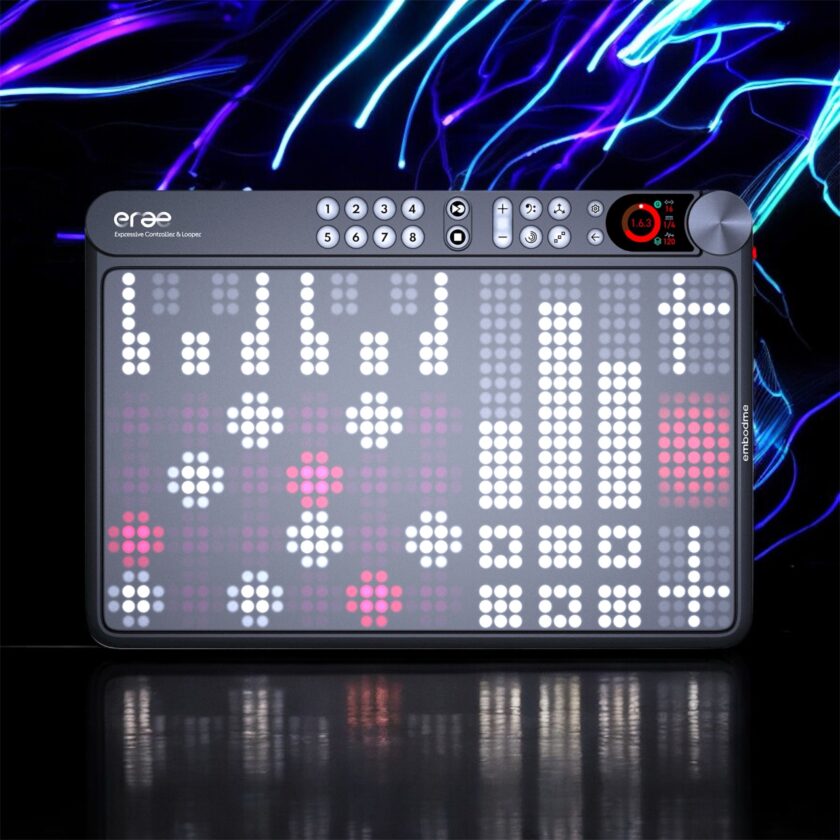
I first saw the Embodme Erae series during the surprise livestream of Linkin Park’s From Zero secret concert. As a longtime fan of the band, I tuned in to the live stream, both nervous and excited about what they were about to unveil.
Amongst the surprise new faces and the premiere of their (then) new song, The Emptiness Machine, the band’s updated stage setup featured two luminous control surfaces beside the synth racks, triggering live samples on the fly and animating with every touch. Close-up shots showed DJ Joseph Hahn and Mike Shinoda hammering and gliding their fingertips across them, reshaping sound in real time. I remember thinking, “Huh, those are neat. What is that?”
Weeks later, whilst looking at the Instagram pages Joe had followed, I got my answer: it was the Erae Touch by the French company Embodme. I reached out to introduce myself, and after a nice chat with Edgar and his team, their latest model, the Erae 2 (which Linkin Park has also since upgraded to), began its journey across the pond and to our doorstep.
When it arrived at our studio, I understood within minutes exactly why a band as big as Linkin Park trusted it in their live setup. There’s nothing else quite like this out there.
Erae 2: Origins & Development
Embodme, a Paris-based company, focuses on creating hardware that interprets human motion as musical control. Its first product, the Erae Touch (released 2020), introduced a pressure-sensitive surface with visual feedback.
While the original was certainly decent, user feedback from touring musicians pushed Embodme to refine the idea for professional use. The result was Erae 2, a complete redesign with lower latency, sturdier hardware, and broader software compatibility. And it was that version that Linkin Park has put to the test across dozens of dates since their return in 2024.
Design & Construction
The Erae 2’s housing is machined from solid aluminum, giving it both stability and a premium feel. Measuring 402 × 277 × 20 mm and weighing roughly 2.5 kilograms, it remains compact yet substantial enough to stay in place during performance.
A 42 × 24 RGB LED matrix provides visual feedback with 1,008 individually addressable LEDs. Beneath that layer lies a force-sensing resistor matrix comprising over 16,000 pressure points, scanning at 2,000 Hz with a latency of less than 1 ms. Each contact point simultaneously detects pressure, position, and motion.
Embodme ships the Erae 2 with a fabric skin and sells additional silicone skins. In our unit, when attempting to lift the installed fabric skin to put on the drum skin, the adhesive was exposed, so we treated it as a permanent fit and installed the optional drum skin on top. That is likely the intended method, and I advise anyone reading this to learn from our failure. Thankfully, the brief lifting did not damage the unit at all, and after a bit of tucking, everything was as good as new.
After this initial mishap, we laid the optional drum-skin overlay across the top. We found that it worked fantastically, without compromising sensitivity, while offering an extra layer of protection.
Sensor Technology & Feel
Unlike capacitive touchscreens, the Erae 2 uses a resistive FSR matrix that measures absolute pressure and XY location. Each point records continuous data, allowing for polyphonic aftertouch and expressive slides. Because the sensing layer reads pressure directly, it responds through overlays such as the drum skin.
Gentle pressure modulates parameters smoothly, while firm presses trigger notes or filter sweeps with accuracy. The 2 kHz scan rate ensures rapid response, and the illuminated grid provides immediate spatial context for every gesture.
Connectivity & Power
The rear panel balances modular, MIDI, and USB workflows. It offers 12 mini-TRS jacks, each carrying dual control-voltage signals, for a total of 24 outputs.
Additional connections include:
- TRS MIDI In and dual MIDI Outs via included adapters
- Three USB-C ports for power, host, and device roles
- MicroSD slot for layout and project storage
Full LED brightness requires the supplied 65W power adapter; bus power automatically reduces brightness to keep the current within limits.
Workflow & Gesture Control
The core workflow centers on the Gesture Looper, which records motion data, including pressure, direction, velocity, and duration, rather than discrete notes. Each loop can store up to 256 steps of gesture data, including modulation movements and automation. (Introduced in Firmware 1.1.2.)
Layouts define the instrument’s behavior, including keys, pads, sliders, and custom control zones. Each project can include up to eight layouts, switchable during playback.
Layouts are where the Erae 2 shines the most. Because of the adjustable layouts, you can program multiple virtual instruments or samples onto the playing surface. You can use this to trigger samples of pre-recorded songs during a live performance, or, if you’re using the Erae for studio recording, to control multiple drum, keyboard, string, and effect VSTs simultaneously.
Say you want to build an Acid Techno track. You could control a TR-909 or 606 drum machine emulator in one part, an acid bass plugin in another, and use other parts of the surface to control modulation. It truly is terrific.
Layouts are created and managed in Erae Lab, Embodme’s companion editor. Power users can further customize configurations through the developer resources and tools available via Embodme’s support site.
Firmware & Software Ecosystem
Embodme continues to update the Erae 2 through Erae Lab.
- Firmware 1.09 added velocity and pressure-sensitivity curves, Ableton controller enhancements, and CV arpeggiator options.
- Firmware 1.1.2 expanded loop capacity to 256 steps and introduced quick doubling and halving shortcuts.
Updates install quickly via USB, and user projects remain available afterward. Erae Lab also includes templates for Ableton Live, Logic Pro, and hardware synthesizers supporting MIDI Polyphonic Expression (MPE).
Embodme maintains open documentation and tutorial videos explaining calibration, layout design, and CV integration, making the learning process straightforward.
Performance & Integration
With MPE enabled, the Erae 2 sends independent pitch, timbre, and pressure data per note. In Ableton Live 12, assigning the Y-axis to filter movement and the Z-axis to aftertouch allows fine control over tone and expression.
Through TRS outputs, the controller drives analog oscillators or filters directly, offering a −5 V to +8 V control-voltage range suitable for most Eurorack gear.
In testing with Arturia Pigments 5, the plugin recognized MPE output instantly. Pigments, in particular, showcased how smoothly the Erae 2 translated subtle finger movements into modulation.
The arpeggiator features pressure-sensitive options that introduce rhythmic variation. Combined with the Gesture Looper, this keeps performances spontaneous rather than pre-sequenced.
USB-MIDI works reliably over both host and device ports, and major DAWs recognize the Erae 2 without special setup.
Artists & Real-World Use
In addition to Linkin Park, the Erae series is already popping up in several professional settings. Jean-Michel Jarre has used Embodme’s controllers for live spatial and expressive control, as featured on Embodme’s website.
Additionally, given its ability to control multiple VSTs and trigger samples, artists could use it for both Hip-Hop and electronica.
Sensitivity
We will say that sensitivity can take time to master. The lightest of touches will trigger the playing surface, occasionally leading to unintended triggers. However, it’s still better than other surfaces. Once accustomed, the precision enables truly adaptive performance.
Full LED brightness still requires an external power supply, and we found that in some brighter rooms, the LEDs weren’t as crisp. However, in a dimly lit room, it’s both colorful and visually appealing, with touch-activated animations constantly moving across the surface.
Otherwise, performance remains consistent. Tracking stayed accurate over extended sessions, and it feels ready for both studio and touring use.
Future Outlook
Embodme continues to refine the platform through software updates. The company’s public roadmap focuses on expanding the API and improving cross-platform integration within Erae Lab. This measured approach suggests the hardware will gain new capabilities over time without needing replacement.
Verdict
The Embodme Erae 2, in its current state, is fantastic, and we can see why it’s finding its way into more and more live rigs and studio setups. Its 16,000-sensor fabric surface is a joy to play with, even if we found ourselves preferring the drum skin, which allows for more intense playing. Once you adapt to its sensitivity and performance surface, it’s hard to want to go back to pads.
For artists who want more control over their VSTs without having 5,000 different devices, the Erae 2 offers a brilliant path to get you there.
