
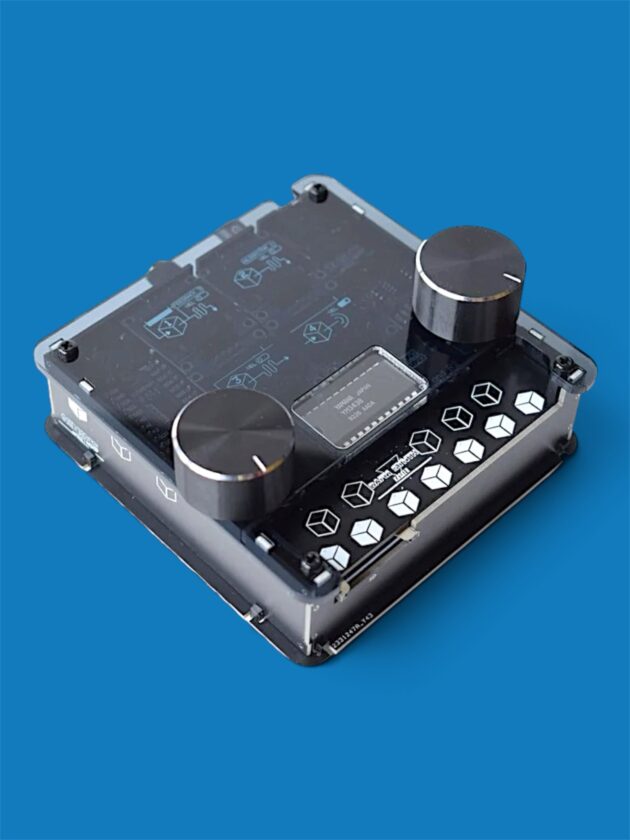
Green Hill Zone has been in my head for most of my life, so hearing that familiar tone coming out of the DAFM Genesis was always going to hit the nostalgia button pretty hard. That was also what caught my attention when I first found Kasser Synths An Tindie. This creator builds small hardware synths around classic game-era sound chips, and after I reached out about a feature, Kasser provided the Genesis review unit used here.
Kasser lets you choose between the original YM2612 and the cleaner YM3438, and mine has the YM3438.
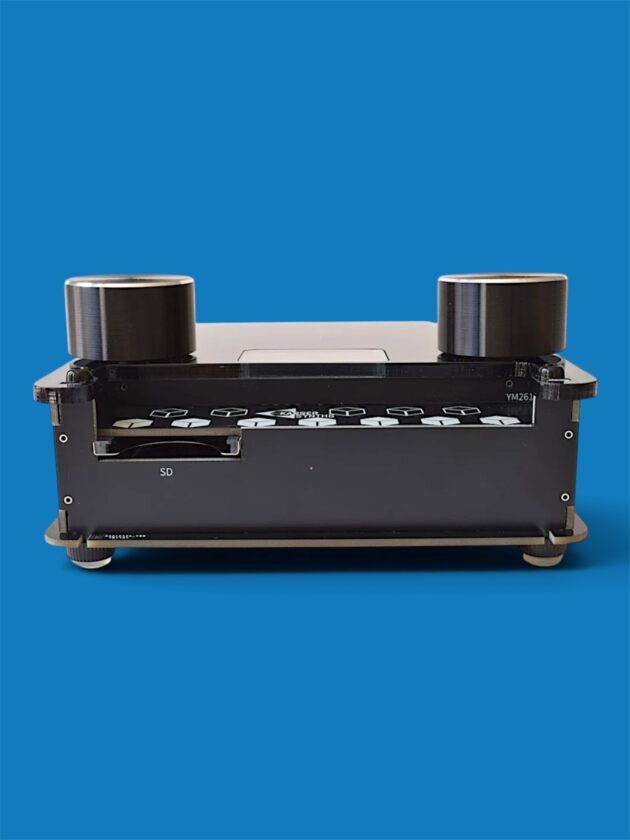
Everything around that chip is deliberately small. The Genesis gives you six four-operator FM channels, eight algorithms, envelopes, LFO control, more than 30 included game presets, SD storage for up to 128 custom presets, MIDI CC control, a 12-note tactile keyboard, two rotary encoders, and four blue OLEDs. Audio leaves through a 3.5mm stereo output, and USB Type-B handles power. Kasser also builds the YM2151-based Arcade and YMF262-based Blaster, but the Sega-family OPN2 hardware is a great place to get familiar with what Kasser Synths is all about.
Hearing the Old Sounds Again
The factory bank is a greatest hits of some of the best gaming soundtracks of the early 90s. Kasser includes patches tied to Sonic the Hedgehog, Sonic the Hedgehog 2, Streets of Rage 2, Thunder Force IV, and other Genesis-era releases, with sounds linked to Green Hill Zone, Chemical Plant Zone, Dreamer, Go Straight, and Metal Squad.
Sending familiar MIDI parts through those patches was a great nostalgia trip, with bass patches carrying the textured sound I remembered and metallic sounds keeping the sharp, glassy edge I associate with the console. If nostalgia were my only interest, the Genesis could have stopped there. After a few months, though, the presets have become more of a starting point as all six channels expose operator frequencies, levels, envelopes, feedback, LFO behavior, amplitude modulation, detuning, and the rest of the accessible OPN2 parameters directly from the hardware.
The default presets give you plenty to start with, but DAFMExplorer is where the rabbit hole gets ridiculous. Bank 1 can hold up to 128 custom DefleMask DMP presets from an SD card, and Kasser’s DAFMExplorer project opens the door much wider with more than 93,000 presets extracted from Genesis-era material; the web app lets you audition sounds, explore similar neighboring patches, hold six selections while building a bank, and export the result as a DMP file for the hardware.
Pulling the Patches Apart
Once I started changing those relationships, feedback could turn a polite tone into rasp, while a small ratio change could move the sound in unexpected directions. Somewhere in that process, FM synthesis stopped feeling nearly as daunting as it usually does to me. I ended up with hollow basses, brittle bells, pinched digital tones, clangs, growls, and sounds that seemed slightly broken in ways I liked.
Editing all of that means living with four small blue OLEDs and two rotary encoders, which sounds cramped but Kasser did a great job with the UI. The displays are bright and crisp, the relevant FM information stays spread across four screens instead of disappearing behind one tiny window, and the twelve tactile note buttons let me make a change, audition it, move through octaves, and keep working without reaching for another controller every few seconds.
Full performance is still better from an external MIDI controller, but I never felt like I needed one to program the synth. The presses and turns change jobs with context, so some muscle memory is involved, but the hardware never became as tiny or carpal tunnel-inducing as it looks in a photo.
DAFM Genesis YM2612 vs YM3438: The Cleaner Chip
If YM2612 versus YM3438 means absolutely nothing to you, the practical difference is pretty simple. My unit uses the YM3438, and although it belongs to the same OPN2 family, it has a slightly cleaner character. The older YM2612 is famous for the low-level ladder-effect distortion created by its DAC, particularly around quiet material and fades, while the YM3438 cleans up much of that behavior. That means I can’t fairly point at every nasty or grainy sound coming out of my DAFM Genesis and credit the famous YM2612 ladder effect. Much of the roughness I was creating while pushing patches came from the FM programming itself, particularly operator ratios, levels, envelopes, and feedback.
There are no onboard effects, so those hard upper frequencies, metallic edges, and nasty bass tones sit there exposed until I decide what reverb, chorus, delay, compression, or other processing comes afterward.
Abschließende Gedanken
Kasser Synths is still supporting the Genesis, with firmware v1.98 current as of August 2026 and the manual, quick guide, firmware download, and DMP browser all available from the same resource page. The assembled synth has a regular price of $289.99, with a $169.99 DIY version also available, which remains an unusually good price for a hardware FM synth built around a real Yamaha OPN2-family chip.
Green Hill Zone and the other familiar patches were a great first experience, but after a few months the DAFM Genesis shows itself as a capable, easy-to-edit FM synth. More than once, something recognizable has disappeared after a few changes, leaving me with a patch I liked better than the one I loaded.
That’s the best compliment and description I can give it: Come for the old sounds, and enjoy discovering what else is hiding inside them.
NOTE: In addition to being available online both through their official site and Tindie, folks in the US can purchase Kasser Synths products through Perfect Circuit, who also have a physical showroom!
Check out more reviews Hier.
