
There is a quiet irony to modern social life. We have never been more connected, and we have never spent so much time sitting next to one another without actually interacting. Phones glow on opposite ends of couches. Conversations fracture mid-sentence as notifications arrive. Even shared entertainment has drifted inward, toward personal screens and individualized feeds, while a TV show plays in the background.
Technology did not set out to do this. But it has done it anyway.
Board exists as a response to that reality. A deliberate attempt to take the power of modern computing and recover what we’ve lost in a post-COVID world.
Our latest feature story isn’t about another game console. Instead, it explores how a particular group of people, coming from fitness hardware, AAA games, computer vision, and indie design, tried to answer a deceptively complex question:
What would technology look like if it were designed first for face-to-face connection?
The People Behind Board
Board does not come from a traditional games company. Its origin is closer to a collision of disciplines than a straight lineage.
At the center is Brynn Putnam, founder and CEO. Her previous company, Mirror, redefined at-home fitness by merging hardware, software, and content into a single reflective surface. When Lululemon acquired Mirror in 2020, Putnam stepped away from a category she had already helped shape.
What came next was not another optimization problem. It was something more personal.
Post-pandemic life sharpened a realization she had already been circling: powerful technology increasingly surrounded families, yet it disconnected them from one another. Traditional board games often failed to span wide age and skill gaps. Video games, for all their sophistication, drew attention to a screen rather than to the people sharing the room.
Putnam did not want to build another screen people disappeared into. She wanted to build something people gathered around.
To do that, she assembled a team with deep experience across sensing hardware, large-scale game development, and interactive system design.
Ryan Measel, Board’s CTO, holds a PhD in Electrical Engineering and previously co-founded a computer vision and localization startup that exited via acquisition. His background sits at the intersection of sensing, machine learning, and embedded systems. If Board was going to understand the physical world in real time, it would be his problem to solve.
On the creative side, Seth Sivak is the Chief Creative Officer. Sivak co-founded a venture-backed game studio that ran for nearly a decade before being acquired by Activision Blizzard in 2022. He later served as VP of Development on World of Warcraft. His experience spans everything from live service design to shipping games at a massive scale.
Supporting that leadership is a bench of designers with credits at Epic Games, EA, Zynga, Disney Interactive, and beyond. Combined, they are a team that has spent years watching players break systems, exploit mechanics, and abandon experiences that fail to respect their time.
A Console That Refuses to Be a Tablet
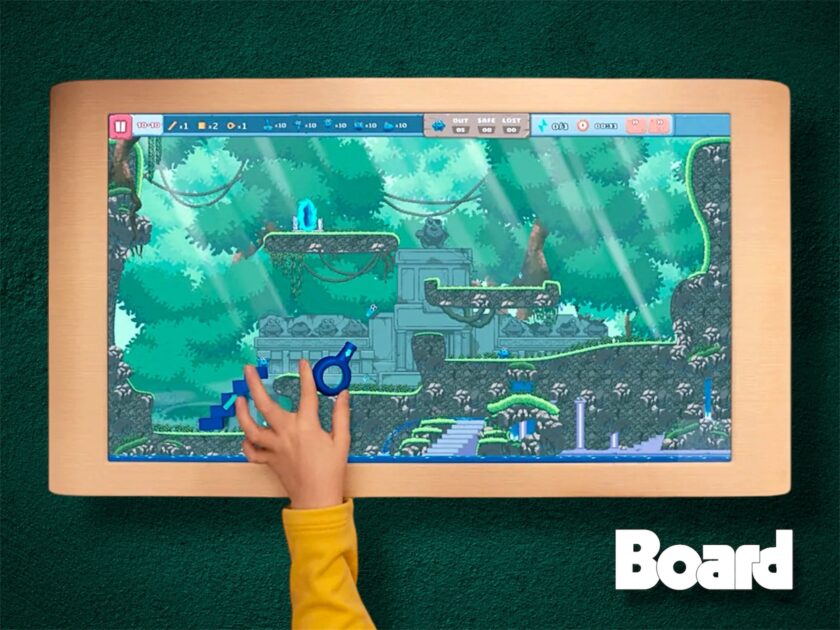
Like the board games of yesteryear that inspired it, Board is a large, horizontal console designed to live on a table. Lying it flat across a kitchen table, it takes up more space than expected. It is also heavier than expected, noticeably so. Heavier than a PlayStation 5. Heavier than an Xbox Series X.
The screen itself is generous, immediately readable from any side of the table. Everyone sees the same thing at the same time.
Plug-and-play, usually a marketing catchphrase, applies literally in this case. Plug it in, and it immediately boots to the logo screen and, within a few seconds, to the player selection screen. There, you can choose an existing profile or add a new one. Note that all usernames are globally unique, so if you pick a first name like “Nicole” for your screen name, someone may already have it. It’s better to use a gamertag than your name, because while early adopters may get lucky, people will claim common names like mine (Derek) quickly.
Otherwise, the Board’s sensors require no calibration and are ready to play immediately. The learning curve is closer to that of a board game than to a console.
Only in the most chaotic moments, particularly in fast cooperative games like Chop Chop, do arms occasionally collide as players reach across the surface at once. But that is table play behaving like table play. Anyone who has scrambled for pieces during a party game will recognize the choreography immediately.
The Technology You Don’t See Working
Under the glass is a custom touch-sensing stack built on top of an off-the-shelf controller. Rather than invent exotic new hardware, the team chose to extract far more capability from what already exists.
They wrote their own touch driver, bypassing the standard operating system limits that cap most devices at ten simultaneous touch points. Board reads the whole sensor array directly. Every contact. Every shape. Every pressure pattern.
On top of that, a real-time machine learning model running locally on the device’s neural processing unit processes touch data. It distinguishes fingers from palms. Hands from forearms. Intentional interaction from accidental contact as someone leans across the board.
The physical game pieces are made of conductive plastic. They contain no batteries, no electronics, no sensors. Each piece has a unique conductive pattern molded into its base. When placed on the surface, that pattern creates a distinct signature in the touch sensor data.
The system knows which piece it is. It even knows when a piece is being actively held versus simply resting on the surface. And what’s truly insane is that it recognizes orientation, too. Whether a piece is pointing to the left, right, north, south, or diagonally, it knows.
The result is a surface that can track dozens of simultaneous inputs without confusion, even when multiple players are reaching, dragging, lifting, and stacking objects at once.

Games Built for a Surface, Not a Screen
Board launches with twelve games, all included. Four of the games fall into a retro arcade category. Short sessions. Immediate feedback. Competitive or cooperative bursts that work well in party settings.
Others slow the pace, leaning into strategy, puzzles, or narrative problem-solving. Some can find a single round completed in under five minutes. Others stretch toward decently longer.
Chop Chop
At first glance, Chop Chop evokes comparisons to Overcooked.
One player manages orders at an expo station, watching timers and tips. Others grab physical tools. A knife piece chops ingredients on cutting boards. A spoon stirs ingredients at the stove. A salt shaker finishes dishes. A sponge cleans dirty plates, chopping boards, or stoves (a must if you want that cleaning bonus and don’t want to be penalized!)
There is a small helper character that can assist with basic tasks, preventing food from burning, but crucially, cannot clean. Players remain essential.
The game spans 35 levels across five restaurants, each introducing new layouts, appliances, or dishes. It scales remarkably well across ages. Younger players can meaningfully participate with simple roles. Older players optimize timing and coordination.
It’s chaos, but fun.
Strata
Strata is a turn-based territory control game built around polyomino blocks. Each turn, players place three pieces. Tiles on the board require different stack heights to claim. Build upward. Bridge gaps. Steal territory by spanning black squares.
It supports two to six players, depending on mode, and it is difficult to imagine this game working anywhere else. The physical stacking, the orientation of pieces, and the shared visibility of vertical structures all rely on the board’s spatial awareness.
Save the Bloogs
For many, this will be the game that grabs the most “whoa” reactions to the tech at first glance.
Inspired loosely by Lemmings, Save the Bloogs tasks players with guiding small creatures across hazardous environments. Physical pieces become stairs, walls, cannons, and tools. Combine blocks to create bungees. Stack too high, and the Bloogs struggle to climb.
Watching digital characters hop onto physical objects, react to their height and placement, and fail or succeed based on how you arranged real pieces on a table feels uncanny in the best way. I told my fiancée that it reminded me of all those science-fiction depictions of holographic game tables and simulated strategy surfaces, that seemed a far way off, if ever at all. But this one was real, and it was sitting in our kitchen.
With 100 levels and both cooperative and competitive modes, Save the Bloogs is the clearest articulation of Board’s promise.
Beyond the Flagships
Other launch titles include Omakase, a hex-based strategy game built around tactile drafting with chopstick pieces; Thrasos, a 1v1 worker-placement game about currying favor with gods; Spycraft, a narrative escape-room experience built around a reconfigurable spy kit; and Mushka, a virtual pet game that leans into gentle interaction and memory-based play.

What It Feels Like to Play
There is a temptation, when writing about a product like this, to lean into spectacle. The better story here is the quieter moments it brings.
Playing Board changes where eyes go. Instead of staring forward at a television, playing couch co-op games, players look down, then up, then at each other. Reactions shift to shared glances.
Even in competitive moments, there is a softness to the interaction. Smiles. Groans. Laughter. You see who made the mistake. You know who saved the round.
With my fiancée, moments of competition turned into moments of connection. Not the passive togetherness of watching something side by side, but the active engagement of doing something together. The kind of engagement that traditional board games or a sweet dinner offer, and cellphones have helped society lose.
For people who find traditional board games too slow or procedural, Board offers a more stimulating approach. And yet, for those who love slower, more thoughtful play, the platform accommodates that too.
A Platform, Not a Box
Fortunately, the creators of Board have not placed it behind a closed ecosystem, and plans already exist for its future. An SDK is available, and the same tools used internally are accessible to external developers.
A store will follow. Expansions will arrive. Additional games are already in development.
Long-term, the team envisions user-generated content tools built directly into the device—a community of user-made games that showcase talented small studios or individual developers.
Nintendo once changed gaming by inviting families into the living room together. Board is attempting something similar for a different era, one where we are more disconnected than ever before. Even in its beginning launch stages, this is a massive leap forward in gaming technology, and we cannot wait to see where it goes in the years ahead.
