
The Birth of The Sway
If you live in Australia, your first introduction to The Sway or Audima Labs may have been on Shark Tank Australia, where many startups get their first spotlight. However, the story of The Sway began over a year before that appearance.
Founded in March 2023, Audima set out to create a controller that turned motions into music while removing the barriers and technicalities of products like Thermins, motion gloves, and wearable tech. When they appeared on Shark Tank, Audima Labs was pre-revenue, operating on about $70,000 in self-funded R&D for sensors and patents. They spent over a year testing prototypes and functionality before landing on the MVP.
Filmed in July 2024 but aired in November of that same year, Audima’s two co-founders, Jeremy Buckley and Isaac Jack, entered the Shark Tank studios seeking $50,000 in exchange for 5% equity in Audima Labs.
They hoped their pitch for a MIDI controller you play by moving your hands above it with different gestures, with no keys or faders, would spark a few offers. A couple of the Sharks passed. Nick didn’t. He proposed $50,000 for a 15% equity stake. Buckley and Jack accepted. That Shark Tank appearance put the name out there. Afterward, the Audima team devoted the next few months to making their dream a reality. Next came crowdfunding.
969% and 256 Believers
In October 2024, Audima Labs launched The Sway on Indiegogo with a funding goal of $22,800. People piled in early, and they cleared it almost immediately. When the campaign closed on November 28, 256 backers had pledged $220,958, surpassing the target by over 900%.
The average pledge was about $863. As production got underway, Audima kept backers in the loop, delivering the first batch in June 2025. Orders for Batch 2 started a month later and were delivered in December 2025. Both batches have now shipped, with Batch 2 priced at $830 USD.
As of early 2026, they’re preparing pre-orders for Batch 3 to start on February 24th, with delivery targeted for June/July 2026.
Since launch, they’ve stayed largely direct-to-consumer, with only limited third-party availability. When we checked, it wasn’t on the shelves of big retailers. For most buyers, it is available at audima.com.au.
So What Is This Thing, Exactly?
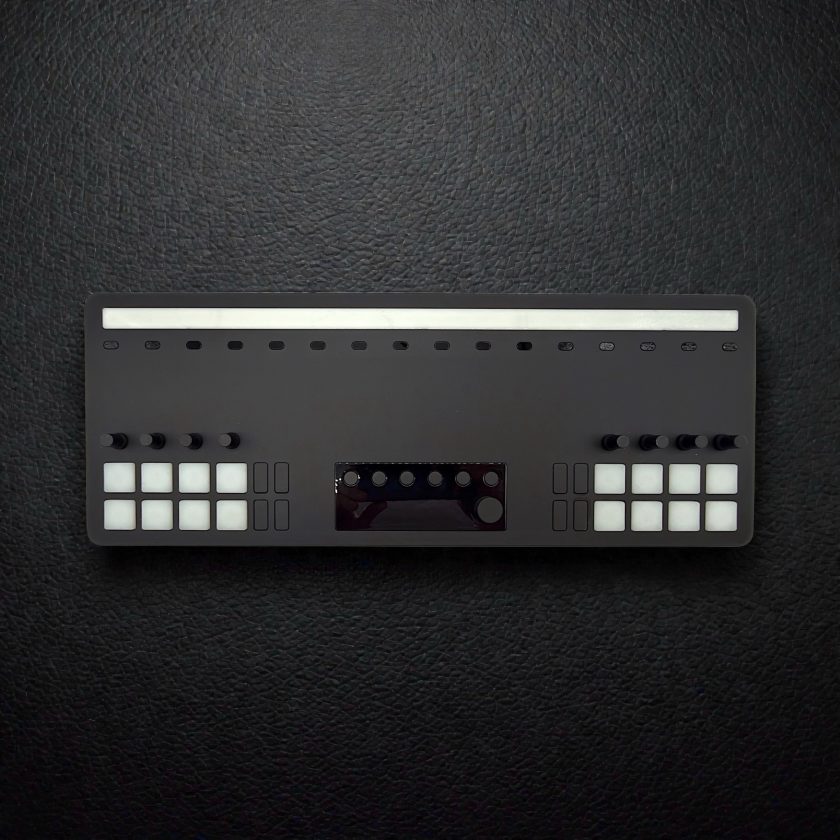
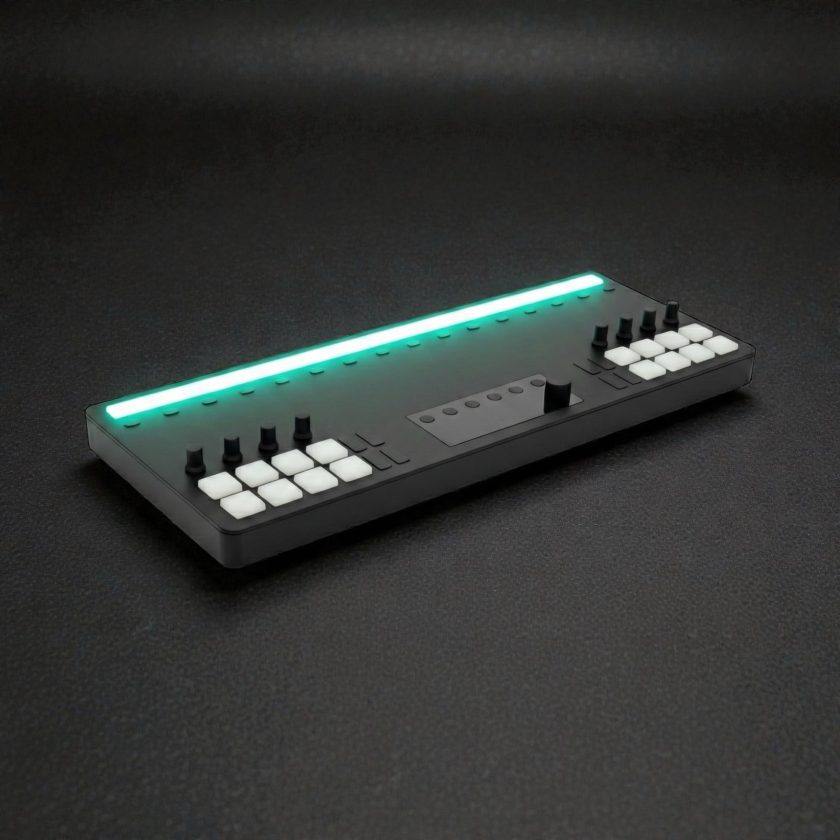
The Sway is a desktop MIDI controller built around 16 distance sensors. Audima calls them light sensors but does not get granular about the underlying tech. Move your hand left and right, up and down, strike downward, pulse upward, glide across the surface, or bring both hands in together for different movements.
The unit includes 8 rotary encoders, a 3.2-inch OLED, a bank of performance pads and buttons, and a grid of RGB LEDs that react to motion, plus USB-C and hardware MIDI connectivity. The companion software runs on macOS and Windows, with MIDI remote scripts for Ableton Live and Cubase.
Hands On: What It Is Like to Actually Play
The Sway arrives with a zippered case and a microfiber cloth to keep the interface and sensor strip clean. After the initial tutorials, it was simple to connect The Sway to my computer, have it recognized by the companion software, and connect to Ableton with the provided script.
Playing the Sway and shaping sound in the air is fun, though it can be a surprise workout for your wrists. Mastering the specific motions it detects takes time. It took a while to get comfortable with how the sensors read my movements, find the sweet spots, and understand which gestures produce what data.
The Sway has six expression modes, which are different ways the sensors read movement and turn it into control. Strike treats the speed of your downward motion like velocity, so striking downward into the air comes through as harder accents. Sway tracks left-to-right movement, making it good for smooth parameter sweeps and transitions that don’t feel like a switch flip. Pulse (Y mode) is an up-and-down motion, less about playing notes and more about adding rhythmic modulation to whatever you’ve mapped it to.
Glide is the continuous mode, built for moving across the surface without stepping or sudden jumps. Press focuses on how you move in and out, pushing closer for intensity and backing off to ease it up. Sculpt is the two-hand mode, letting you use both hands to shape multiple parameters at once.
A good tip is to follow Audima Labs on YouTube. It’s not easy to figure out how to trigger these different expression modes at first and their video guides help. While there are setup guides for connecting to your DAW and some basic software and function walkthroughs on their website, the most in-depth tutorials are on their YouTube channel, with a few uploaded within the last month. We cannot recommend following these enough as it will make the beginner experience much more rewarding.
Once you settle in, the core interaction starts to click. The X axis is impressively responsive and sensitive; subtle horizontal movements register even at the slightest jitter of your hand. Testing the opposite direction, I found the Y axis detects movement up to about a foot above the surface, though ambient lighting conditions may influence this range.
Two experiments during testing stood out to me as particularly fun and genuinely useful. The first was using Strike mode to hammer out drum patterns, one hit at a time, building loops layer by layer.
The second was in a DJ context: I mapped the X axis to the CC value of a knob in EDMProd’s Superknobs and had a blast sweeping effects and transitions on and off with hand movements. There is plenty of fun once you figure out which gestures work best.
The Bottom Line
At $830, this is premium pricing. For the price, it offers gesture control, a full set of buttons, pads, encoders, an OLED display, a built-in Theory Engine, and hardware MIDI connectivity, all in one integrated unit. This is more of a performance station. They do not have big-company economics lowering the price. This is small-batch hardware from a small Australian team, shipped worldwide.
If you are looking for something different and have a specific use case in mind, such as live looping, DJ performance, or experimental expression control, The Sway is a fun piece of hardware. It is led by a small team that successfully brought its first product to market without falling into the pitfalls of overpromising in crowdfunding. Having had my hands on it, I see potential for this device to improve and gain wider adoption as more examples exhibit its use.
We plan to update this review within the next month or so, as we’ve learned that a firmware and software update is scheduled for then, which will add some new features. We will update this review with our impressions when it happens.
I am rooting for these guys and look forward to seeing where this grows from here.
Watch a demo of the Sway in action here (our own demos are coming soon):
Check out more reviews here!
