
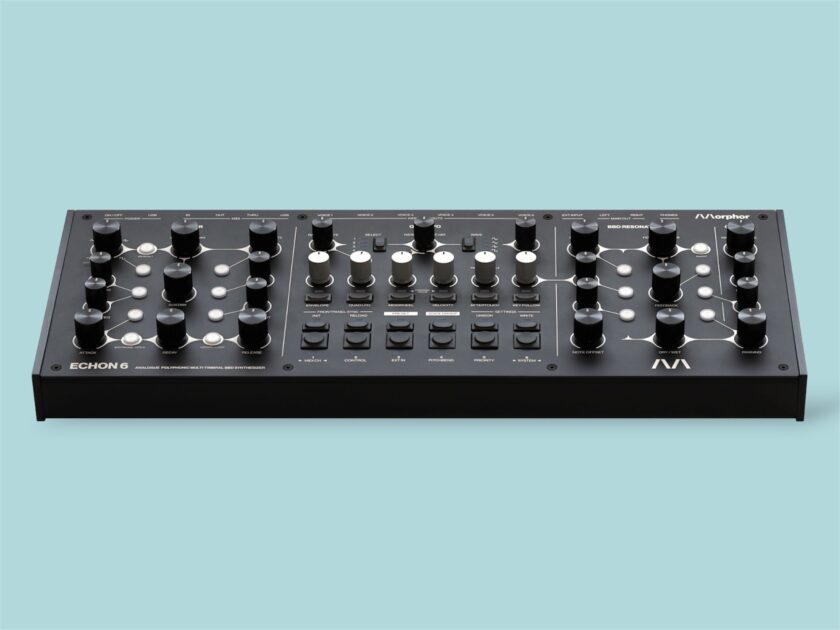
The following opinions are based around our experiences with a loaned review unit from Morphor.
About halfway up the ECHON 6‘s feedback control, one initialized patch started groaning like heavy machinery trying to fold itself inward. The image that kept coming to mind was an old iron ship under stress. Meanwhile, another patch went so far in the opposite direction that its plucked attack could have passed for a recorded acoustic instrument if I had heard it blind. Both sounds came from the same basic idea. Each of the six analog voices us an Exciter to feed a pitch-tracked bucket-brigade resonator. The resonator defines pitch while the VCO can either follow it or pull away.
Playing a Bucket-Brigade Delay: The Core of The ECHON 6
Those two extremes make more sense once you stop thinking of the BBD as an effect tacked onto a synth voice. On the ECHON 6, it’s the thing you are actually playing. Each voice has a 1024-stage resonator with input filtering, feedback filtering, feedback amount, and polarity control. The Exciter can feed it from the internal VCO, noise, or external audio. Meanwhile, the VCO itself moves continuously through sine, triangle, ramp, narrow pulse, and square waveforms. Detuning the oscillator against the resonator was enough to turn a fairly plain starting point into beating intervals and increasingly inharmonic textures before I had even pushed feedback very far.
As feedback came up, the decay grew longer and heavier, and soon the loop contributed so much to the timbre that it could eventually self-oscillate without much help from the Exciter. ECHON 6’s input filter shapes the sound entering the resonator, while the feedback filter works on the signal circulating inside the loop. Each return passes through that second filter, gradually changing the harmonic content available to sustain the resonance. A few degrees of feedback travel could stretch the decay noticeably or push the resonator into a much more dominant tone, especially once polarity and oscillator pitch were already changing the relationship.
That’s how a relatively plain sound could slide into metallic FM-like hollowness, strange percussion, or the heavy groaning from the opening. Moving the same controls in another direction produced a physical pluck that kept putting acoustic guitar in my head. The BBD’s loss, noise, and softened top end stayed audible throughout, and ECHON 6’s Dry/Wet control became a way to decide whether the harder Exciter center or the ringing loop would dominate.
The Ringing Was Coming From Me
Speaking of ringing, I learned very early on how sensitive some of these controls could be. I created one high-pitched ring that kept appearing over presets I had generated. It sounded like someone hitting a triangle over and over. After chasing the patch around for a while, I discovered I had driven the Key Follow source macro far too hard. Once I saw how many destinations one source could affect, the mistake made much more sense.
Each voice gives you nine modulation sources and 32 destinations, with four LFOs, the envelope, mod wheel, velocity, aftertouch, and Key Follow feeding controls across the Exciter, LFO, resonator, and output sections. Assignments happen directly from the panel. Select a source and move a destination control; the distance moved determines modulation depth. LEDs show amount and polarity, so several relationships can accumulate without ever disappearing onto a separate modulation page. In my ringing patch, Key Follow was derived from the resonator’s tuning chain. This chain combined the incoming MIDI note and pitch bend with Note Offset, Fine Tune and Glide. I had routed it to several pitch-related destinations, so one overcooked macro exaggerated all of them together.
I backed it down, and the triangle disappeared. More importantly, the mistake taught me that high feedback, open filters, and several aggressive assignments can go from interesting to piercing faster than any one control suggests. Randomizing everything without understanding those relationships still seems like a wonderful way to create either silence or an emergency volume reduction.
Six Voices Can Go Their Separate Ways
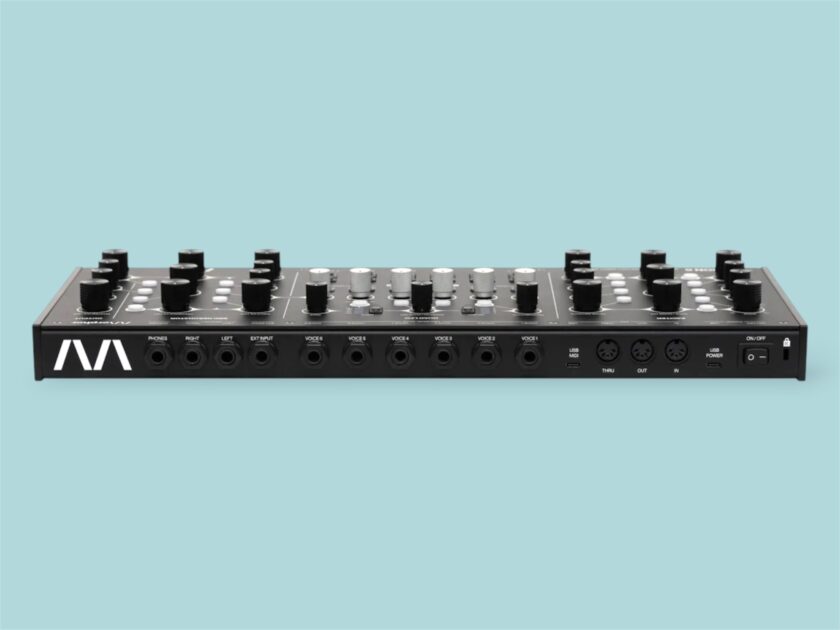
Once I stopped abusing one voice at a time, the six-voice structure opened a completely different side of the instrument. Voice Groups divide the analog voices among separate sounds and MIDI channels, with unison available at both preset and group levels. Individual stereo TRS outputs let those voices leave the main mix one by one. With my old rack processors sitting nearby, I immediately wanted one voice through a compressor, and bury another in an effects chain. A third untouched, with the remaining voices using the main pair.
ECHON 6’s individual outputs can even come back around to the external input for chained resonators and cross-feedback patches.
ECHON 6 Meet…Noise.
I fed a noise synth into the ECHON 6 as Exciter material and used low MIDI notes to give the resonator a bass pitch to work around. God damn.
Some of the nastiest bass I made with the ECHON 6 came from that setup. The noise supplied rough material for the resonator to chew on, while the low MIDI notes gave that resonance it’s bass pitch. Feedback could pile on a crunchy metallic layer without separating the grime from the pitch. It got dense and dirty fast enough that I recorded it before touching anything else.
What made the patch worth keeping was that the ugly upper structure and the low resonant weight still moved as one sound when the note changed. That also made the external input much easier to understand. It enters at the Exciter stage, can be blended with the internal oscillator through the Wave control, and can be enabled or disabled separately for each Voice Group. A drum machine, voice, field recording, or another synth doesn’t simply pass through the ECHON; it changes the material the resonator is asked to turn into a pitched sound.
Should you buy the ECHON 6?
With US pricing reaching $2,999, the ECHON 6 is undeniably expensive hardware. But if you can afford it, I highly recommend it. The combination of BBD resonators, external excitation, per-voice routing, and deep modulation gave me sounds I wasn’t getting from the other synths in the room. It also invited more experimentation than anything else I’ve demo’d in the last 12 months. It’s easy to spend hours feeding external inputs into this alone and seeing what happens.
We still have a few months left in 2026, but of everything I’ve had through here this year, the ECHON 6 is already one of my favorites. It may end up being the best of the bunch.
Check out more hardware reviews here.
