
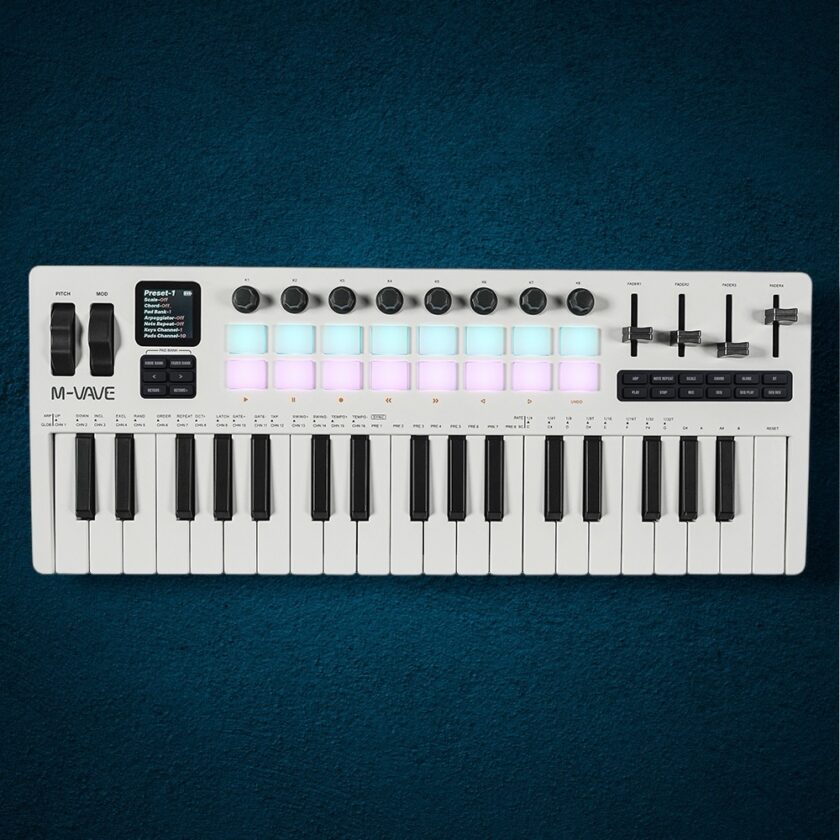
Portable DX color, real sequencing, and hands-on control in a compact 37-key board.
Quick Take
For those looking to replicate classic DX-7 sounds on hardware, but without the complexity of an original DX-7 (or its price), the M-VAVE SMK-37 Pro is one of the easiest and most affordable ways to achieve this. It combines a portable FM engine with a 64-step sequencer, velocity-sensitive pads, and faders, making it useful as a sketchpad and a controller.
Build Quality
The SMK-37 Pro is smaller than some other 37-key keyboards. In fact, it is about half the overall width of an MPC Key 37. Considering its price, it feels more like a $250-300 MIDI controller and doesn’t feel like junk.
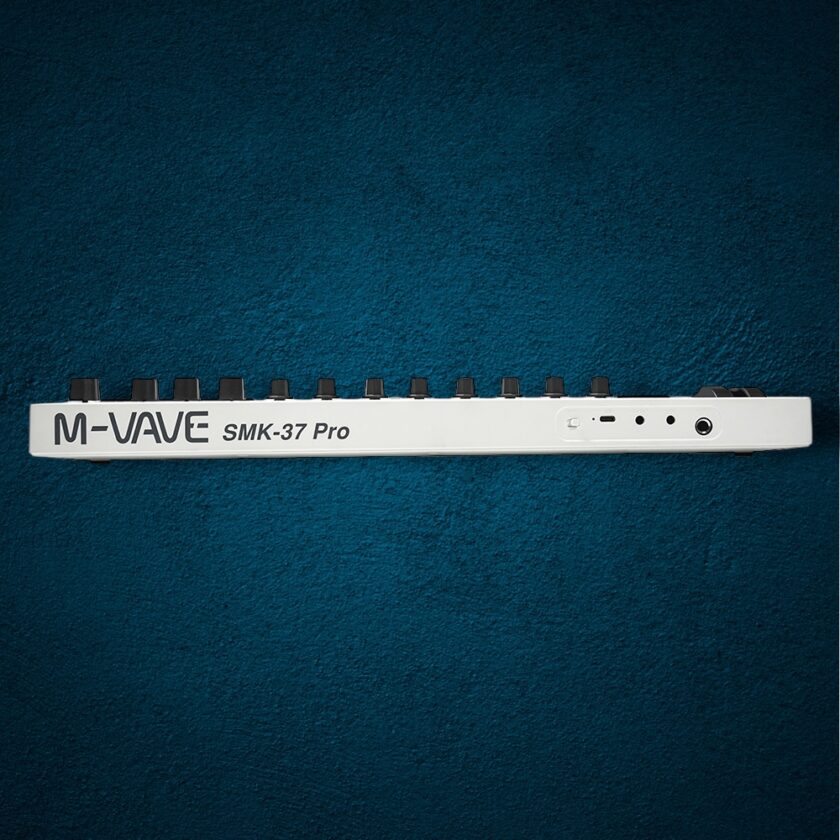
The 37-note mini keybed isn’t in Yamaha Reface territory but is playable. It will feel familiar to those accustomed to controllers in the mentioned price range. It took me a bit to get used to the button combinations and menu shortcuts, but once I learned them, navigation was smooth enough that it didn’t hinder creativity. All I/O ports are on the back, including USB-C, 3.5 mm TRS MIDI Out, 3.5 mm audio output, and sustain/expression input.
Sound Engine
Under the hood, it is a DX-style FM engine with 32 algorithms. The results are what you would expect: bright bells, metallic keys, and the unmistakable FM flavor.
The first patch I hunted down was Bass 1. Those unfamiliar will recognize it as the slap bass immortalized on “Take On Me” and “Never Gonna Give You Up.” The SMK-37 Pro’s 24-bit output makes it sound a little cleaner than a vintage DX-7’s gritty 12-bit DACs, but the vibe is there.
Other famous patches you can find in its library:
- E.PIANO 1 from ROM1A – The quintessential DX‑7 electric piano. Used in the Twin Peaks theme; featured in countless ‘80s pop ballads like Whitney Houston’s and Celine Dion’s tracks.
- CALLIOPE from ROM1A – Used as a flute-like sound in Tina Turner’s What’s Love Got to Do with It
- SYN-ORCH (Strings/Orchestral) from ROM2A – An orchestral-style preset used by Queen on Who Wants to Live Forever
The genuine surprise came when I loaded the SMK-37 Pro’s companion software. It ships with a vast collection of classic DX7 ROMs preloaded. You can only keep four banks on the hardware at a time, but with the app, you can swap between ROM sets. If you remember a ROM from the original, there’s a good chance it is available here.
Workflow and Sequencer
The sequencer is where the SMK-37 Pro feels more like a groovebox. Each sequence can hold up to 64 steps, and you can switch between Key, Live, and Drum modes. In Key mode, the 16 pads act as 16 steps with manual or automatic step entry. Drum mode maps the 16 pads to 16 tracks, each tied to a drum sound, and you can edit each track’s steps. Live mode captures patterns in real time.
That said, there is a catch. If you’re looking to input external MIDI, there is no MIDI In. Thanks to a suggestion on Reddit, I created a workaround by connecting the SMK-37 Pro to a MIDI hub and routing it in Logic as a virtual external instrument to feed MIDI back into the keyboard. Thankfully, this workaround did the trick, and once I did that, I could record authentic-sounding 80s melodies into my DAW, making it a fun sketchpad.
For sound shaping on the device, you can adjust algorithm, feedback, mono/poly, volume, and FX (filter cutoff, distortion, reverb, delay) from the Para and FX pages. Recent firmware updates have improved stability, eliminated pop/click noises, and provided a better experience.
Portability
I did not realize it had a built-in battery until I noticed the icon on the screen. A rechargeable battery at this price point is a strong plus. Many more expensive synths either skip it or rely on AA batteries. The internal battery charges over USB-C, making it practical to use the SMK-37 Pro anywhere, even without a power supply.
Comparisons
Compared to the Yamaha Reface DX, the SMK-37 Pro lacks the Reface’s incredible feel and true FM editing capabilities, but offers DX7 patch imports that the Reface DX lacked. The Reface is better for programming, while the SMK is better for quick ideas.
Compared to the Korg Volca FM 2, the SMK-37 Pro is larger but much more playable. The keyboard, pads, and encoders make it more versatile while still keeping the portability factor.
Плюсы и минусы
Плюсы
- DX-style engine with 32 algorithms
- 64-step sequencer with Key, Drum, and Live modes
- 16 RGB pads with velocity and aftertouch
- 8 encoders and four bankable faders
- USB-C, Bluetooth MIDI, sustain/expression input
- DX-compatible ROM imports through the editor
- Rechargeable battery
- Frequent firmware updates (one July release fixed random popping)
Минусы
- No DIN or MIDI In
Заключительные мысли
The DX7 has always divided opinion. Some find its sound dated, while others value its digital stamp on the 1980s. I am firm in the latter group. I liked the Yamaha Reface DX for its playability, but missed the ability to import DX7 patches. The SMK-37 Pro gives me that, along with sequencing and portability.
While not a DX-7 replacement, it works great as a tribute, putting authentic patches, a usable sequencer, and battery power in a portable unit at a very low cost. For producers who want FM sounds without the weight or complexity of the original DX7, this is a strong buy under $150.
