
Most musicians don’t look to Etsy for synthesizers. The site is better known for boutique pedals, handmade controllers, and other curiosities. Yet tucked between craft projects and circuit art lies a fun little nod to computer music’s past: the MIDISID 4 Morpheus.
Built by Shiela Dixon under her PeacockMedia banner, Morpheus is a dual-SID hardware module that delivers authentic Commodore 64-style sound without the need for an ancient PC. With six voices, General MIDI support, USB host capability, and a sub-$200 price, it provides musicians with instant access to the iconic timbres of the 8-bit era in a compact, hand-assembled package.
The SID Legacy
The MIDISID Morpheus owes its identity to one of the most essential chips in the history of computer music: the Sound Interface Device (SID). Designed in 1982 by Bob Yannes for the Commodore 64, the SID was a hybrid of digital logic and analog synthesis, featuring three oscillators, full ADSR envelopes, a multimode resonant filter, and modulation options such as ring modulation and oscillator sync. It made the C64 sound more like a small synthesizer than a home computer.
That capability inspired composers like Rob Hubbard, Martin Galway, and Chris Hülsbeck, who commonly used arpeggios, pulse-width modulation, and rapid modulation tricks to sidestep the chip’s three-voice limitation. Their inventive soundtracks became the foundation of today’s chiptune music.
Two main SID revisions existed: the earlier MOS 6581, often described as noisier and grittier with variable filters, and the later 8580, known for a cleaner, more stable output. Both are now rare and fragile, pushing builders to seek modern replacements. Hardware clones such as Kung Fu SID aim to faithfully emulate the original architecture, which is why Dixon chose it for the MIDISID Morpheus.
Shiela Dixon and PeacockMedia
Shiela Dixon has run PeacockMedia since 2000, based in England’s East Midlands. Her company began with Mac utilities, link checkers, site crawlers, and other web tools, and later expanded to include creative software and personal projects.
A combination of different passions over the years shaped her journey to this point. An interest in coding, electronics, and vintage computing, and a lifelong passion for music as an amateur musician in various bands (from brass to rock), became ‘instrumental’ in the birth of the MIDISID.
The MIDISID line started as an experiment to modernize the SID experience. The Morpheus revision adds a larger OLED display, a reorganized menu system, a mono/stereo switch, and USB-C support for both firmware updates and hosting class-compliant MIDI controllers.
Each unit is hand-soldered, tested, and shipped by Dixon herself. Buyers receive direct support and quick firmware responses. It is a genuinely personal product, built by an incredibly personable and responsive 8-bit enthusiast.

Hardware and Build
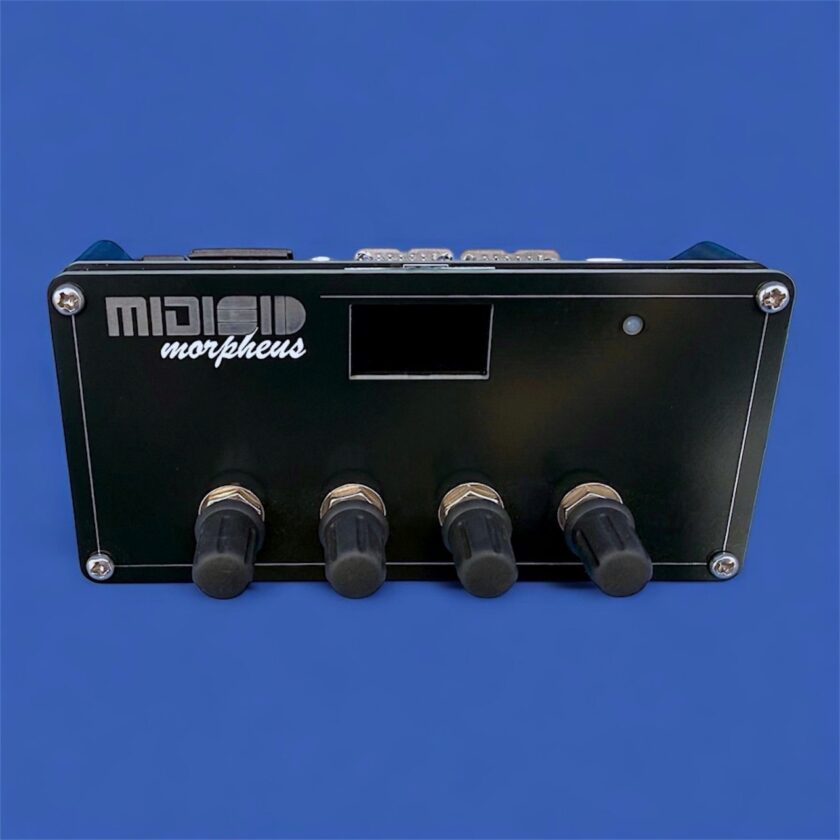
The MIDISID Morpheus maintains a practical yet straightforward layout. On the front panel sits a 128×64 OLED display flanked by four push encoders used for menu navigation and parameter adjustment.
The rear panel houses a 9 V DC power input, a standard 5-pin DIN MIDI input for controllers or sequencers, a 3.5 mm stereo audio output, and a USB-C port. A small front-mounted toggle switch lets users quickly switch between mono and stereo operation, either summing both SIDs for a centered, unified tone or panning each SID left or right for a broader stereo image.
Inside, the circuitry centers on two Kung Fu SID chips, each providing three voices. In the original Commodore 64, out of the box, Commodore only included one. However, modders discovered it could easily accommodate another, giving birth to a very popular mod over the years, and a standard revision in all modern C64 clones.
MIDISID follows this lead with its double chips, while maintaining the same analog-style oscillator structure and characteristic filter tone of the classic 64. Dixon includes a battery clip-to-barrel adapter for 9V batteries; however, the manual recommends using mains power for consistent performance. The case is compact, sturdy, and minimalist by design.
Sound and Features
As expected, the MIDISID Morpheus captures the raw charm of the SID. It generates pulse, sawtooth, triangle, and noise waveforms, each capable of modulation through pulse-width adjustment, vibrato, ring modulation, and oscillator sync. The filter circuit models the expressive resonance that gave classic C64 music its growl and depth. With two chips running in tandem, Morpheus supports layered patches, thicker harmonies, and sustained chords.
In General MIDI mode, users can access 128 standard program slots plus percussion mapped to Channel 10, making the unit compatible with sequencers and DAWs that expect conventional MIDI behavior. Firmware 4.0 introduced the Morpheus UI and USB-host support.
Firmware 4.1 introduced 64 patch slots, new arpeggiation controls, and CC refinements, enabling easier customization of sounds for both live and studio use.
Switching to stereo mode separates the two SID chips into independent left and right channels, while mono mode blends them for the compact sound characteristic of early chip music. This flexibility makes Morpheus equally at home in both DAW projects and live performance setups.
Day-to-Day Workflow
The MIDISID Morpheus is very user-friendly. Power it up, connect a keyboard or sequencer, and it is ready to play. Each encoder performs a specific task: one scrolls through menus, another adjusts values in coarse or fine increments, a third handles transposition and octave shifts, and the fourth saves or loads patches. The OLED display presents waveform, envelope, filter, and modulation settings on clear pages, making editing intuitive and straightforward.
We loved how Morpheus integrated easily with any MIDI-capable setup through its DIN connection. Whether it was controlling it via “External Instrument” in Ableton or hooking it up to a sequencer, it did not take long for us to start playing back patterns in fun 8-bit glory.
At a price under two hundred dollars, Morpheus undercuts some boutique synths and offers a fun solution for musicians who want the SID’s distinct timbre in real hardware form.
Closing Notes
While I had never been a chiptune creator myself, I can completely understand the allure of this era and why it remains so cherished forty years later. There is something deeply satisfying about those early digital approximations of guitars, pianos, and drums that got lost in the era of high-fidelity, realistic emulations. The grit, crunch, and lo-fi nature of these sounds pair beautifully with modern synths or plugins.
Since receiving it last month, we have found so much joy in this little 8-bit box. It has become a constant fixture near the MIDI keyboard, a quick way to add the unmistakable crunch and shimmer of 1980s synthesis to any project. MIDISid 4 stands as both a tribute to a classic and a bridge to the present, continuing a small creator’s passion project that keeps a legendary chip alive in the hands of new musicians.
