
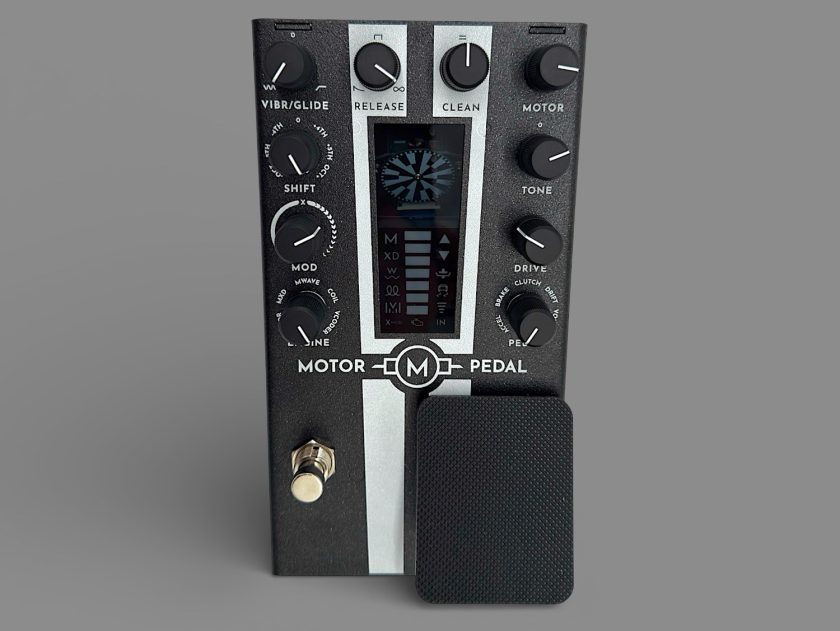
A glass window sits on top of the enclosure, revealing a brushed DC motor. Feed in a note, and the pedal’s pitch-tracking system uses that note to drive the motor oscillator. An A4 at 440 Hz corresponds to about 146.6 revolutions per second. Higher notes accelerate the motor. Lower notes slow it. A calibrated inductor picks up the electromagnetic behavior generated by the spinning coils and converts that signal into audio.
It runs and looks like nothing you’ve seen before. Its name is the Motor Pedal.
I’d been watching the Motor Synth from a distance for a while. Loved the concept, but lacked the capital to add it to my collection. When Gamechanger Audio announced a pedal built around the same idea in late 2025, for a fraction of the cost, I didn’t hesitate.
Instead of a guitar, my first signal was a synth saw wave. The return had weight and edge, like metal hornets swarming. Its physical roughness doesn’t smooth out with EQ or less gain, and you hear movement even on steady pitches. That’s pure motor behavior.
Even though I loved the Motor Synth, as far as the Motor Pedal goes, I deliberately went in blind with no demos. Just a press of the footswitch to activate, followed by a pure holy-fuck moment.
Guitar vs. Synth
Everyone’s first thought is going to be to plug this into a guitar. But honestly? Skip that and feed a synth through it.
In my testing, synths produced the most stable results with the Motor Pedal’s pitch-tracking system. Sustained notes stayed coherent, the motor followed pitch changes cleanly, and the output held together well.
Guitars introduce variables such as pick attack spikes, decaying sustain, and adjacent string noise and sometimes they can make the tracking feel less predictable. You can absolutely use it with a guitar, but you may find yourself adjusting your playing to suit the pedal. With synth, it just works.
The Engines
Five synthesis modes are built around the same mechanical core. Five separate instruments crammed into one housing.
Motor presents the raw electromagnetic signal from the spinning coils as captured by the inductor. It carries a gritty metallic edge in the upper harmonics, with slightly uneven density in the low end that reminds you this is a moving part generating the waveform. Aggressive but uncompressed. You hear micro-fluctuations in sustained notes.
You know that thing you did as a kid where you made car sounds with your mouth, raising up in pitch, with little gear shifts? Motor mode is that idea turned into an instrument.
MXD multiplies the motor oscillator signal with digitally generated waveforms. The tone becomes denser and more cutting, with upper mids sharpening toward square-wave territory while retaining the motor’s instability. One of the more abrasive modes, especially with the Mod control pushed.
M-Wave routes the motor oscillator into a digital waveform generator that is pitch-locked and hard-synced to the motor’s motion. In my testing, the result had more low-end authority than the other modes. In a mix it behaved more predictably, with the motor’s instability translating into subtle movement rather than overt chaos. I kept coming back to this one when I wanted the motor character without everything falling apart.
Coil bypasses physical rotation entirely and instead resonates the motor coils using alternating current. Pitch becomes less defined while the texture of the resonating coils takes over. In my testing, some of the original signal occasionally bled through before the effect fully engaged, and then it tipped straight back into chaos. Easily the least predictable voice in the set.
VCoder is a vocoder-style engine that combines the motor signal with the incoming audio through multiband filtering. The Gamechanger Audio team describes it as a multi-band digital vocoder that incorporates the motor oscillator into the modulation system.
The Mod Control
Left of center, the Mod knob alters engine-specific behavior. Depending on the selected engine, it may reshape waveforms, alter harmonic emphasis, or shift how the motor interacts with the digital synthesis layers.
Right of center, the knob enters X-MOD territory. In this mode the motor oscillator passes through an analog multiplier IC, where it is modulated by the incoming signal. The two signals effectively combine into a hybrid output, blending the motor tone with the source audio.
The LED indicator responds to this interaction, flashing with the dynamics of the input signal.
There’s no subtle crossover point. You know when you’ve hit it.
The Gas Pedal
Gamechanger Audio could have shipped the Motor Pedal with a standard expression jack and called it done.
Instead, they built a spring-loaded expression pedal directly into the enclosure, themed like a throttle.
It has tension. It resists under your foot the way an actual gas pedal does. It doesn’t slam to the floor the moment you touch it. Small movements can produce significant changes, and pressing past the normal travel enters a deeper “floor-it” zone.
A settings mode (hold the footswitch while powering on) allows the pedal sensitivity to be adjusted.
From there, five control modes determine what the pedal motion affects.
Accel raises pitch by one octave across the normal pedal range. Pressing deeper into the floor-it zone pushes it another octave higher.
Brake lowers pitch by an octave in the normal range, with deeper travel dropping it even further. Gamechanger’s product description compares the deepest pedal travel to bringing the motor toward a stall.
Схватить temporarily disables the pitch-tracking system and holds the motor at its current speed, allowing sustained drones.
Drift introduces vibrato, moving from controlled modulation to chaotic fluctuations as the pedal is pushed further.
Volume adjusts the output level of the motor oscillator.
I spent most of my time on Accel and Brake. There’s a visceral quality to sweeping pitch up or down by an octave with your foot, then flooring it to push further.
That said, don’t feel bad if you need the manual open the first time through. The control labels aren’t exactly self-explanatory. Once you get the hang of it, though, this thing is a blast.
Gating and Response
I’d read complaints about abrupt note cutoffs, and that issue appears to be handled by the Release parameter.
Release behaves similarly to an envelope release control on a synthesizer. Lower settings shorten the decay and can choke off notes quickly. Higher settings allow the motor signal to continue ringing after the input fades.
If notes are cutting off harshly, turn up the Release.
Practicalities
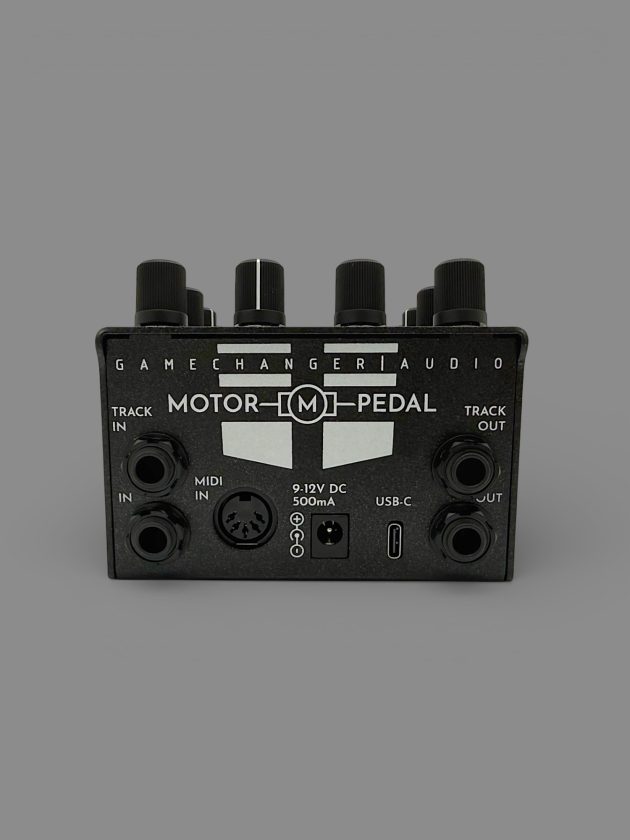
The Motor Pedal runs on a center-negative 9–12V supply requiring at least 500 mA, and Gamechanger specifically warns against using 18V power sources.
Because the pedal’s sound generation relies on a physical motor, the lifespan of the motor itself depends heavily on operating conditions and usage.
When the motor begins approaching the end of its life, the pedal’s Check Engine indicator will alert the user. Replacement motors are user-installable and simple.
Заключительные мысли
$399. Gamechanger Audio’s Motor Pedal is a thick boi with a learning curve.
For $399, you’re investing in something that doesn’t sound like any other pedal out there. If you’re into noisy, experimental music, it’s truly a no-brainer. It introduces a new sound source with its own behavior, limitations, and architecture.
Most new releases are variations on existing ideas. Gamechanger Audio’s Motor Pedal is one of the first pedals in a while that genuinely feels like it’s trying something different.
It produces sounds I haven’t heard from anything else, and it’s worth the board space and power. You’ll need to read the manual since the controls aren’t immediately obvious, but months later the Motor Pedal still provides new ways to use it.
Take the time to tame the beast, and you’ll have one of the most creative pieces of hardware you can add to a pedalboard.
Check out a demo below, and for more of our reviews, please go здесь!
