
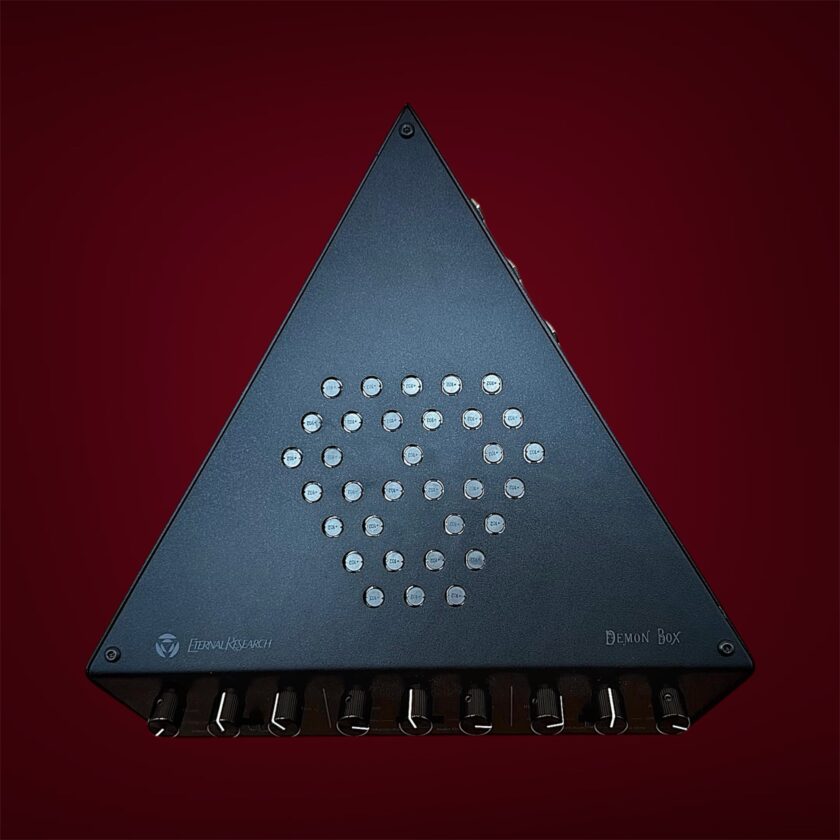
A unique instrument that turns invisible magnetic fields into playable sound.
Everything hums, but most of us never hear it. The Demon Box, created by Eternal Research in Los Angeles, captures invisible electromagnetic fields and turns them into playable sound. Instead of generating tones with oscillators, its 33-inductor array detects nearby electromagnetic fields and converts them into audio, CV, and MIDI signals.
Move your phone above it, and it’ll help create texture, generating MIDI or CV. A power drill generates a wonderful drone sound. From the buzz of a light bulb to any device that emits EMF, the Demon Box reveals a hidden sonic landscape that few ever hear.
Legacy & Origins
The Birth of Eternal Research
Inventor Alexandra Fierra and engineer Bryn Nieboer founded Eternal Research after years of building experimental instruments. A Pennsylvania native from Emmaus, Alexandra grew up surrounded by makers and electrical tinkerers (her great-grandfather even founded an electrical device company). Fierra often recalls being drawn to the hum of electronics as a child, a fascination that shaped the birth of the Demon Box.
After developing multiple prototypes, they announced the Demon Box in 2024 and launched a Kickstarter campaign that hit its goal within ten minutes.
Development History
Fierra’s early prototypes utilized small wooden enclosures, six inches square, for gallery installations and sound-art projects. She refined the concept into the current triangular metal design to improve pickup coverage and durability. The 33-inductor layout now strikes a balance between spatial sensitivity and portability. She presented the production model at NAMM и Superbooth 2025, where audiences recognized its mix of lab-instrument precision and gothic style.
Branding and Design Philosophy
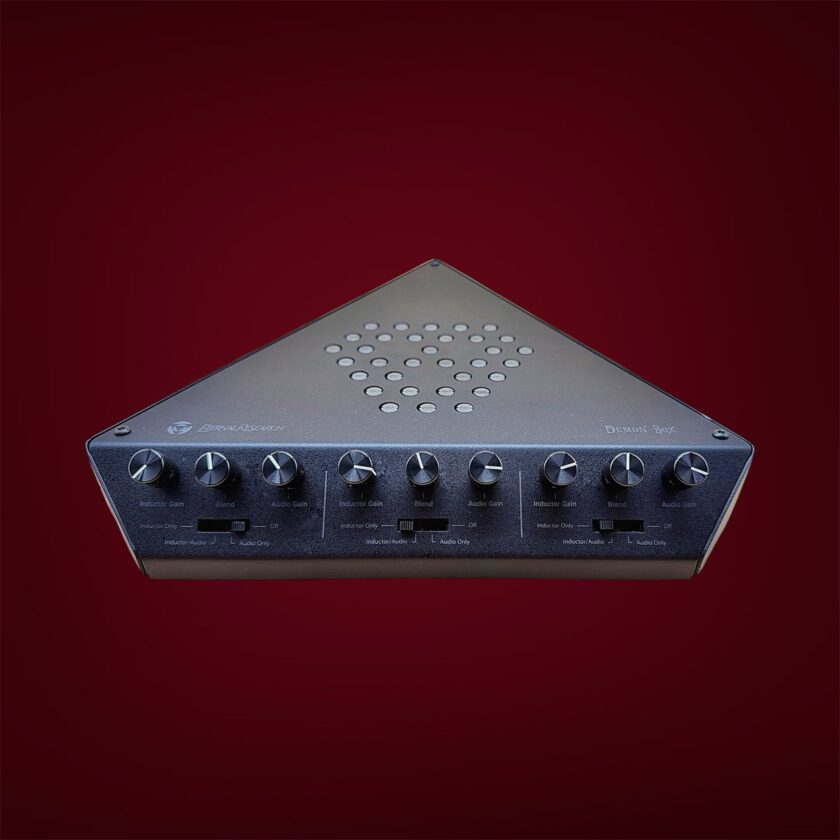
Working with Cotton Design, Fierra and her team developed a design language that fuses Victorian-era science with modern minimalism, featuring black steel, and turn of the century typography. In a Fast Company interview, she described the aesthetic as “scientific, open, but slightly unsettling.”
And while you can’t quite put your finger on why, it looks unsettling among a mix of brighter-colored and vibrantly designed synths.
It’s a conversation piece that bridges art and technology, the very space where the Demon Box was born.
Design & Build
Physical Form
The Demon Box’s black steel triangle resembles a piece of Victorian laboratory equipment. Its folded-metal enclosure feels hefty, and the 33 inductors shimmer under light.
The Demon Box draws power over USB-C. Each of the three audio channels has a selection switch for EMF input, external input, or blend mode, accompanied by a corresponding mix knob to adjust the balance of the selected mode.
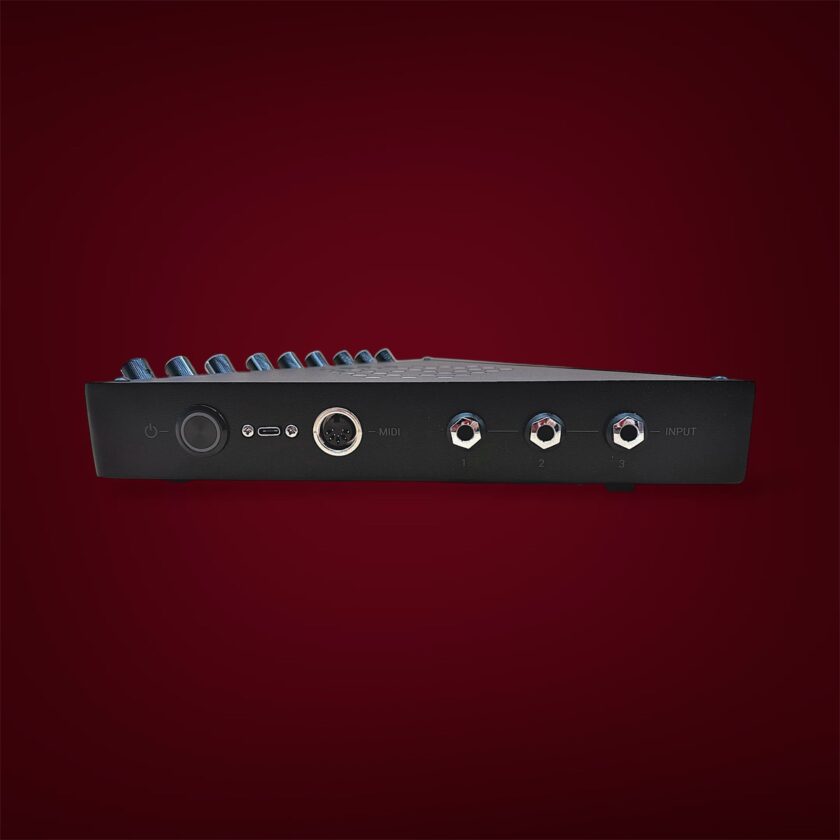
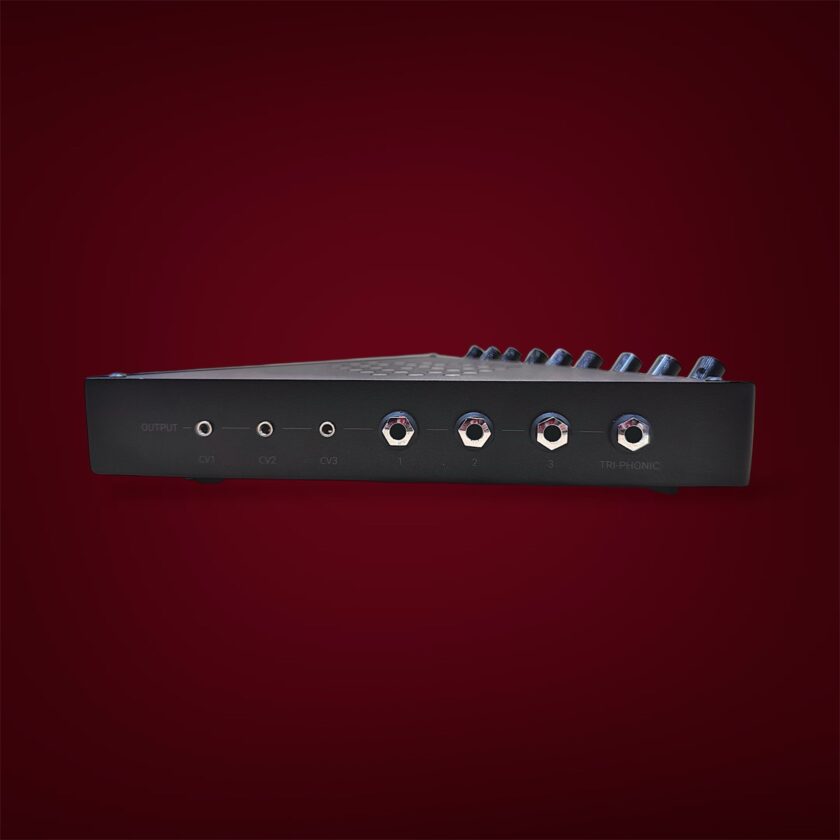
The side panel houses three ¼-inch mono outputs, three ¼-inch auxiliary mono inputs, and a combined triphonic stereo mix out. The instrument relies on physical controls; no screens or menus interrupt the workflow.
Eternal Research will be manufacturing units 150 miles from Los Angeles by early 2026, selling the Demon Box for $999 USD with staggered fulfillment cycles throughout 2026. The folded-metal enclosure felt solid and precise, with machined details that made it a beautiful piece.
Sound Engine, Workflow & Character
Electromagnetic Performance
Using it feels like performing with the room itself. Drills create pulses reminiscent of early techno, while different toys yield rhythmic squelches or high-pitched whines. Playing a video or song on a phone while hovering it over the grid produces faint audio echoes.
The Demon Box manual lists familiar EMF sources, including hair dryers, drones, chargers, VR controllers, and fluorescent огни. That said, musicians can use anything that emits or fluctuates EMF signals as a signal generator, turning everyday devices into playable tools.
The sound is raw, often harsh, but full of character. Mixing EMF signals with the integrated MIDI generation produces drone-like whines and erratic melodic bursts on a connected synth, controlled by the surrounding electromagnetic activity.
Triphonic Field and Spatial Imaging
Each channel outputs a separate feed from its region of the inductor array, creating what Eternal Research terms a triphonic array. The triphonic array allows for a 3-way blend of all three audio out channels to encourage users to explore different approaches when it comes to spatialized sound.
Interaction, MIDI & CV
Beyond audio, the Demon Box converts electromagnetic fluctuations into MIDI data and CV. Three CV outputs and a DIN MIDI port transmit that motion to modular synths or software instruments. The unit smooths intensity changes as it converts EM fluctuations into MIDI CC or CV.
Under the current firmware, the Demon Box sends unclocked MIDI notes and CC messages through USB-C and 5-pin DIN. These notes remain asynchronous, which makes the instrument unpredictable but expressive. The notes are quantized to notes-per-second, but don’t sync to a clock. This untraditional approach to MIDI is intentional. Much as the Demon Box is meant to be experimental and unique, so is it’s approach to MIDI output.
We also paired it with Landscape FM’s Ferrous, a magnetic resonator. The Ferrous created drone textures that changed depending on how fast the disc on the Ferrous spun. Together, they formed an ecosystem of electromagnetic instruments, each revealing another facet of the hidden electrical world.
Firmware and Detection
Undeniably, different objects have different effects, and the detection capabilities of the Demon Box are defined by the type of EMF source. The best way to explain how this works is to explain EMF in further detail, and help demystify it a little, as I admit to being unfamiliar with the science before receiving this device, and I am sure others may be as well.
Basically, EMF is not a monolithic encoded signal that the Demon Box sometimes picks up, but rather multi-layered 3-dimensional invisible waves emitted across an extremely wide frequency spectrum from radio waves to infrared.
Every object reacts differently to the Demon Box, even cell phone to cell phone. All EMF implements generate MIDI and CV signal, which is 2/3 of the signal output of the Demon Box. It’s difficult to say which devices are the ‘best’ to try. While certain objects have undeniable controllability (like the Ferrous.), performances are affected by the type of device used. This is part of the fun of experimenting with the Demon Box. Some may react ‘louder’ to your ear, but this is related to the power of the EMF field, the voltages behind the emf determine its reach. Example: a power drill is higher voltage than a phone so you can hear it from feet away.
Already with launch firmware, the device is fantastic to experiment with, and it’ll be fun to see what tweaks future updates bring.
When updates arrive, Eternal Research distributes them through its website and newsletter, and Demon Box owners can update via the Daisy Web Flasher в flash.daisy.audio.
Verdict & Outlook
The Eternal Research Demon Box stands among the most distinctive experimental instruments we’ve tested. Sound designers and live performers can capture and manipulate the unseen sonic world in ways no conventional synthesizer allows. While traditional musicians may view it as a niche, that niche rewards exploration and innovation.
Although it’s not the first device to explore this concept, it carries out the idea with impressive depth and personality. Alexandra’s and Bryn’s initial venture into musical gear is a delightful success, and we look forward to seeing where it goes with future updates.
