
Introduction – From the SH-101 to the Essential L1
In 1982, Roland pitched the SH-101 as an affordable, portable monosynth for working musicians. Over time, its snappy envelopes, elastic bass, and resonant filter made it a fixture in acid house, techno, and electro. Artists from Orbital to Aphex Twin pushed it far beyond its simple layout, proving that a single oscillator could carry an entire track when paired with the right filter and sequencer.
Four decades later, Donner has revisited that formula with the Essential L1. Rather than aim for a strict one-to-one replica, Donner has taken the SH-101’s core strengths: the punchy 3340 oscillator, the smooth yet biting 3109 filter, and built them into a more flexible instrument. The Essential L1 adds features the original never had: dual ADSR envelopes, a triangle waveform, an expanded sequencer, USB-MIDI, and portable power options. It acknowledges the past, but the design accommodates modern music creation.
Build and Design
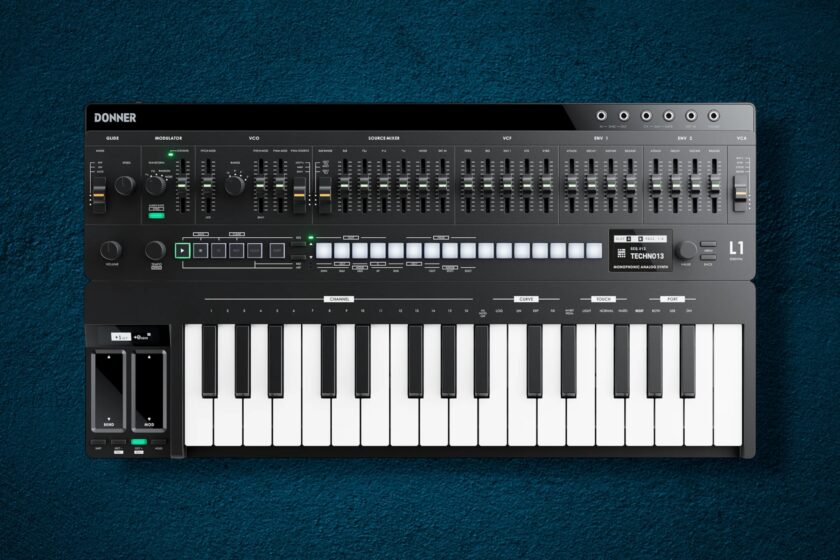
The Essential L1 comes ready to use as a desktop module. Its matte black finish reads clean and understated, which makes the white legends and section dividers pop in a way that’s easy to read under any lighting. Donner arranged the interface in a straight line from left to right, starting with glide and pitch range before moving through the VCO, filter, modulation, and envelopes, then landing at the sequencer controls towards the bottom.
Sliders dominate the layout, each capped with a flat-top fader that has a painted stripe for quick visual reference. Knobs control parameters that benefit from continuous rotation, like tempo, waveform selection, range, and main volume. All section labels are clearly separated, so you can move from VCO shaping to filter work without hunting for the right control.
The KB-32M keyboard connection point sits on the underside and uses a magnetic latch, which keeps the profile clean.
With the aforementioned keyboard, it works great, but the connection itself has some caveats. While the magnet holds well when the unit is flat, it is not strong enough to move both pieces without supporting them underneath. During testing, the keyboard detached mid-lift and disconnected, thudding back onto the table. Thankfully, it wasn’t high off the table and escaped scratch-free. However, with that in mind, for live setups or frequent transport, it is best to support both sections at once.
Sound and Circuitry
At its heart, the Essential L1 uses an analog signal path anchored by a CEM3340 VCO and an IR3109 four-pole low-pass filter. This is the same core combination behind the SH-101’s signature sound. The oscillator section offers saw, pulse (with PWM), sub-oscillator one or two octaves down, noise, and an added triangle wave for smoother, rounder tones.
The sawtooth wave delivers a full-bodied, rich character, while the square cuts through with a bold, prominent presence. Pulse-width modulation keeps sustained notes animated, and the sub-oscillator thickens basslines without muddying them.
The IR3109 filter is smooth at low resonance and sharper as you push it, delivering that familiar acidic squelch without losing low-end weight. Dual ADSR envelopes offer more shaping flexibility than the SH-101’s single-envelope design; you can keep the original “snappy” response via envelope merge mode or use them independently for more complex modulation.
The single LFO goes well beyond vintage limitations, offering multiple waveforms, audio-rate modulation, and MIDI sync. This makes it at home in classic bassline territory and experimental textures.
Sequencer
The 64-step sequencer is a major upgrade over the SH-101’s, allowing patterns to be saved, chained, and edited in both real-time and step-entry modes. There is room for 128 patterns and 32 songs, with swing, ties, and rests available per step. The arpeggiator expands to five modes: up, down, up/down, down/up, and random, across three octaves.
You can prepare an entire bank of patterns, chain them into a set, and shift between them without touching a computer. In the studio, MIDI sync over USB or TRS keeps timing tight with DAWs and external gear.
Everyday Use and Workflow
The Essential L1’s one-slider-per-function interface makes programming fast. For bass, pairing the saw or square with the sub-oscillator and adding glide yields elastic, mix-ready lines. For leads, the dual envelopes let you shape, filter, and volume independently for sharper, more expressive attacks. The audio-rate LFO opens metallic and FM-like timbres that push beyond SH-101 territory.
Verdict and Comparisons
Compared to the Behringer MS-1, the Essential L1 offers a more authentic and much better sound. However, unlike some copies (both hardware and software), the Essential L1 sits between two extremes. It is both faithful to the SH-101’s sound, but also not afraid to modernize in ways that add flexibility. Additions such as dual envelopes, a triangle waveform, an audio-rate LFO, and a more capable sequencer make the Essential L1 great enough to stand on its own.
For players seeking a portable, authentic-sounding analog monosynth with thoughtful modern touches, the Essential L1 continues Donner’s legacy of affordable music options, making it one of the strongest options in its price range.
Check out more hardware reviews здесь.
