
Death By Audio has been hand-building noisy pedals in New York for over twenty years. The Fuzz War is standard-issue in noise rock. The Rooms is one of the most unhinged stereo reverbs you can buy. If you’ve followed them for a decent period, you’ll know they loved to build some heckin’ chonkers. Compactness was never part of the DBA story.
The Destroyer Series flips that idea on its head.
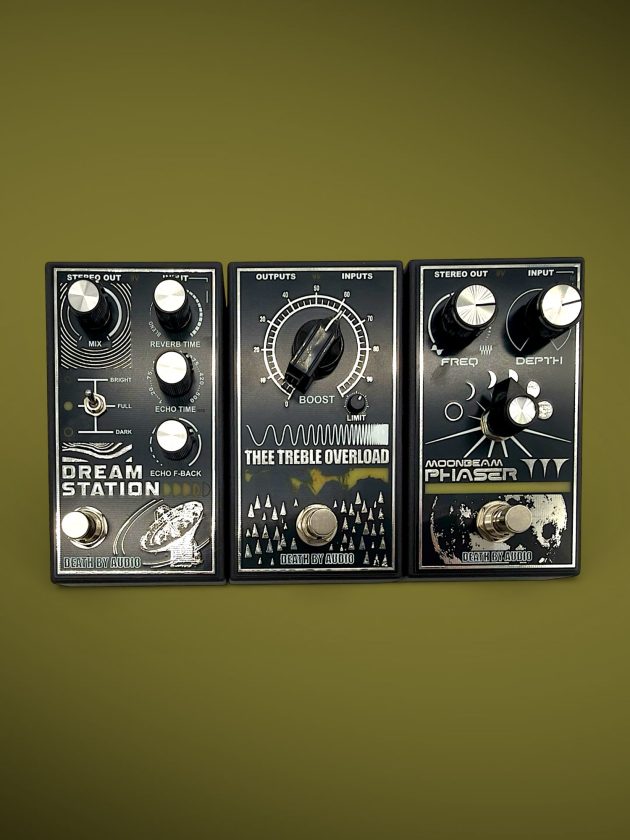
With this, DBA has put three new circuits inside 5.16” × 2.76” × 2.38” enclosures with stereo TRS support and simple controls. The debut lineup: the Dream Station, a reverb and delay combo; the Moonbeam Phaser, a six-stage analog phaser; and Thee Treble Overload, a treble boost/distortion hybrid. Each one runs $250.
I reached out to DBA after the announcement to see how these compact guys perform and spent months with all three, running each through a Waldorf Iridium Core to isolate what makes them tick.
Moonbeam Phaser
I plugged in the Moonbeam first and cranked the Frequency control past the point of no return. At the top of its range, the pedal interacts with the signal in unusual ways. The LED cycles through colors in time with the LFO, and at high speeds, it looks less like a status light and more like something is about to go wrong.
The real moment came when I ran all three together and heard what the Moonbeam did to the overall sound. It changed the character of everything around it. That was when I knew this was the one I’d keep coming back to.
Moonbeam features a dual-analog phaser design with six selectable modes on a rotary switch. Flip the stage count, and the notch pattern shifts with it. Even-numbered modes keep the low mids intact and land closer to familiar phaser territory. Odd-numbered modes strip some of that weight away and exaggerate peaks. The odd modes have a hollow, almost skeletal character that grew on me.
The LFO sweep holds throughout its range. At moderate speeds, the motion rounds out, closer to a sine-style sweep than anything jagged, and движение stays continuous without clicking.
Low-frequency settings were the first surprise. Instead of an obvious swirl, the signal narrows and darkens. At the slowest settings, the sweep can drift into extremely slow territory before completing a full cycle.
Push the sweep faster, and the character shifts quickly. Once the LFO climbs into audio-rate speeds, metallic overtones appear. Single notes splinter. Chords collapse into something harsher and more angular, drifting close to ring-mod territory.
Conservative depth settings leave the low end intact and keep the modulation sitting on top of the signal. Past noon, especially in odd-stage modes, bass thins and transient attack softens. Higher settings introduce a combed, phase-canceled texture that sounds fantastic on single notes but can be borderline unstable with dense chords.
The knobs don’t have dead zones, but minor adjustments in certain modes move the sound dramatically, especially at higher frequencies.
The noise floor remained low during my testing, even with Depth set high and Frequency sweeping quickly. No obvious ticking. No LFO bleed.
Dream Station
The Dream Station is another great surprise, with a wider sound range than even its name suggests.
Short echo time settings introduce audible comb filtering. Collapse the delay and the repeats thicken in a metallic way that edges toward flanging when mixed high. Run that through distortion, delay, and reverb, smearing them into one blurred block of sound. It gets messy fast.
The reverb sits on the dense side with a grainy texture. The tail diffuses rather than sparkling. Push Reverb Time past noon, and the transient attack disappears into the wash. Increase feedback, and the delay can push into self-oscillation; once it begins, it sustains.
The controls reach exaggerated settings quickly, while dialing in balance takes more care.
The Bright / Full / Dark toggle changes the response more than I expected. Bright sharpens the repeats and pulls some low end out, which makes short delay settings cut harder and sound more metallic. Full feels neutral and ended up being where I left it most often. Dark smooths the top end and can slide toward murk if Mix climbs too high. I bounced between Full and Dark most of the time.
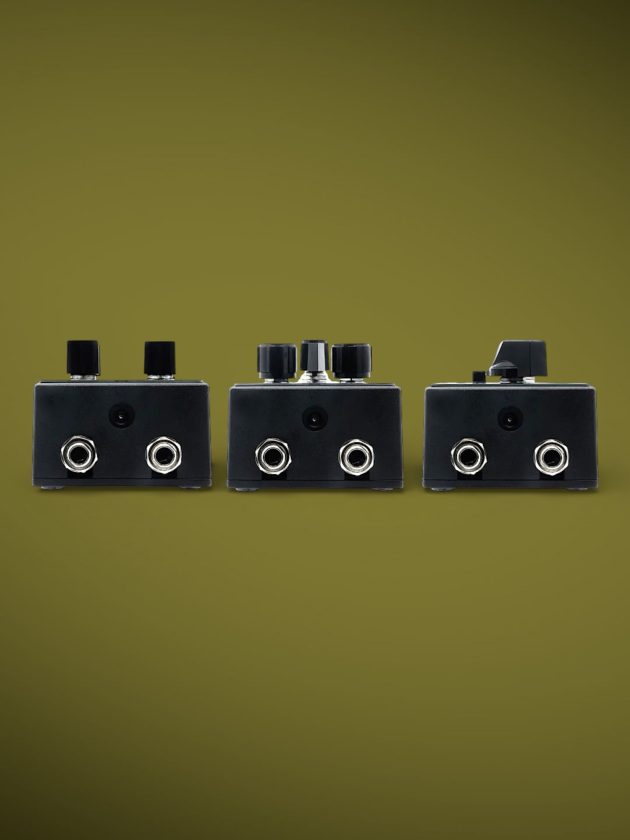
Stereo routing is via TRS connections, with an internal switch controlling the configuration. Mono mode processes a summed signal. Stereo mode keeps the left and right channels separate through both the delay and reverb engines. A mono input can feed a stereo output with proper cabling. This one keeps the channels discrete.
Another internal switch controls bypass trails. Leave it on and delay and reverb decay naturally when bypassed. Turn it off, and they stop immediately.
Knob resistance feels right across the entire series, and the footswitches engage firmly.
Thee Treble Overload
In 2013, DBA and John Dwyer released Thee Fuzz Warr Overload, pairing a Fuzz War circuit with a treble booster. Thee Treble Overload pulls that boost section out, expands the gain range, and drops it into the Destroyer enclosure.
Two controls: Boost and Limit.
Lower boost settings push the high end forward with noticeable bass roll-off. The result tightens the signal. There’s nothing sweet about it. Past noon, the clipping comes quickly. This circuit cuts hard.
Boost spans from +17 dB to +52 dB. The bass reduction is substantial. On a clean amp at bedroom volume, the result can sound thin. Into a driven amp or stacked with fuzz, that same low-end cut keeps things controlled while pushing the upper mids forward.
Rolling back a guitar’s volume softens it but never removes the edge. Higher boost settings introduce a firmer, more saturated edge without the spongy feel of some germanium boosters. The Limit control caps output level so you can push gain without saturating the next stage in the chain. I ended up leaning on it more than expected.
Of the three pedals, this one feels the most single-minded. It shines when things are loud and stacked. I ran it into a fuzz patch on the Iridium with the boost past 3 o’clock, and it sounded like the signal was trying to punch through a wall.
In stereo setups, the Treble Overload operates as two independent boost circuits, amplifying each side of the signal separately rather than summing them.
Build and Platform
My review units seemed sturdy. After years of eyeing up DBA pedals with larger enclosures, it’s strange to drop all three in next to everything else and have room left over.
Power is standard 9V, center-negative, with no battery option. Current draw ranges from 23 mA on Thee Treble Overload to about 95 mA on the Dream Station, which any normal isolated supply will handle.
No MIDI, presets, or expression inputs. DBA kept it simple.
Заключительные мысли
While I absolutely loved the trio, if I had to pick one, it’s the Moonbeam. The moment I heard what it did to the rest of the chain, it was over. At $250, the gap between its tamest and most destructive settings is wider than that of phasers costing twice as much.
Death By Audio’s Destroyer Series is off to a great start, and I cannot wait to see what comes next.
VIDEO DEMO
@altwirenet The best part about TikTok is you can upload extended videos and not have to worry about your reach being limited like IG. If you follow us on IG, enjoy this longer video of us noodling with the new @DEATH BY AUDIO Destroyer Series! #deathbyaudio #pedal #synthtok
