
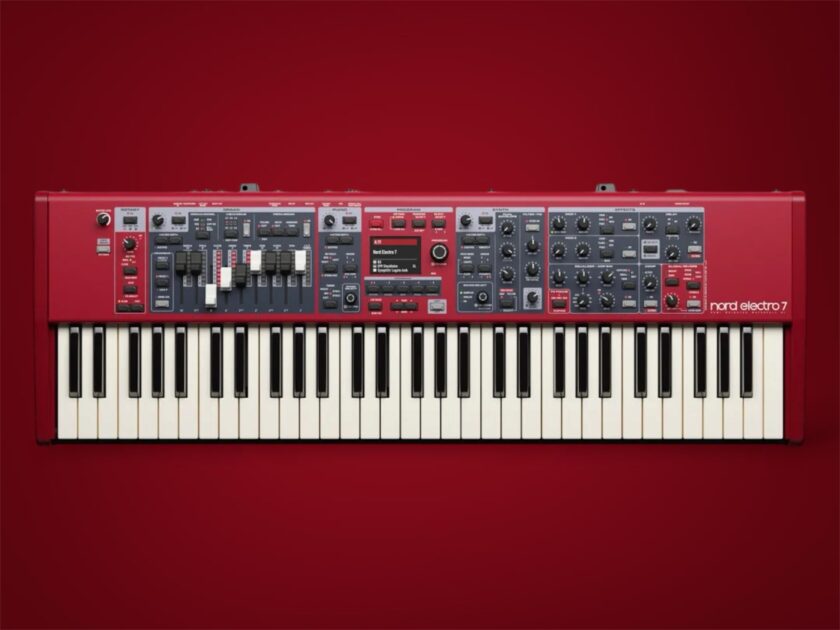
My first experience with the Nord Electro 7 was likely a bit different from most. Rather than spending those first ten minutes on glissandos, random noodling, or menu diving, I took another path: I loaded an “Eleanor Rigby” MIDI arrangement and ran it through the String Quartet patch. After one impressive playback, it was easy to see why this red beauty has become a mainstay in the studios of some of my favorite musicians.
Nord has expanded the Synth section to include Sample, Analog, and FM sounds, brought over the Organ 3 engine and Rotary Speaker emulation, and given each of the three sections its own effects. There’s also a large color display beside the physical drawbars.
I reviewed the 61-key model. The 73 and HP add a pitch stick and modulation wheel, and the HP uses a 73-key Kawai triple-sensor Hammer Action Portable keybed. I didn’t test either version, so the comments on key feel, weight, and physical controls here apply to the 61.
Weight and Feel
At 18.3 pounds, the Electro 7 61 is easy to carry. I appreciated that after reviewing a 73-key piano that turned out to be much heavier than I’d anticipated.
The semi-weighted waterfall action is a delight to play. There’s resistance without stiffness, and nothing felt loose or wobbly. Organ is the obvious match, but I also enjoyed playing acoustic and electric piano on it. A weighted action may be your preference for those sounds; I was happy with how they translated here.
The Organ Is the Highlight
As much as the expanded Synth section has been heavily advertised, and rightfully so, the organ was my favorite part of the Electro 7. It was also where the waterfall action felt most at home.
With the included rotary effect, these patches would fit right into a church service or a live band setting.
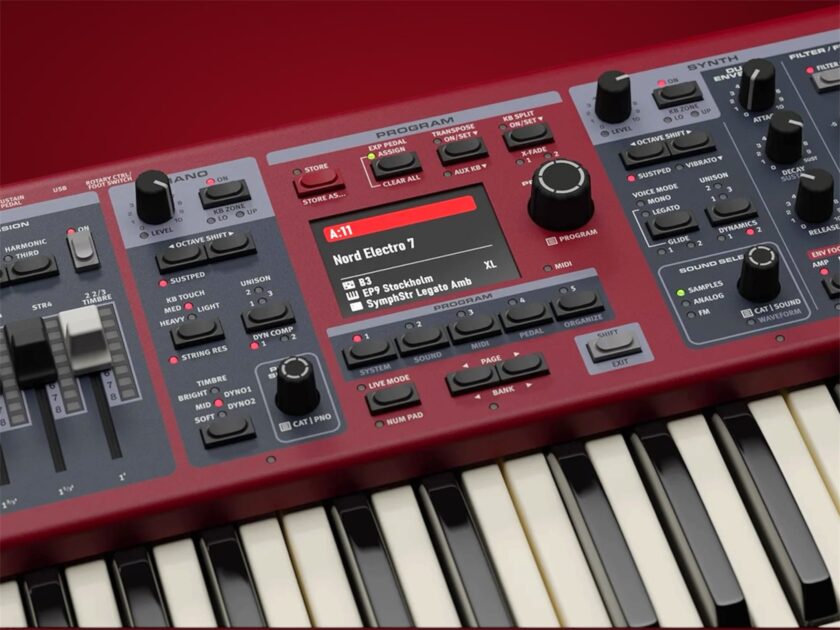
The models include B3, B3+Bass, Soft B3, Vox, Farfisa, and Pipe. Physical drawbars with LED indicators make it easy to see and adjust the settings, while the Organ 3-derived Rotary Speaker section gives you Close, Wide, and XY microphone positions, Bass Wide, and dedicated tube drive. You can even adjust the stopped rotor’s position with Fix Angle.
The Synth Section
Previously, the Sample Synth section always felt secondary to Piano and Organ. Adding Analog and FM alongside the samples changes that impression significantly.
Bowed Lead was an early example that stood out: a sound that made the Electro feel like a synth worth using on its own. Later, the bright, brassy character of 1984 Brass instantly brought Van Halen to mind.
There’s a useful amount to edit, too: unison, glide, vibrato, filtering, and Amp and Filter/FM envelopes, with dedicated preset libraries for Analog and FM. The section has 30+ voices of polyphony. Nord added SuperSaw and revised the Analog and FM edit pages in OS v1.20; I tested the unit on v1.22, and by the end of testing, the Synth section felt far more complete than I had expected.
The layout still gives you one Synth section and one Piano section, with the Organ handling its own dual-manual setups. This does limit layering possibilities, but I no longer saw the Synth section as just an add-on next to piano and organ.
Getting Around the Panel
Organ, Piano, and Synth occupy obvious areas of the panel. Layering them was effortless, and I rarely had to dig through menus to find what I wanted.
The new display is bright, clear, and readable from several angles. It shows program information and the more detailed Synth and effects parameters, while the main performance controls remain on the panel. I appreciated having the extra information without losing the physical drawbars.
Each section now has dedicated effects, with individual Layer Send control to the Global Reverb. That gives you separate effects settings for Organ, Piano, and Synth when you’re combining them.
Aux KB also provides a practical way to integrate a second keyboard. Connect one via five-pin MIDI, and it can control the full Organ section, either individual Organ manual, Piano, or Synth. For instance, you might play the Piano section from a weighted controller while reserving the Electro’s waterfall action for Organ. A second keyboard can even serve as another organ manual if needed.
Updates During the Review
Nord has already made several software changes since the Electro 7 launched. The most substantial was OS v1.20, which added faster Program loading and the Synth changes mentioned above, along with fixes for MIDI, pedals, the interface, and hanging notes. Version 1.22 addressed problems involving reorganized samples and Piano/Sample relinking.
After I finished my testing, Nord released OS v1.30 on September 11. This update brought a Split output option (sending Piano and Synth to the left output and Organ to the right), plus several fixes for Synth, reverb, pedal, and interface functions. All my listening and workflow notes here are based on v1.22.
Electro 6 owners also gained program conversion through Nord Sound Manager 9.20. Version 9.22 followed with a Mac-specific fix for converting Electro 6 .ne6p files. I didn’t have an Electro 6 on hand to test that process properly, but it’s a useful addition for anyone weighing an upgrade.
Nord Electro 7 vs Electro 6D vs Stage 4
At the prices listed for this review, the Electro 7 61 costs $3,299, the older Electro 6D 61 is $2,999, and the Stage 4 Compact is $5,499. That puts the 7 just $300 above the 6D 61, with another $2,200 needed to reach the Stage.
For anyone buying their first Electro, I’d have a hard time recommending the 6D 61 with such a small price gap, when the expanded Synth section alone makes the 7 more appealing, even before considering the organ, effects, and display. It just makes more sense to spend a few hundred extra, and get all the great upgrades the 7 has to offer.
The Stage 4 still offers considerably more room to build layered sounds: two Organ layers, two Piano layers, and three Synth layers based on the Nord Wave 2 engine. It also has aftertouch, three Morph sources, and four assignable audio outputs. The Compact includes a 73-key triple-sensor semi-weighted waterfall action, pitch stick, and modulation wheel. Those are important reasons to spend more if you’ll use them.
Which brings me to my biggest complaint about the Electro 7 61: where are its pitch stick and modulation wheel?
Four days after announcing the Electro 7 in January 2026, Nord responded to feedback by adding those controls to the 73 and HP models. The company said the expanded Synth section deserved more real-time control. I agree, which is my only gripe with the 61 key version of the Electro. They should have been standard across the line. Their absence wasn’t enough to be a deal breaker for me, but it’s the clearest change I’d make to this model.
The Best Nord For Most People
I came into this review expecting piano to account for most of the Electro’s appeal. The organ ended up being my favorite part, but it was such an enjoyable surprise to also find synth sounds I enjoyed and strings that worked far better in that Beatles arrangement than I’d expected.
The Stage still makes sense for players who need its extra layers and advanced performance controls. For most purposes, though, the Electro 7 strikes the right balance between cost and premium feel and features. It’s a fantastic upgrade and one we highly recommend.
See more reviews здесь.
Watch the Eleanor Rigby demo we mentioned earlier, здесь.
