
Waldorf has been around long enough that you can watch digital synthesis evolve simply by looking at their catalog. The early PPG influence shaped everything. Those bright, shifting wavetables became a signature of late-80s and early-90s electronic sound. The Microwave took that identity and sharpened it. The Q carried virtual analog into new territory, and the XT became one of the most recognizable digital synths of its decade.
The Blofeld then advanced compact synthesis, introducing deep modulation and the signature Waldorf shimmer. Later, the Quantum and Iridium brought an engine with broad capabilities: wavetable, VA, granular, sampling, resonators, FM, and hybrid methods, all in one device.
This is where the Iridium Core comes into play. If the Quantum is the flagship statement piece, the Core feels like the company has condensed 30 years of ideas into something you can hold in one hand. It feels like the Waldorf history tour shrunk down to a five-pound metal block.
Using the Core feels like sampling Waldorf’s entire evolution. Decades of the company’s achievements are packed into this small box.
The Patch Browser With A Ridiculous Count
When I first checked the preset browser, I expected a few hundred entries like on recent synths I’ve tested. Instead, Waldorf ships the Core with over 1700 factory presets, plus a large library of preloaded samples, which was a surprise.
Fortunately, the factory presets offer real variety, not just hundreds of similar sounds. You might find a smooth wavetable pad with slow harmonic drift, followed by a granular atmosphere from tiny audio fragments. Next might be an FM ceramic bell, a resonant patch with organic qualities, or classic acid-inspired squelches reminiscent of 90s rave music.
Each engine is shown from several angles, and the differences are clear once you start comparing patches. The deeper you go, the more the architecture gives back.
Five Engines That Feel Like Separate Instruments
The Core uses three oscillators per voice, and each can load one of five engines, just like the Iridium and Quantum. Combining different engines quickly demonstrates the instrument’s depth.
Wavetable
This is the heart of Waldorf’s sound. Motion is smooth and stable. Morphing between waves behaves predictably even under fast modulation, and audio-based wavetable import works the same way it does on the larger Iridium models.
Virtual Analog
Digital waveforms with enough structure to feel musical. Unison stacking stays clean, PWM behaves well, and the envelopes are fast enough for basses and plucks without extra effort.
Particle
The Particle engine handles sampling and granular synthesis. The Core includes 2.6 GB of internal sample flash with roughly 2 GB already filled by factory material, and you can load your own samples via microSD or USB. Basic sample playback is straightforward; granular mode transforms short recordings into pads, textures, or rhythmic effects.
Resonator
A physically modeled approach that adds body, metallic edges, or acoustic flavor to otherwise simple patches. It blends surprisingly well with wavetable and VA tones.
Kernel
Six-operator FM with free routing, allowing simple classic structures or more experimental designs. It is deep, but the visual interface keeps it manageable, and you can import DX-7 patches to recreate familiar FM tones from the 80s and 90s.
This combination approach is where the Core really shines. A wavetable base with granular movement on top, and a Kernel transient for attack, already feels layered before you add a second layer.
The Core stands out by offering multiple synthesis methods: wavetable, granular, VA, and FM, in one unit, opening diverse creative avenues and refusing to limit the user to any single sonic identity.
Touchscreen Workflow That Makes Sense
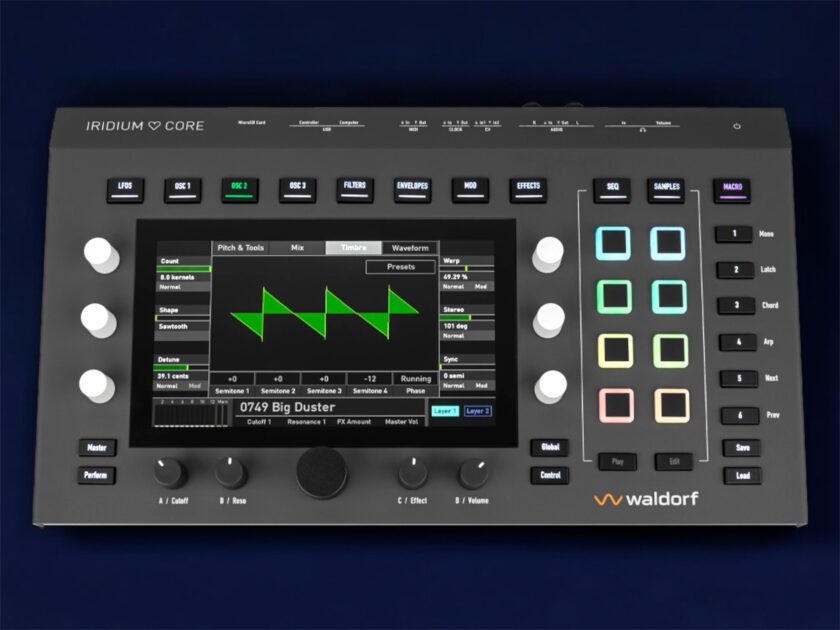
Touch-based synths typically risk too much menu diving or too little control. The Iridium Core balances both. The 7-inch display is high-contrast and responsive, making pinch-zooming, waveform adjustments, FM structure editing, and modulation curve dragging feel intuitive.
The six encoders on the sides change function depending on the page. Once the mapping settles into muscle memory, it becomes fast to navigate. Because of its complexity, the interface requires a bit of patience early on, but the workflow becomes surprisingly fluid once the structure sinks in.
Twelve Voices That Work Until You Stack Too Hard
Twelve voices comfortably cover most uses: pads, leads, percussive sounds, and complex sound design. However, layering engines with long releases in bi-timbral mode can lead to voice-stealing. It’s not abrupt, but you’ll notice it with certain patches.
For live players who rely on huge evolving pads, it is something to plan around. The reduced polyphony makes sense given how much of the Iridium engine survived the transition to this form factor. There are plenty of places Waldorf could’ve cut corners on this thing, but they didn’t.
Layer A and Layer B both function as complete engines, offering three oscillators, filters, Digital Former, modulation, and effects each. You can send each layer to a different MIDI channel, split them, or stack them for more complexity.
It helps to approach the Core with a focus. The engine is deep enough that choosing what to master first makes the process smoother.
Connectivity That Makes It Feel Bigger Than It Looks
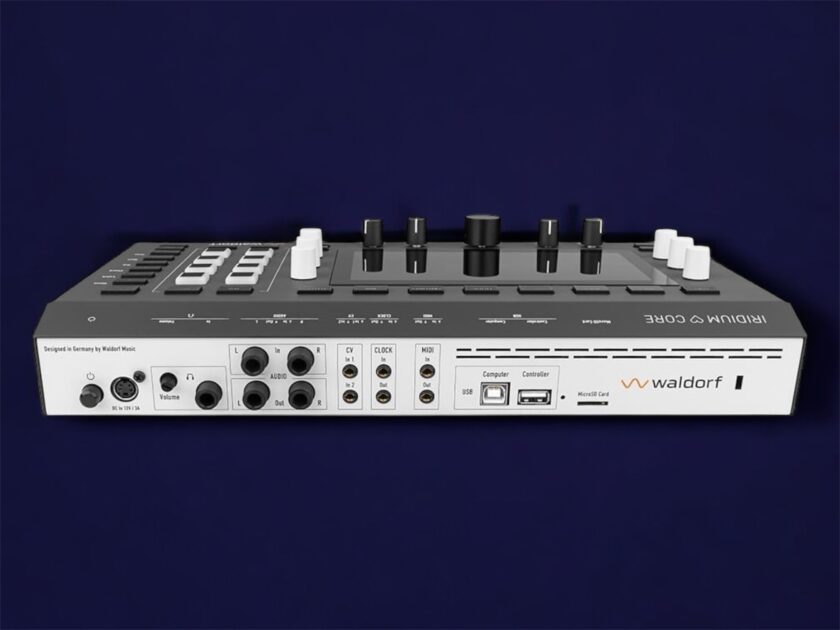
The Core offers a wide array of connections for its size: stereo audio in/out, USB host and device, microSD storage, MIDI over TRS with included adapters, clock in/out, and two assignable CV inputs. I appreciate the included TRS MIDI adapters, though a 5-pin DIN would have been preferable since adapters are easily misplaced. The Core uses a standard 12 V DC power supply with a barrel connector, and it lacks full-size DIN MIDI ports on the unit itself.
Multiple Synths for the Price of… Well, One Really Good One
At $2,199, the Core isn’t entry-level gear and isn’t likely to be a casual purchase for most musicians.
The price makes sense, though, when you consider what’s under the hood. The Core handles wavetable, virtual analog, sampling, granular, resonator, and FM synthesis in a single unit. You’d spend far more and use much more desk space to get this range of features in separate hardware.
Within its compact body, the Core delivers one of the most comprehensive digital engines available, rivaling multiple larger synths. The Core spans a surprisingly wide range of sonic territory, and considering this is something I only have on loan and not as a permanent fixture in my studio, I’m bummed at the prospect of having to send it back. This compact unit handles what many of my other synths can do, and then some.
If you enjoy exploring engines and building your own patches, the Core is an easy fit. Even if its depth intimidates you, the generous amount of varied-sounding presets gives you plenty of starting points. It is a fully digital signal path, so anyone chasing analog saturation or drift will find that the engine points in a different direction.
Four Months Later
Spending enough time with the Core, it’s easy to stop thinking of the Iridium Core as a compact version of anything. Waldorf could’ve released this on its own, without any prior “larger” versions, and it would’ve been a hit and a great addition to their established lineage.
Months in, it still feels like something with room to grow into. For something that weighs about five pounds, it covers a surprising amount of sonic ground, and the preset library alone could keep someone busy for a long time.
For those seeking sonic variety and creative depth, the Iridium Core provides a wealth of possibilities, making it a compelling choice if you want a versatile digital synth.
Sound Demos
Here are some samples of the Iridium Core’s sound, all stock patches:
