AltWire may receive a small commission from purchases made after you click a link on this page.
After several months with Panic’s Playdate, we examine its hardware, unconventional controls, independent game library, and the limitations of its unlit display.
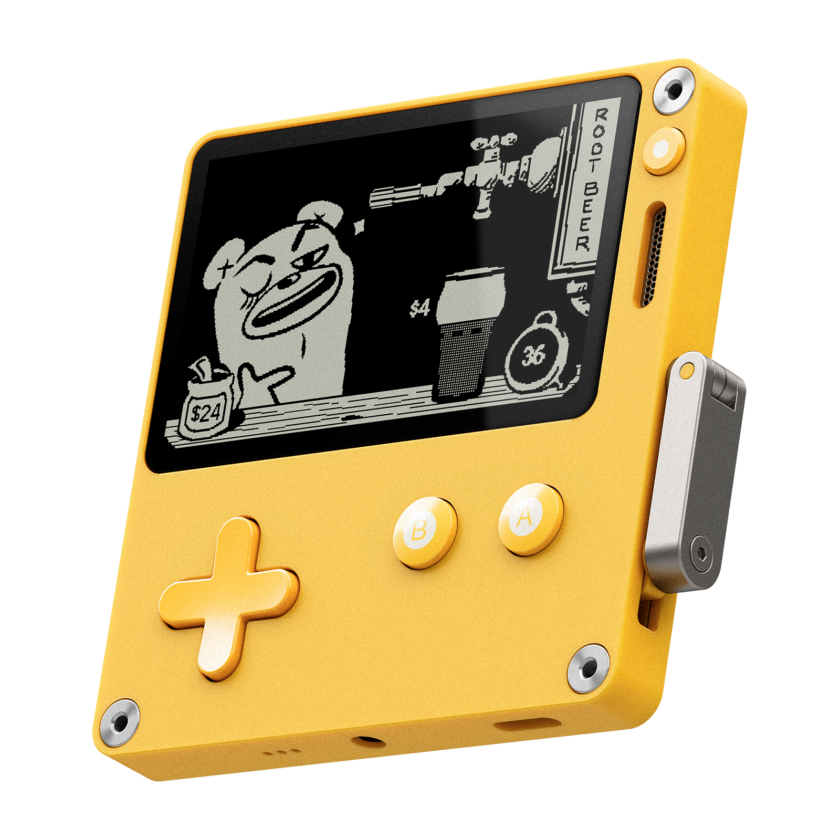
Most of my Playdate time has come in short bursts, usually under an hour. I’ve played it over lunch breaks at work and while waiting for appointments. Of all the portable gaming devices I’ve owned, Panic’s little yellow handheld is among the smallest.
At $229, it’s an unusual purchase in today’s handheld market. Whether it’s worth the money depends largely on your interest in independent games and how much you enjoy finding new ones.
Playdate Hardware and Build Quality
I’d seen plenty of photos of people holding a Playdate, and the size still caught me off guard when I opened the box. At 76 x 74 x 9 mm, it’s smaller than my wallet and about half the size of my iPhone 16 Pro Max.
I was nervous about carrying something that small with a mechanical crank attached to its side. Mine has spent months in my bag, sometimes with less caution and care than it deserved. But despite all that, the screen has no scratches, the crank still turns smoothly, and neither the D-pad nor the face buttons have developed any noticeable looseness.
A lot of the credit goes to Panic’s magnetic cover. It adds little bulk, stays reliably attached, and protects the front of the console. I’d recommend getting one, especially if you plan to carry your Playdate around as much as I have.
The Screen Needs Good Lighting
When it’s under the right conditions, I love how the 400 x 240 Sharp Memory LCD looks. The image is incredibly crisp, and some of the more detailed pixel art looks fantastic on it.
But the ‘right conditions’ carry a lot of weight here. There’s no backlight, which remains my biggest complaint about the hardware. More than once, I’ve picked up the Playdate and found the room wasn’t bright enough. After years of using backlit handhelds, I still haven’t entirely adjusted. I wish I could use it in a dark room.
Battery life has been excellent. With short, scattered gaming sessions, I’ve regularly gone two weeks or more between charges. Panic rates the battery at approximately eight hours of active use and 14 days in standby (I haven’t run a full drain test).
The mono speaker is fine, but I usually plug into the headphone jack because I prefer hearing the music and sound effects that way.
Getting Used to the Crank
The crank folds into a recess on the right side of the console and turns smoothly. Developers have access to its position and rotation, and even slight turns register in a game.
It took me a little while to get used to how sensitive it is. In Root Bear, for example, it’s easy to overdo your movements when pouring root beer. Once you get accustomed to how readily the game responds, you realize how little you need to turn the crank.
I love how Long Puppy by indiana-jonas uses the crank. You control an absurdly stretchy dachshund trying to fetch a ball, and maneuvering the dog with the crank is a big part of the fun.
Developers also have an accelerometer to work with, alongside the D-pad and two face buttons. Some games make extensive use of the crank, while others rely on conventional controls.
The Games
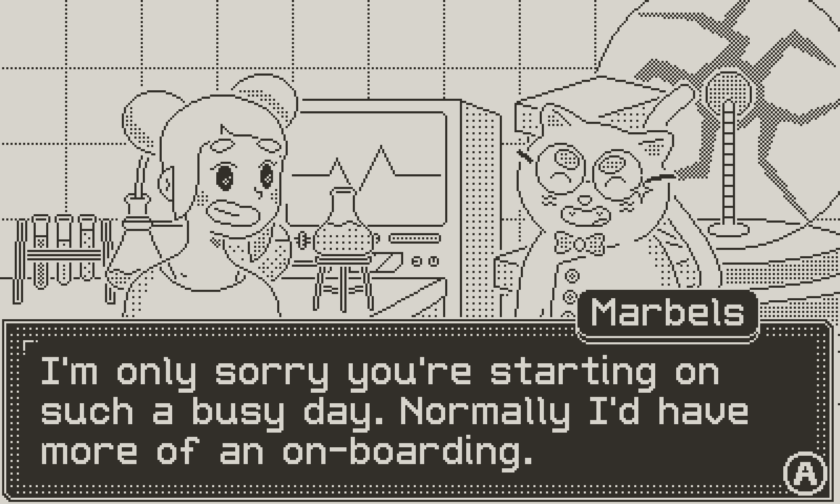
I expected a library consisting mostly of short, lighthearted games for children, so The Whiteout caught me off guard. Scenic Route Software’s dark, story-driven game deals with trauma, loss, and mental illness. It’s a personal favorite, along with Diora, Togglebot, Pullfrog Deluxe, and Long Puppy.
And developers are doing all this on a 168 MHz Cortex-M7 with 16 MB of RAM, 4 GB of storage, and a two-color screen. Its specs are on par with a handheld from the 1990s (save for the storage), and honestly, the gaming experience at times brings back those glory days.
I’d recommend browsing the Catalog before buying a Playdate. The library is a big part of what makes the console worth owning, and looking through the available games will give you an idea of whether they suit your tastes.
Playdate’s Seasonal Games
I particularly enjoy the way Panic distributes its seasonal games. Season One comes with the console and includes 24 games. The first two come preinstalled, with the remaining games arriving in pairs throughout the following weeks.
Getting games this way has encouraged me to spend time with every title, instead of just picking a few key favorites from a collection being dropped all at once. I also appreciate having a week to explore each pair before more games arrive. Everything you’ve received remains available afterward.
Season Two arrived in May 2025 with twelve games delivered over six weeks, including The Whiteout and Long Puppy. The season also included a surprise bonus: Blippo+.
Season Three launched on October 8, 2026, with eight games distributed over four weeks. Both Season Two and Season Three remain available through Catalog for $39 each.
Outside the seasons, Catalog offers hundreds of independently developed games. Browsing it on the handheld is easy, although I’ve occasionally preferred to make purchases through the website. Those purchases then become available to install on the console through your account.

An Open Platform for Developers
Playdate supports installing games acquired outside Panic’s store. Some of those projects may never appear in the Catalog.
The development tools are free, too. Panic’s SDK supports Lua and C, and Pulp is a browser-based editor for creating simpler games. Developers can test their projects on a regular Playdate without purchasing a separate development kit.
Playdate Review: Is It Worth $229?
Months later, I still reach for the Playdate when I have a little free time. There are additional expenses to consider beyond the $229 purchase price. The magnetic cover costs $34, bringing the combined total to $263 if purchased separately. Panic also lists a $249 bundle containing both. Additional seasons and individual Catalog purchases increase that cost over time.
The lack of a backlight is a frustrating omission on a device this well suited to portable gaming. If you frequently play at night or in poorly illuminated rooms, that limitation is worth considering before purchasing one.
Several months in, I’m still excited to see what independent developers come up with for such limited hardware, and I’m glad I gave the console a chance. I’d happily recommend it to anyone who enjoys exploring indie games and wants a break from the glitz and glamour of high-budget games like GTA VI.
Get the AltWire newsletter
The week's best from AltWire, with the artists and sections you pick first. Free; unsubscribe anytime.