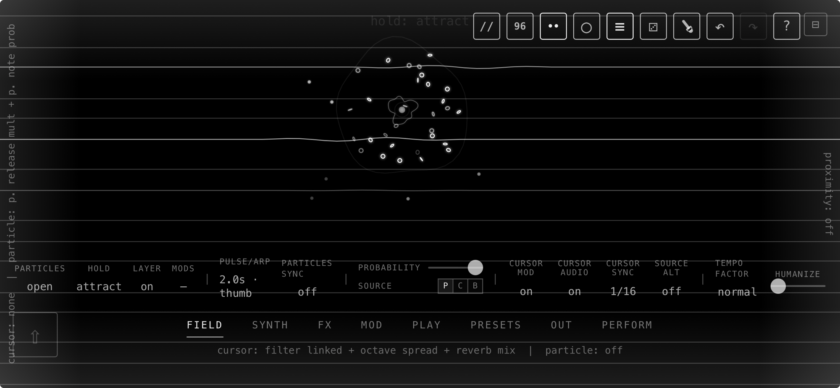
Developer Matthew Sferro has expanded FieldSynth to iPhone and iPad, bringing his generative software instrument to Apple’s mobile platforms. The application uses the movement of particles within a graphical field to produce musical patterns. Desktop plugin editions and a browser version are also available.
Released under Sferro’s The Tin Box name, the instrument combines elements of an arpeggiator and a performance synthesizer. Musicians influence the behavior of particles and cursors to create evolving melodic and rhythmic material.
FieldSynth uses motion to generate musical patterns
The instrument’s visual field provides a way to interact with its generative process. Movement within that space affects the musical output, while incoming MIDI notes can establish pitch-related positions for cursors. This provides an additional means of performing with the instrument from a keyboard.
Sferro’s published documentation describes MIDI output from the particle system and cursors. On compatible setups, this allows FieldSynth to control other instruments. Producers can therefore explore its pattern generation while using sounds from elsewhere in their software or hardware collection.
The desktop manual documents three independent MIDI sources: particles and two cursors. On macOS, the instrument creates a dedicated MIDI port. Windows users need a virtual loopback port to preserve the separate channels. This distinction matters in Ableton Live, where direct track-to-track routing merges channels, potentially sending all three parts to a single instrument.
New desktop plugin instances start with the Mica Drift factory patch, according to the manual. Saved DAW projects, however, restore the instrument’s performance state. Musicians can also save custom presets for use in new projects. The developer recommends leaving the interface open and recording or rendering in real time to capture the generative performance correctly.
The iOS version supports the AUv3 plugin format, while desktop users can access VST3 or Audio Unit versions on compatible systems. The browser edition offers an opportunity to explore the instrument without installing a plugin. The US App Store listing specifies iOS 17 or later and an introductory price of $9.99 through January 3, 2027, rising to $14.99 afterward.
The manual also states that activating external MIDI output mutes FieldSynth’s internal audio. Producers who want its synth sound alongside externally generated parts should plan their routing and recording accordingly. The browser version offers a standard MIDI file recorder, although live MIDI routing depends on browser support. These are documented capabilities and limitations; AltWire has not yet tested them firsthand.
Get the AltWire newsletter
The week's best from AltWire, with the artists and sections you pick first. Free; unsubscribe anytime.