
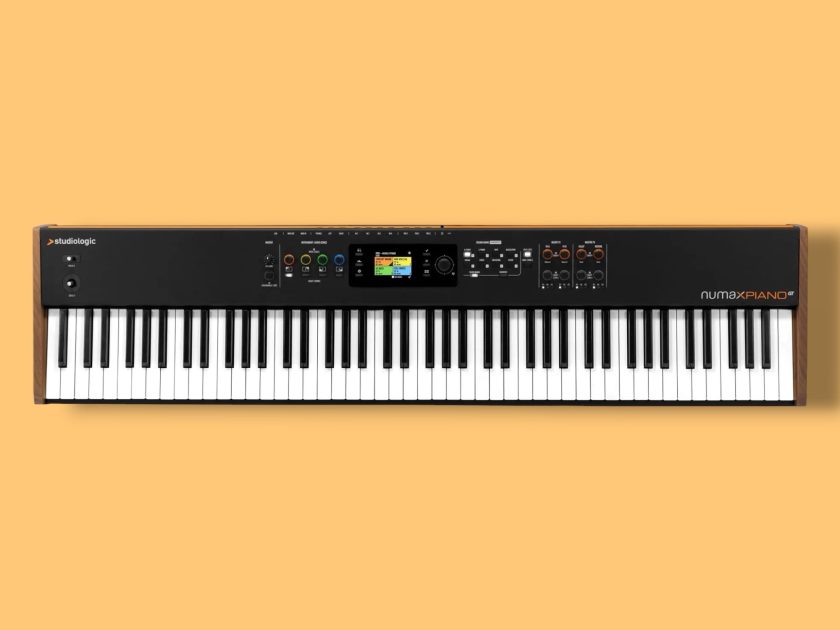
I’ve spent the last few weeks learning what it’s like to play a true studio workhorse. American Music & Sound sent this to me on loan, and the experience was fun, if not an exercise for my lower back.
Here’s some backstory: most of my 88-key piano experience is with plastic-housed MIDI controllers that feel more like toys than instruments. When American Music & Sound offered the Numa X Piano GT for a few weeks of testing, I underestimated the physical reality of a professional stage piano. The moment the box arrived, I thought: “Holy shit, that box is huge.” My fiancée just smiled. “Yeah, good luck with that. That was fun getting off the porch.”
She wasn’t wrong. At 22 kilograms (about 49 pounds), the Numa X Piano GT is back-breakingly heavy. It’s a massive, premium instrument that makes its presence felt the moment you try to lift it. I genuinely thought I might get a hernia just getting it out of the box.
Of course, going this heavy isn’t the only option available. Studiologic also offers lighter 73- and 88-key models in the Numa X Piano line for those who are concerned about portability. In conversations, they’ve actually suggested that the GT is ideal as a studio instrument, while the lighter 88- and 73-key versions which feature the TP110 keyboard, are better suited for gigging musicians. All software, sounds, and presets are fully compatible across the entire line.
Built Like a Bunker
However, since this specific review is indeed for the GT, it’s a tank. I hate using that phrase and typically ban it from my vernacular, because reviews use it to death. Yet, it fits here because the Numa X Piano GT feels so substantial. It’s a beast of a chassis (50×12×5 inches) wrapped in black-painted, textured metal with stained ash wood side bumpers.
Once you’ve done your lifting exercises and set it up, Numa X’s TP/400 Wood keybed is a joy to play. It feels closer to a real grand piano than any digital unit I’ve tried. Unlike cheap controllers, it doesn’t shove all the “action” (the point where keys actually respond to your touch) to the front edge.
Studiologic uses a sophisticated three-sensor action here, meaning each key can detect three distinct positions as it is played, with pivot lengths of 21.7 cm for white keys (the distance from the front of the key to its fulcrum point) and 16.5 cm for black keys. The result is a playing experience that lacks the clicky, half-weighted feel found on lesser synths.
The Sound: HD Digital Character
Studiologic built their entire Numa X line as serious stage and studio powerhouses. These pianos use physical modeling, multi-sampling, and waveshaping technology to achieve acoustic realism. Details like string resonance, duplex-scale modeling, and damper noise simulation matter here. With 300-note polyphony, it has the headroom to sustain massive layers without choking.
This approach shines through in the piano patches and modelled electric pianos. The EP Mark I is the star here. Although it can’t name the piano directly due to licensing limitations, this patch fully models the classic Rhodes tine-based electric piano sound. It nails the warmth, slight grit, and the tone that blooms when you dig in.
The Wurlitzer holds up just as well. With the grand piano emulations, add a touch of master reverb or delay, and the tones sit naturally in the soundscape. Some of the other instruments don’t fare quite as well. Certain patches have a crystalline, slightly synthetic quality that keeps them from landing in “pure realism.” Still, you’ll spend most of your time in the piano bank, and that’s where it excels.
The synth patches are where things get interesting. Model D 1983 sounds incredible with a bit of delay, while Eighties DX delivers those bright, shimmery FM bells that were everywhere during the 80s. You also have Hybridtone, which pairs dark FM bass (think 80s horror-movie territory) with almost-piercing synth pad highs.
You’re also able to utilize up to four analog inputs which take advantage of the internal digital mixer, and built in FX. Audio over USB allows for backing tracks to be sent directly into the X Piano, or recorded into a DAW, cleanly.
[Editor’s Note:] After my review period wrapped, Studiologic unveiled firmware 3.0.0 at NAMM, a free update rolling out to all X Piano owners that brings meaningfully improved E-Piano and Synth sounds, plus new effects. I didn’t get to test it firsthand, but in the demos I’ve seen, it has addressed many of the concerns above.
Zones and Workflow
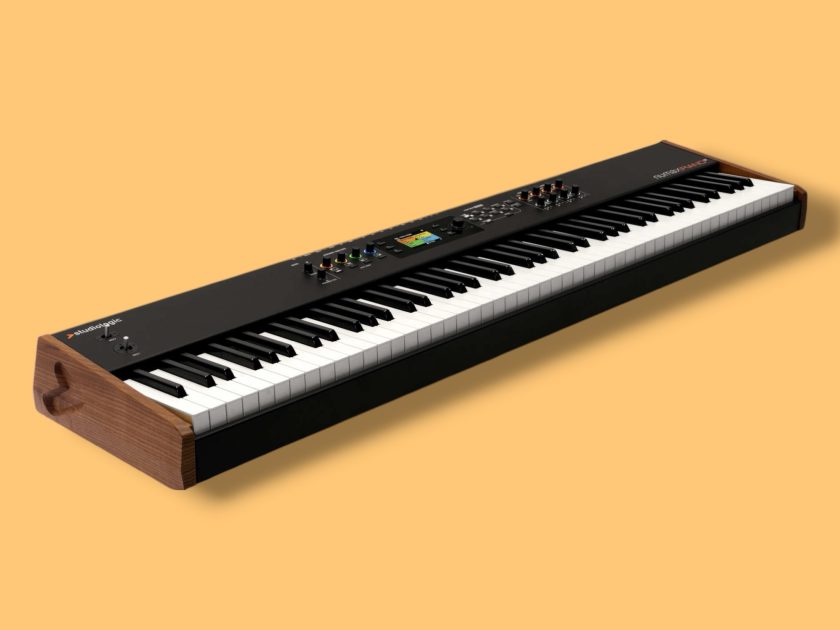
The GT’s four-zone architecture is its most flexible feature. Stack a fretless bass, a Wurlitzer, and a DX-style piano in one patch. Setting up is simple with the “Zoom” function, though the workflow takes a minute to learn. The color-coded UXlogic system is very helpful. Each zone gets its own color on the display, so you always know exactly where you are in the mix.
One feature may take getting used to: the joysticks. These joysticks replace the traditional pitch and modulation (mod) wheels found on many keyboards, which control the pitch and add effects such as vibrato. I found them fun to use: same principle, different controller. But if you’ve spent years on wheels, expect a brief adjustment period for quick pitch dips.
Verdict
To be transparent, this particular model in the Numa X line is overkill for my needs. The largest keyboard I own is an M-Audio Venom, which while big, is nowhere near the size of this. If I bought from this line, I’d likely opt for their smaller models, which have many of the fantastic features I’ve outlined above. Even for touring, some of the lighter options would be better.
However, where this will best shine is in the studio. Studiologic built this for the uncompromising musician: those who want rich, realistic piano modeling and a piano that will deliver quality results session, after session. For them, it’s worth every pound. For me, it was a weeks-long dive into a different world of piano playing. Pros seeking great action and fast splits around $2,000 should try this before buying anything else. It’s a stellar workhorse.
Buy the Numa X GT Hier.
