
A hybrid instrument that works well for practice and casual jams, but reliance on app control and the absence of MIDI output hold it back from professional use.
Quick Take
Der Enya Cyber-G is a beginner-friendly, app-driven smart guitar that blends playfulness with practicality. Its built-in speaker carries enough volume for casual sessions, and the illuminated guidance system lowers the barrier for anyone just starting. The trade-off lies in creative depth: without MIDI output and with the guitar relying heavily on its companion app, it’s not a tool for serious production. It succeeds best as an accessible starting point for music performance.
Testing Context
All impressions here come from use in a home studio. Most of the evaluation relied on the Cyber-G’s built-in dual-driver speaker, which proved loud enough that an external amp wasn’t necessary. Control flowed through the Enya iPhone app, and firmware updates were easy. This setup reflects how most casual users will interact with the instrument day to day.
Build & Hardware
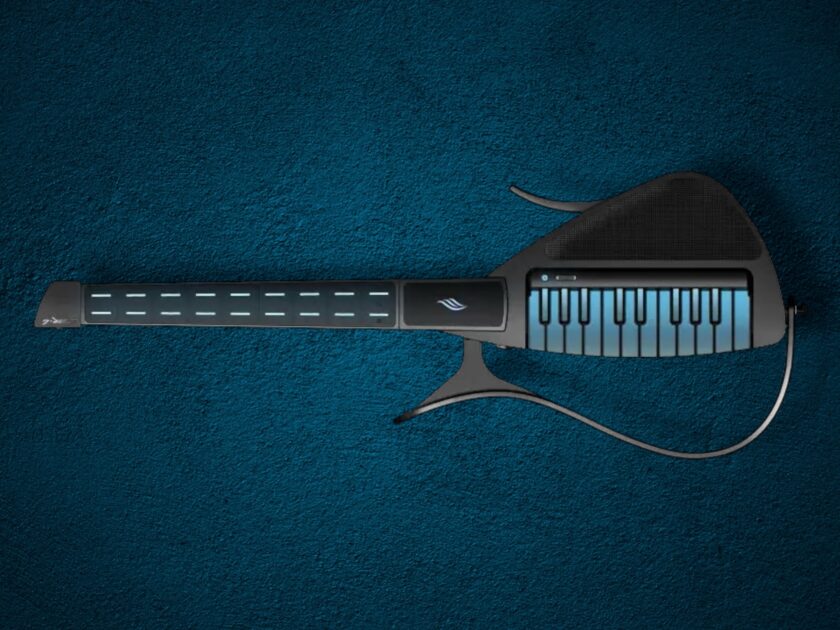
The Cyber-G’s body, neck, and fretboard are all molded from ABS plastic, which it uses across the top, back, and sides. Enya has covered the touch pads & surface of the neck with a rubbery material, but the majority of the build consists of plastic.
The tested unit arrived in black and weighed 4.4 pounds. Though the weight is noticeable, the guitar-shaped profile makes it easy to hold. Most of the weight concentrates at the base, in the speaker area, but it never feels uncomfortable.
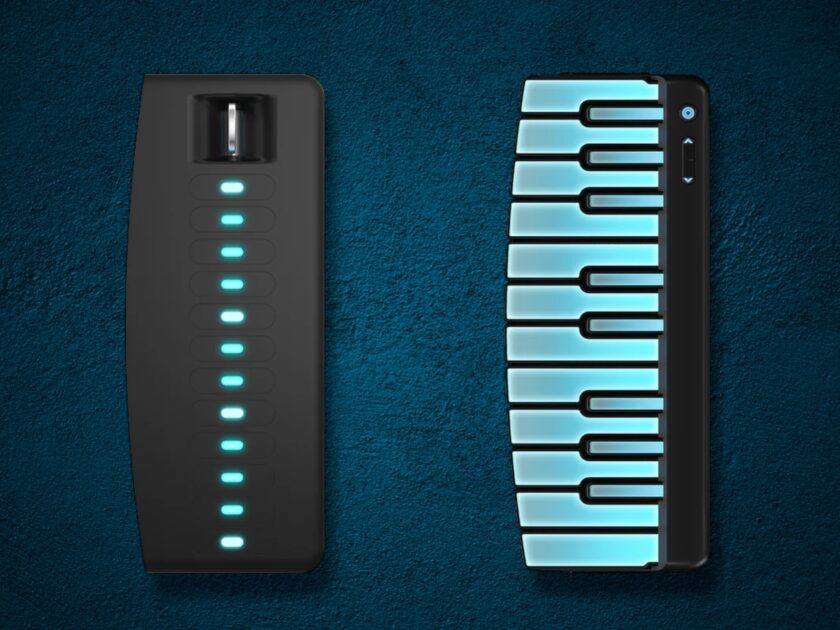
One of the more appealing touches is modularity. The neck detaches for storage or transport, and users can swap between different modules, including keyboard and pick variants. The retail package includes a hard-shell protective case, a strap, a charger, a USB-C to USB-C cable, a quick-start guide, and a sticker.
Sound
The Cyber-G offers 20 built-in voices. The electric guitar proved to be the most commonly used sound during our testing, although the tonal palette of the voices spanned a wide range of styles. Options range from bright, synthetic textures to Chinese instruments and classic synth tones.
The speaker design features a 10W tweeter paired with a 20W woofer, yielding a clear and balanced sound. Sustain is digitally managed, producing a moderate but responsive feel that keeps transitions between chords fluid, and latency was minimal.
Workflow
The Cyber-G provides two modes for players: Sing & Play Und Solo.
Sing & Play mode focuses on chord-driven performance with rhythm backing. The illuminated Smart Tab system guides the left hand by lighting up chord pads, making it easy to follow. When you trigger a chord, the right-hand keyboard responds differently based on your key presses: white keys activate rhythm patterns linked to the current chord, and black keys generate arpeggios. With a single click, bass and drum accompaniment can join in, or you can enable Auto Drums to start accompaniment automatically. This design simplifies playing, allowing the performer to focus more on singing.
Solo mode shifts the balance. Here, the left-hand chord pads still trigger backing bass and drum parts, but the right-hand keyboard takes on the role of a solo instrument. Instead of triggering patterns or arpeggios, every key produces real melodic notes. Users can select from up to eight solo instruments, adjust octave range, and apply sustain using chord pad controls. With solo mode, the Cyber-G becomes a performance tool for playing melodies or improvising lines over the generated rhythm section.
Switching between modes through the app was fast, and the instrument felt forgiving enough that beginners could find a groove quickly. These qualities made it easy to picture the Cyber-G in busking setups or as a quick tool for social content creation.
The app’s involvement is central here: it supplies chord charts, rhythm control, and access to different sounds. That design makes the Cyber-G approachable for beginners, though it also defines its limits.
Why? Well, the guitar doesn’t do much outside of the app. In fact, one area that stands out as a missed opportunity is MIDI. With its hybrid design and responsive play modes, the Cyber-G could have been a capable MIDI controller, bridging practice and production.
Cyber-G only half achieves this. Once the keyboard module is detached and connected to a computer, it can function as a USB MIDI keyboard controller. However, it will not transmit MIDI data while it is still attached to the guitar, and the guitar itself has zero MIDI out capabilities. A disappointing omission that could’ve taken this guitar to the next level.
Connectivity & Power
Lack of MIDI output aside, the instrument supports Bluetooth, USB-C OTG audio, quarter-inch output, headphone output, foot pedals, and wireless microphone connections. In testing, Bluetooth remained stable, with no sudden dropouts.
App Integration & Features
The companion app serves as the Cyber-G’s command center. It ties together rhythm patterns, instrument tones, and chord guidance, making it the backbone of the experience. With it, players can access 100 rhythm accompaniments, adjust settings like transpose and tap tempo, and follow illuminated chord guidance for practice.
The licensed song library is extensive, with selections from artists such as Jason Mraz, Christina Perri, The Beatles, Eagles, Die Preiselbeeren, Ed Sheeran, John Denver, Coldplay, Radiohead, Eric Clapton, Linkin Park, Queen, Maroon 5, Guns & Roses, and more.
Beyond playback, the app supports tab creation to share with others: for 4/4 songs, chords are marked on beat 3, while in 6/8 they are marked on beat 4. For 2/4 and 3/4 time signatures, chords fall as written. At present, there is no way to notate 5/8 or 7/8 patterns.
Regular updates have improved stability and added content, and firmware patches have unlocked tones that were not appearing for some users, while smoothing Bluetooth performance.
Pricing & Editions
The Cyber-G is available in multiple versions, priced at $399 for the pick model and $499 for the keyboard version. Regional availability includes the US, EU, UK, Canada, and APAC, with special editions such as ChouChou and Mars Red rounding out the lineup.
Pros & Cons
Pro
- Comprehensive all-in-one instrument: guitar, bass, drums, keyboard
- Strong battery life and a loud built-in speaker
- Very beginner-friendly with guided learning
Nachteile
- Very reliant on the app
- No full MIDI output from the guitar itself
Verdict
The Enya Cyber-G succeeds when approached as a connected instrument built around its app environment. Its modular design feels solid, the built-in speaker is capable for practice, and the guided system lowers the barrier for beginners. In that role, it works as intended: a fun, accessible gateway to making music.
However, it’s wise to set expectations accordingly. Without MIDI output, it does not extend easily into production setups, and its design favors casual performance over deeper studio integration. For those wanting an easy, all-in-one practice and performance tool, it delivers. For those seeking an instrument to anchor a broader MIDI rig, it leaves a noticeable gap.
