
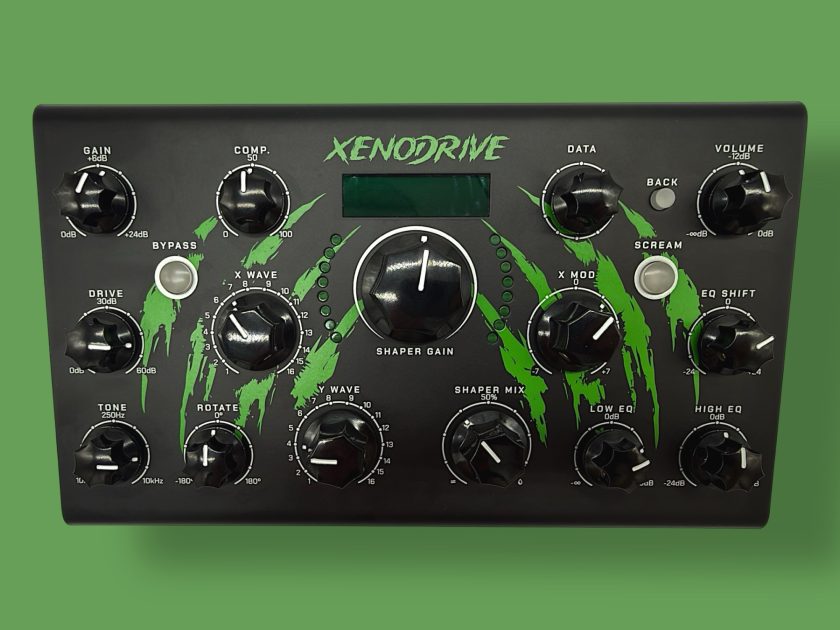
If you want a one sentence takeaway from this review, go no further than this: Erica Synths‘ new Xenodrive can make your synths an industrial workhorse.
Xenodrive: Bringing a Synth From a Whimper To a Howl
If you’ve been on synth forums, you’ve probably seen the Akai Timbre Wolf slammed as one of the worst synths ever made: just four voices, only two waveforms, and thin, unremarkable sound. I picked one up recently, and while it’s better than its reputation suggests, it clearly has its flaws.
So why bring up Akai in a piece about Erica Synths? Well, some have already pointed out the slight 303-esque quality in the Wolf’s sound, but when I ran the much-maligned Timbre Wolf through Erica Synth’s new Xenodrive, the Timbre Wolf finally gave a howl worthy of its name. It became a true acid powerhouse, and from there I soon realized that Xenodrive is a must-have for anyone making industrial or acid techno.
Xenodrive Specs
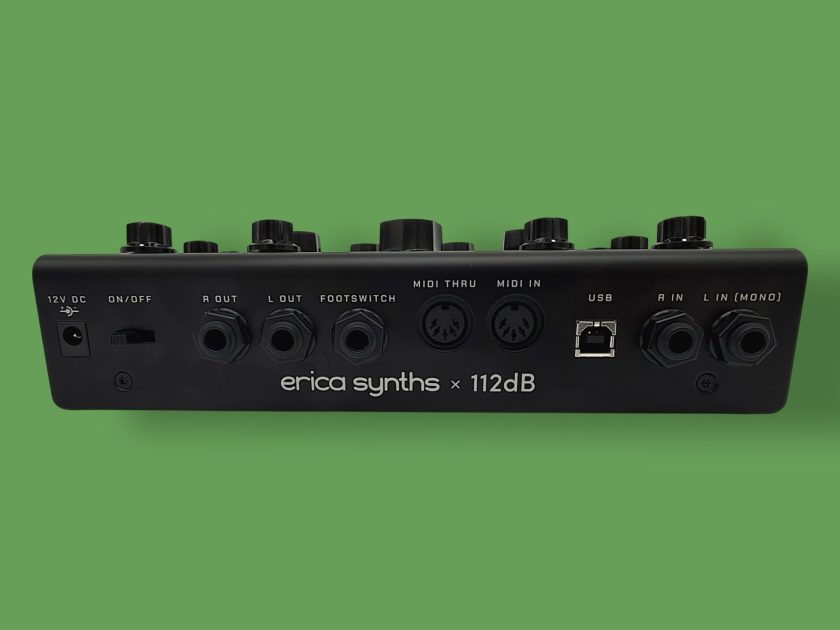
Built in collaboration between Erica Synths and Dutch DSP company 112dB, Xenodrive follows in the footsteps of their Echolocator delay and Nightverb reverb. It’s a stereo distortion, overdrive, and waveshaper in a desktop box. The price is €490. The signal path runs an analog input gain with a hefty +24 dB boost, then straight into a fully digital chain: compressor, germanium diode overdrive emulation, an XY wavetable waveshaper with envelope follower, a two-band shelving EQ with a single button called Scream that drops in a resonant peak, and a noise gate to keep things tidy.
The waveshaper alone offers 256 waveforms, mapped in a 16×16 grid and navigated by the X Wave and Y Wave knobs. With 12 hands-on controls, full MIDI, and 42 morphable factory presets, the Xenodrive is clearly built for both recording studio flexibility and live performance.
Droppin’ Acid
I spent most of my time running both the Timbre Wolf and the NORAND Mono MK2 through it: demoing acid lines and squelchy sawtooth patterns, surgically applying grit to the output, and alternating between defined squelchy distortion and a complete collapse of shape at extreme levels. In most experiments, I kept the Input Gain trim conservative from the jump. That turned out to be the right call. Feed the Xenodrive something clipping before you’ve dialed in Drive and Shaper Gain, and you’ll end up somewhere genuinely ugly before you find the interesting ugly. Keep the input clean, and the architecture has room to do its thing.
The germanium overdrive emulation lays down a gritty foundation. It adds just enough warmth to the Mono’s midrange without burning it to a crisp. That is, until it meets its match in the waveshaper. With the XY matrix and Shaper Gain, you can go from subtle harmonic thickening to outright sonic destruction. The envelope follower ties the X axis to your playing dynamics, so the waveforms shift and morph as you play. On a rolling acid sequence, the distortion breathed into the notes rather than sitting on top of them.
Xenodrive’s Scream Button
Scream is my favorite feature on this device. Pressing that button adds a sharp, resonant peak to the shelving EQ at the frequency set by EQ Shift. On a bass groove already using filter resonance on the Mono, and with either Acid preset on the Xenodrive, Scream pushed the resonance even further. That convinced me this box is perfect for hard techno, acid techno, or industrial music. Drum machines and synths can really go in new directions with it.
If you turn up the Shaper Gain on a bright sound, you’ll hear a metallic, fizzy quality in the high end. The highs can get harsh and digital. For warm, vintage acid sounds, the ‘creamy ACID’ preset still does the job without that digital feeling. But that sharp character is worth keeping in mind. For modern hard acid, industrial techno, or any aggressive style, it actually works in your favor. The main downside is that there’s no multiband processing, so the distortion affects the whole signal. As far as I can tell, you can’t keep the sub-bass clean while adding dirt to the mids and highs.
Verdict
If you produce acid or industrial techno, or if you run synths through outboard distortion and want preset recall, you should get the Xenodrive. Being able to morph presets during a live set is something most distortion boxes in this price range don’t offer. Scream gives you a powerful effect with one button, instead of needing a separate pedal and lots of footwork.
The once-tame Timbre Wolf has never sounded better.
Erica Synths Xenodrive – Available direct from Erica Synths and through Thomann, Perfect Circuit, Sweetwater, and Guitar Center.
