
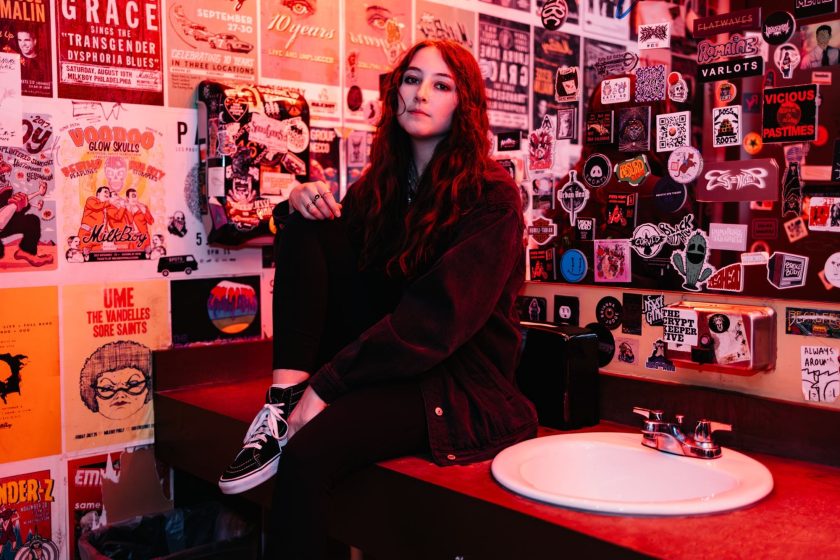
Nicole Alexis – Image Credit: @kesa_luxe
Nashville’s DIY Alt Singer-Songwriter Nicole Alexis is building hype for her upcoming cozy, vulnerable acoustic EP, Mirrors and Smoke, out on April 17th, 2026. From creating content of stripped-back performances of her songs in parking garages, putting on a killer performance at the 2025 Warped Tour revival, and prioritizing her creative vision and relationships with her fans, Nicole Alexis shares with us the importance of maintaining relatability and authenticity with everything she does in her career, and the ways she’s challenged herself with her upcoming EP.
AltWire [Iceis Augustino]: You do have quite a variety in your discography up to this point, but if your music discography were a coffee order, what would it be?
Nicole Alexis: My music discography coffee order would probably be “Find Another You.” With a little bit of “Don’t Tell Me To Breathe.” And “Lost Sometimes.” I would say it’s alternative rock with hints of pop melodies and fun guitar playing.
AW: Out of all of those songs as elements, what would they be assigned to if they were the coffee equivalent?
NA: I have to think about my coffee order now. I haven’t been to Starbucks in so long. I would say it’s a little like a basic coffee with a little bit of milk [and] not too much sugar. I love the heavy guitar [strumming] and the acoustics that I’ve been playing recently.
So, I think that’s the foundation for the black coffee. Sprinkle in some light production and light ambient guitar sounds for the milk. The sugar on top would be the fun melodies and the very confessional [styled lyrics]. That’s my coffee order. It’s hard to compare [that] to a Frappuccino.
AW: Fair, and that all makes sense. It’s not over-the-top in a way that some coffees are. It’s something you could do safely that you enjoy at the same time. So yes, very fitting.
NA: Yeah, that’s a good way of putting it. Something consistent [with] what you would have every day as your coffee order.
AW: In addition to creating music, I imagine the live show [performance] is really fun [to do], too. So, if you had endless resources to introduce something to your shows, what would it be?
NA: Ooh, that would be fun. If I had endless resources to build the shows out, I would do it [almost] like how John Mayer does his shows. He’ll do the John Mayer Trio. Then he’ll do his acoustic set. Then he’ll do different parts of the show. I would probably build it out [so that in] the first half, [I’d] be live-looping. [In] the second half, I’ll do the full band rock show. And then the last half would be more intimate [with] acoustic style stuff.
AW: That would be really cool. It’s almost like a play where you have the intermissions, and then it turns into something else. That would be so cinematic and so cool for a live experience.
NA: It would be so fun. I think it would be very immersive, and different people can like different parts of the show. You don’t have to like every piece of it, but I think it would be so cool to [have] the different styles [resonate] with people [who] like that [particular] style.
AW: Absolutely, and then everybody gets what they’re there to hear or see ‘cause you have a little bit of everything. So, that would be really fun. That should be [an] idea for the future.
NA: Yeah, absolutely. I wish I could say backup dancers, but I don’t think that I have any songs that would fit [that] well.
AW: I can see it now. We can have breakdancing to your new Acoustic EP in slow motion. It would go [perfectly].
NA: Yes, totally! It would be my mom, too. No one professional.
AW: Heck yeah, there you go, even better. Mom [will] start breaking some moves [and] the audience will be into it. Just trust.
AW: And the [last question from] our super, fun, random questions [is], if you could be BFFs with your favorite fictional character for twenty-four hours, what character would it be? And what would you do together?
NA: Okay, my favorite fictional character is Anna from Frozen. I think she’s so fun. [Spending] a day with her, I feel [I’d] be able to have so many fun adventures. It would be endless fun.
AW: Heck yeah, what would you and Anna do for twenty-four hours?
NA: I would love to go run around and [try to] find talking snowmen and the moose. I love just going out and exploring [while] not having a plan for things. I feel that would be the perfect person to do that with.
AW: See, that is why you are an artist, because that is the best mentality to approach everything [creatively] with.
NA: Totally, you never know what any day is going to bring. So, it’s fun and exciting.
AW: You do have a variety of skills in your skill set. You don’t just do guitar. You sing and [play] other instruments as well. What instrument did you start learning first? ‘Cause I feel like the go-to for people [is] either piano or guitar, usually.
NA: It is funny you say that. Piano, technically, is what I started out with. But when I was five, I told my parents I wanted to play drums. So, they brought me [to] the local music store, and they were like, “Yeah, she wants to play drums. She’s young, and she never played before. Can we get her lessons?” And they were like, “No, she’s too young. They don’t normally pick it up that fast, so we’ll start her on piano and see where it takes her.” So, I started [with] piano. I think within two lessons, I just had a natural ear for it.
So, they’d be like, “Yeah, play ‘Mary Had a Little Lamb.’” And I’d play it by ear. And then, two lessons later, [they were] like, “Okay, we can move you to drums.” Then, I started playing drums. I think it snowballed from there, and I was like, “I have to learn every instrument.” A couple [of] years later, I started with guitar. And [ever] since I picked up [a] guitar, it was the end-all, be-all. I knew that was my favorite.
AW: I very briefly did piano when I was in elementary school, like a lot of kids did, and after six months, I was just like, “This is too boring. Give me something new. No, thank you.” So, moving quickly from piano to drums is more exciting.
NA: Yes, I remember being five, [and] I just wanted to pull my hair out. [I was] like, “I don’t want to look at these notes, read [them], and then play [them]. I just want to-“
AW: Hit stuff, buchstäblich.
NA: [Yeah, that’s] so much more fun!
AW: A lot of people usually choose one or two things to master, and you were like, “Why choose one or two, when I can choose everything?” What made you not settle [for] just doing drums and guitar?
NA: It’s crazy, but when I was little, I would almost hear full songs in my head that didn’t exist yet. They were random full symphonies in my head. When I was young, [I was] like, “Why can’t I learn how to play every one of these instruments, learn how to put ‘em all together, and make one song myself? I want to learn every instrument, I want to learn how to produce, and I want to learn how to get all these thoughts in my head out on paper.” So, that’s why I wanted to learn every instrument.
AW: Heck yeah. Honestly, instruments are hard to learn, especially when you get older. So, I think that deserves a round of applause. A lot of people don’t think, “You know what? I’m gonna learn every single thing I need to play to make this one song.” Versus “Let me just play one or two, and then I’ll get someone else to play X, Y, and Z.”
NA: Yeah, it takes a lot of patience. When I was younger, [doing] that was the only thing that would give me patience and [settle] me down, ‘cause I was a very hyper kid. I think for kids, it’s helpful to learn an instrument.
AW: I think having a creative outlet for any child is a very healthy and helpful thing.
AW: You also learned production, which is part of music creation, but different than playing instruments. What made you get interested in learning and doing that?
NA: I was [around age] thirteen when I wrote my first song, and I didn’t know what to do with it. [I was] like, “Okay, great. I have this song, but it’s only going to be in my head until I actually record it and get it out there.” So, I went to Guitar Center with my dad, and we bought a little audio interface, and I watched hundreds of YouTube videos on how to actually work it and record. So, I started [by] just recording the songs that I would write when I was in middle school. [I would record myself playing acoustically] and singing, and [I started] learning that [way].
Then, I would slowly start to build onto it [by] adding drums and guitars. It was a long process of learning how to build a song out and bring the emotion into that song [with] the production. I really got into production when I was in college. I had a lot of friends who were also playing music. We would get together [to] write music, [and] I would record it. After that, I was like, “Okay, producing is really fun. Let’s keep growing those skills.” But I started when I was really young [with] the [basics of] recording my vocals and guitars.
AW: It’s a very versatile skill to have. You can either use it for your own projects. Or, a lot of times, other musicians are looking for people to help with production and stuff like that. Have you exclusively just used it for your projects? Or have you branched out and worked with other people?
NA: I have worked with a couple [of] other people. In general, [I’m] very quiet when it comes to working with other people. There [have] been situations where they’ll be like, “This is really cool! We have to add this to the song!” And secretly, I don’t like it. But it ends up there, because I’m like, “Well, they like it. So, maybe it’s good.”
AW: “Question mark?”
NA: Yeah, “Question mark?” So, [there are] definitely times when it’s important to work with other people, especially in the engineering side of things. But I like to keep it [for] myself because I feel I have more power in what goes into it, versus [when] I’m working with other people. I’m a little more shy on that side.
AW: That’s so valid. I imagine it’s more fulfilling for you to use that for your own stuff [that] you’re creating. You get to focus more on the stuff that you want to create, versus just applying it to what someone else is trying to do.
NA: Absolutely. Some people are really good at working with other people, and then some people are [quieter]. When I’m in a room and I’m writing with other people, I’m very tempted to throw thoughts and ideas out there. So, it is fulfilling to just do it [for] myself.
AW: A lot of your music is very alternative. You do give me alternative, girly vibes. And it’s a great addition to the current music scene. [There are] more people doing more atmospheric and cinematic [styled songs]. You found this blend of cinematic and atmospheric, yet it’s still very alternative. Did you always know you wanted to create in that direction?
NA: I didn’t always know that that was the direction I wanted to take, but I always felt the most drawn to alternative music and rock [music], in general, especially when I was younger. I would experiment with different styles like pop, country, [and try] to fit into a box. I think over the past couple of years, [I’ve gone] back to the music that I grew up listening to; the Paramore, Green Day, and 90s [to] early 2000s styles. [It] came full circle to me. [It]is the [type of] music that I love and grew up on.I’m not trying to chase that type of music either, but it just feels the most authentic.
So, it’s definitely been an evolution. I think, [with] where [it falls] right now, it’s definitely the most authentic that I’ve ever written. And keeping it pulled back and not overdoing the production has definitely helped, especially [staying focused on] the songwriting, lyrics, and the actual song, versus the vibe of the song.
AW: And that’s extremely important, too. ‘Cause a lot of [the] bands you mentioned were very iconic and pivotal for creating what we have now as a genre and sub-genre. But obviously, the goal is to never be the next Green Day. The next Paramore. The next Meine chemische Romanze, woo! It’s always the most culturally [impactful] stuff that’s usually made when people are like, “You know what? I’m inspired by this, but I’m gonna go do my own thing and create that instead.”
NA: Totally agree.
AW: You were talking about other genres as well. Do you feel you pull any influence from those other genres or artists still?
NA: I think I definitely pull [inspiration from] all different styles of music, and it’s totally unintentional. When I think about the music that I grew up listening to, I think about [how] John Mayer‘s guitar skills are incredible. I [practically] learned every one of his riffs growing up. And Hayley Williams.
[The] songwriting and lyricism of her work is incredible. So, blending a lot of these different genres has definitely been influential in the music that I create now. And playing around with the different genres has helped me figure out what I don’t really like. I do think you have to filter out what you don’t like to get what you do like.
AW: The alternative scene has evolved so much. It’s been more open and welcoming to blending things from different genres into it, and it’s exciting to see it continue to evolve. Is there anything that you’re hoping continues to grow and evolve as time goes on with the genre? Whether directly impacting you, or indirectly [impacting you].
NA: I’m always experimenting with production. I think that’s gonna be [an] ever-evolving process for me. I could go on TikTok, and it’ll be like, “There’s this new plugin and that new plugin.” And I wanna try all these different sounds. I think it’s gonna continue to evolve. For me, it’s all about trying new things that I haven’t tried before, and seeing how I could fit different sounds or melodies within what I enjoy.
In the past, I’ve definitely [written] songs or put out songs that don’t really connect with me as much as they should have. So, going forward, the evolution is [that] I need to love the song before putting it out. That’s definitely been a very mentally evolving thing for me.
AW: Yeah, that’s one of the most important things about it. You have to be content, happy, and connected to what you’re making. But at the same time, [you] always [have to] want to grow and do more. Otherwise, you’re just stuck, and it loses all its fun.
NA: Absolutely.
AW: Some artists do tend to have a little trouble finding where they fit into [in] the genre, its endless sub-genres, and [people’s ideas about what] those genres and sub-genres are supposed to be. Up to this point, and maybe you have an idea for the future about how it’s going to play out, how do you feel your music and yourself as an artist fit in or challenge some of those things within those genres and sub-genres?
NA: It’s been a struggle for me because I want to fit into one of those genres or sub-genres, but I don’t think that I do. I think it’s its own thing, and I’ve definitely been embracing it. I am not chasing a sound [that already exists]. I’m not trying to be the next Paramore oder Dashboard-Beichtstuhl, or anything like that. I want it to fit in its own lane. I think that people [who] are fans of the music are going to be fans of the music. Not the sub-genre that it fits in. So, to answer that question, I don’t know. I think it’s a form of alternative, and it’s acoustic [and] singer-songwriter. I’m always asking [that] question: “What genre would I call it?” I don’t know.
AW: And that is so fair. A lot of times, people feel so pressured to fit themselves into a particular genre or sub-genre that they end up shooting themselves in the foot, as they say. They don’t implement a lot of the creative ideas that really set them apart from everybody else, or [they] don’t implement the ideas that make things that they want to make.
NA: Totally. I spent a lot of time producing and writing for other artists before releasing my own music, and [there were] a lot of times where I would go into a session, and they would be like, “I want to make something that sounds similar to this song that’s [on the] top-twenty on the radio right now.” And in my head, I’m like, “If it’s already been done, then we need to find something that you haven’t done before that somebody else also hasn’t done.” It’s hard for artists. [It’s] like, “I want to make something like this, but I don’t know what that is yet.” And it’s constantly evolving as your taste evolves and trends evolve.
AW: Oh, absolutely! It’s like, “If it’s already been done, then why do it again? What’s the purpose?”
NA: Right, exactly!
AW: You were mentioning women like Hayley Williams aus Paramore. There are a lot more iconic women in the industry [that’ve] really pioneered things for women in the industry. For you, how do you stay confident in what you’re doing and making as a woman in a genre that’s very male-dominated, historically?
NA: I grew up playing in rock bands, and the trend when I was in middle school and high school was always “She’s the rhythm guitar player, and she’s going to sit in the back and play the G-chords and A-chords.” So, for such a long time, I let myself be in the background and just be the “Girl guitar player” in the band. I’ve always [thought], “I think I’m a better guitar player than some of these people. I think I’m a better writer [and a] better singer, [too]. But I’m constantly being pushed in the background.”
I think at some point, I was like, “I don’t really care anymore because this is making me so unhappy.” I love to make music. I love to sing and express myself, but I was being suppressed for so long. So, I was just like, “Why don’t I just do it for myself? Show up for myself, post consistently, write whatever comes to mind, and not really care. Because if I don’t show up for myself, and at least give it a shot, then it’s never gonna happen for me.” So, I’ve definitely let go of the thought of just being the “Girl in the band.” [It’s] not what I wanna be. I want to be the band.
AW: And that’s so valid. You outgrew the perimeters and barriers of just being the “Girl in the band.” And you’ve gone on to make your own things, which sound amazing. So, I always say one of the best things you can do for yourself is to bet on yourself.
NA: Absolutely. Just go for it. Do the things that you want to do. If you’re scared to do it, then it’s probably what you should do.
AW: Oh, absolutely. A lot of times, the things that scare you the most end up [resulting in] the most rewarding or fulfilling [payoffs].
AW: When we look back at some of the women who have paved the way, has there ever been [something they’ve said], or one of the current artists that are in the scene [have said], that really stuck with you?
NA: That’s an amazing question. When I look back at the music that I would listen to, it was always female-leaning. I think that the vulnerability, lyrics, and [relating] to a song is the most empowering thing for me. Just don’t hold back on what you want to say. There’s not a specific moment where I was like, “This is exactly what I wanted to hear!” But growing up, especially [during] coming-of-age moments, listening to female-led music definitely helped me relate to different emotions and [learn to] not [be] afraid to express [them] in [songs].
AW: Absolutely, and I think that being able to listen to a lot of female-made music, hear women talk in the genre and industry, and seeing them gives you more of a feeling of relatability, [feeling ] seen, and [feeling like you’re] able to connect [to it] more, which is very important when you’re trying to enter an environment, group, a career [field], or anything where there’s not a lot of other people like you.
NA: It’s definitely exciting. [I] think it’s more of an opportunity than anything. [As] I look back and think of the music that I grew up listening to [with] all the other female-fronted bands and singers, [knowing] that I could potentially have that same weight they had on me growing up [for someone else], is such a cool thing to think about.
AW: Oh, absolutely. I think a lot of the female musicians and people in [the] industry we have now are going to continue to broaden that path for new people [in] the future.
AW: What do you think is important for other women looking to get into the industry to know or hear about?
NA: I think for other women getting into the industry, it’s important not [to] be shy about what you want to say. I know that when I’m in a session or in a room with other artists, writers, or producers, I definitely feel shy about what I want to say. I think if I had that “Don’t be afraid” mindset going into it, I probably would have [learned] a lot more. But instead, I always allowed myself to be in the background.
So, what I would say is don’t be afraid. Learn how to record yourself. Learn how to put music out. If you [can] do everything yourself, it’s so much more rewarding. You can do it, and you shouldn’t be afraid to. Take that extra step in learning how to do things for yourself.
AW: I feel we’re at a point right now, where a lot of artists and bands have started to become more independent and do things themselves more, which is extremely exciting to see. I feel you get more control of [the] things [you] create, what you want for yourself, and your career.
AW: When we talk about being independent, what are some things that are very important for you, you feel, to be involved with? Versus, [what are] some things you might not mind if someone else did and helped out with?
NA: I love everything that has to do with the creative vision. I’m big into cameras and videography. I love gear. [I love the] overall production of the music, writing, and everything. I love everything that has to do with the creative vision. If I could let go of anything, I would say it would be the final stages of the mixing process because I get so caught in my head.
When I’m producing a song and [I’m writing] the song, I record it, and then I sit on it for months because I’m like, “It’s just not there.” And if I had someone [who] was like, “Okay, I’m going to finish this up, and then we’re going to put it out, and you’re not going to think about it.” I think that would be the biggest weight off [of] my [shoulders]. Versus me just sitting there, and being like, “This isn’t good enough. I wish this guitar part [were] different.”
I’ve gotten better about that over time, but I still think that that kind of help is very valuable [for me to have]. [Like] a final ear. But I love everything to do with the creative process. I love that, at the moment, I have complete control over what I release or take videos of. It’s all really exciting to me.
AW: Oh, I imagine. I feel some of the best stuff that’s created is usually stuff where artists get to be very unfiltered and make what they want to make. Versus, having so many different cooks in the kitchen, as they say. Because then it no longer really is one-hundred percent about what you’re wanting to make.
NA: It becomes the Starbucks run of all your different coffee orders. It gets all mixed up, and then it’s not yours.
AW: Literally. You’re like, “Wait, whose coffee order is this? Who is Miranda? Huh? What?”
NA: Yes, exactly.
AW: For you, what are the pros and cons of doing everything yourself?
NA: The pros are being able to create whatever I want to create, put it out whenever I want to, and [having] very direct [relationships] with people that listen to my music. I’m responding to every one of my comments and emails. I’m going live. I’m able to have that face-to-face reaction. And, especially during shows, getting to meet people is so rewarding. I love that I have that complete control, [and that] I [get to] have a direct relationship with people. I think [those are] the pros.
[A con is] the mental hurdle of “Is this good enough? Is this what people are gonna relate to?” Obviously, another con is not having access to things that could bring you to that next level. When you’re doing it all yourself, it’s a very slow growth, but being consistent is definitely the way to go.
AW: Consistency is one of the most important factors in how you grow and evolve, too. If you’re not consistent, you’re not really going to grow anywhere.
AW: Social media has become such [an] important tool for artists to get an audience and connect with them, but it does take a lot of time to be able to create that [content], especially to create it consistently. How do you find [a] balance between content creation and music creation?
NA: It’s definitely hard. You can make a bunch of music, and it’s [all] great. But if you don’t post the music, then you’re not gonna get the reach that you want. So, it’s definitely a balance. I personally love creating content. I do a lot of cover videos, too.
[It’s like] I’m re-imagining some of my favorite songs and how I would [make them] if [they] were my own [songs]. I love the process of creating content. I feel even when I’m doing covers, I’m still learning something new [that] I can implement in my own music. And I could write a new song and create content around that.
So, it’s definitely a balance. It’s hard because if a post doesn’t do well, and it’s an original song, it’s hard not to be like, “Well, maybe people don’t relate to this.” Or“Maybe this isn’t the song that should go out.” But it’s really exciting when you find a song that people can relate to. It’s definitely hard to find that balance, and I’m still trying to find it, but the consistency has been so rewarding.
AW: It’s the never-ending search for every creative ever. “What is the balance? Where’s the balance?”
NA: “What do I do today?”
AW: Literally.
AW: Your content has a very stripped-down DIY feel about it. You performed one of your songs on your upcoming EP, “Don’t Tell Me To Breathe,” in a parking garage that you got kicked out of recently. Do you feel you always want to keep it in that direction? A very simple “Do-it-at-home” vibe? Or do you want to broaden it a bit?
NA: I want to keep it simple. Again, I love cameras, videography, and stuff [like that]. [I go] to these different parking garages [and] parking lots, I set my camera up, I play, and then [I] go back and color edit everything. That’s so fun [for] me. That’s the most fun part of it. I personally don’t love super polished music [videos and] stuff. I feel there’s a little less relatability. Unless it’s story-driven.
So, I do want to keep it stripped-back and intimate. I feel I’m not someone who could get on TikTok and talk about my day. I just never had that outward personality. So, my way of relating to people [is] through more stripped-back intimate content.
AW: It’s easier to connect to, too. I think when you pair it with the music you make, especially with your upcoming EP, it blends very well in delivering that simplicity. It’s relatable, and you can connect to it, versus if it [were], [as] you were saying, super polished, very over the top [with] production, loud, and bright to people. ‘Cause that’s not what people’s everyday [life] is.
NA: Yeah, thanks for acknowledging that. I feel it’s great when people can make it work for them [by making it] polished and very on-brand. I love it when [that work] for them and [it feels] authentic to them. But for me, to branch off and do something that’s so loud, it would never be real [to] me. Keeping it stripped-back and very low-key is my vibe.
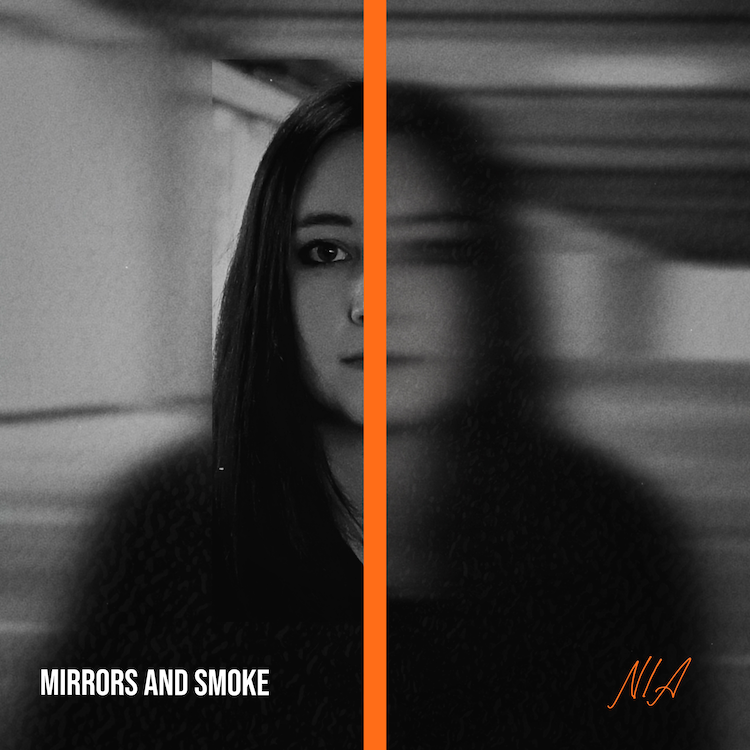
AW: Your EP’s coming out on April [17th], Mirrors and Smoke, which is beautifully put together. It’s very cinematic. And at the same time, it’s contrasting [and] interesting. I was like, “This is very artistic.” A lot of your earlier work was [made with] full-blown electric [guitars and] drums. [It is] very high-energy. How do you feel this EP is different from your previous work?
NA: In previous work, I’ve definitely felt [that] I had to prove myself in production and stuff. I love all the music. I love the songs that I’ve put out, but I can listen back and think to myself, “This moment probably didn’t need this guitar part, vocal throw, or whatever that is.” I wanted to challenge myself [with] these couple [of] songs on the EP, [and] really focus on the song. Not overdo the production [and] keep it very stripped and intimate.
It’s a challenge for me to get out of that [mindset of thinking that] I have to go over the top for it to resonate with people. So, this is definitely more stripped-back [and] acoustic, but [it has] very real messages. I do love it all. I love the heavy upbeat stuff that I play [at] the live shows. It’s very Pop-Punk-leaning, [with] how we are [so] high-energy the whole time, and it never really slows down. These songs allow me to slow down a little bit, and I think that’s what’s so exciting about it.
AW: When you look at the songs on the EP, they have variety [between them]. Some are more high-energy, but acoustic. And then you have slower, sadder, more emotional songs on it, too. It really balances itself out. [It’s] easier to deliver something for everybody at a live show when you have the ability to give both.
NA: That’s awesome to hear. Thank you.
AW: With this EP, when you were creating it, what was the process of that? Was there a specific vision you had going into it?
NA: Not really. A lot of these songs I’ve been sitting on for a while. A lot of times when I write a song, I’m never like, “Oh, I love that song that I wrote.” But sometimes when I go back and listen to the demos that I have, I can pick out pieces of it where [I’m] like, “I actually really like that hook. Let’s revisit it.” It’s probably been two-years of [me] just picking apart different songs and reworking ‘em. It was a last-minute thing for me.
[I was] like,“I have all these great songs, but I don’t really know what to do with them ‘cause they’re all very stripped-[back] and acoustic.” So, last-minute, I was like, “Why don’t I just throw them all together in a package and put them out? Because I don’t want them to sit on my hard drive.” I’ve written hundreds of songs, and for some reason, these stuck out the most to me because [they] felt the most real. And that’s really my mission with it.
AW: You were saying you had these songs [that you] had been writing for the past couple of years. How did you figure out exactly which ones you were going to put on this EP? I’m assuming there [were] more [you had written] than what you [put on this EP] over a two-year-period. What deciding factors made [you] be like, “Okay, we’re going to put ‘Close 2 U’ on this EP. This other song, eh, no. We’re gonna scratch that. But you know what would fit really well? ‘Don’t Tell Me To Breathe!’” What was the deciding factor for all of those?
NA: If you listen all the way through, it’s a very cohesive story. It takes you through this journey of a bad relationship. If you listen all the way through, you can definitely tell the different moments within the music where this person is realizing “Oh, this is really not good for me and [it’s] very toxic.” When I [listened] to all the songs together (it was very unintentional), I was like,“Wait, this all works really well together, and it tells the story that I want to tell.”
For me, it’s the cohesiveness of the storytelling within all of the songs [that] made me pick them. It’s sad. I’ve been through it. I’ve had family members go through it. You want something to work so [badly], but there’s that moment [where you’re] like, “This is not healthy for me.” And you’re just processing.
When I’m writing these songs, I never sit down, [and] I’m like,“I have this idea that I have to write.” It’s like [a] stream of consciousness. I’m processing whatever I’m thinking, and that’s what comes out in the music. It’s not overthought. I’m not overthinking the lyrics or anything like that. [It’s] what in [that] moment, I felt I wanted to say. My goal with it is to be able to [have it be relatable to] people who are trying to find their way through these different toxic relationships.
AW: I imagine that’s also very cathartic and healing for you, too. It’s a very healing moment when you get to take whatever painful moments that formed, and you turn them into art. It’s like carving something bad into something beautiful, in a way.
NA: Absolutely, and when I personally listen to the music, or just any song, I think of how I can relate myself to whatever they are saying in the song. So, I hope that people [can] do that with these songs.
AW: What is something that you really would like fans and listeners of this EP to know about this EP or take away from it?
NA: Listening to the songs, you’re not going to get this, but if I were to tell somebody, “This is what I want you to get out of this EP.” It would be that you can’t be perfect all the time. Allow yourself to challenge yourself. Just show up for yourself. Releasing these songs very stripped-[back and] acoustic, is not something that I thought I would do because I’m like, “I want the heavy rock stuff. I want the drums and all that.”
But I wanted to challenge myself, keep it stripped-back, [and] really focus on the lyrics and stuff. I want people to take away that they can challenge themselves, do something different, and [they can] be comfortable with [it].
AW: I think the most important thing is to never stop challenging yourself [in regards to] whatever creative passion you have. ‘Cause at the end of the day, if you don’t ever evolve, you’re always just stuck in the same place.
AW: I have to ask because you did play Warped Tour last year for its big revival, which is such an iconic event. What was your experience like playing that? I imagine it had to be huge for you.
NA: It was so cool. Seeing [the] backstage operations and being next to people I grew up listening to, [was] a very surreal moment. The coolest thing was [being] behind the scenes, [learning] how it all works. I got to play the unplugged stage, which was the more acoustic-leaning stage.
That [was] a really real place where people who just wanted to chill and listen to acoustic-leaning music would hang out. It was really cool, especially watching other people before me play. Seeing people being able to chill and be calm in those moments (A festival is very crazy), I thought [it] was very cool. I fangirled a little bit because I was in the elevator with Demi Lovato, and I was like, “Wait, this is so crazy.”
AW: Oh my god!
NA: But I did not say anything, because I was like, “Oh my gosh, what am I gonna say?” It’s so cool being around that crowd.
AW: Yeah, Demi has put out her own rock-influenced album, and then she went back and redid a lot of the classics as rock versions. So, it was great to see them do that last year for Warped Tour.
NA: Yeah, it’s awesome. Reinventing yourself is always very respectable. If you like something, and you could turn something that you made in the past [into] something that you currently resonate with, I think [that’s] so cool. And she’s done [that] many times.
AW: There were so many new artists, [and] old artists [who] were part of the original Warped Tour. I think [it] is great to see the new generation with the old generation. Were there any artists you wanted to see that you were super excited to watch?
NA: Yeah. [I] got to see a little bit of Ein unvergesslicher Tag, which is sick. It was a long, long day, so I got to catch a couple of songs, and then I had to leave before they played “If It Means A Lot To You.” But that was awesome. We saw Mayday-Parade, which [was] incredible. And Gelbe Karte. It’s so cool to see that these guys are still ripping the same songs that they’ve been playing. It’s really fun to see. [It was] a fun show, for sure.
AW: Oh yeah, Gelbe Karte is so culturally impactful for the scene, too. I feel they’re one of the bands that, even now, are so extremely relevant when we talk about the alternative scene.
NA: Yeah, it’s really cool to see. I feel there’s definitely a resurgence of that Pop-Punk style right now. It’s really fun to see the bands come back, release new albums, and play shows again.
AW: We look ahead to your EP coming up. But after this EP, drops, do you have a vision yet for what you want to do onwards with your musical choice and style? Or is it still like, “Don’t know yet. I guess I’ll figure it out when I get there.”?
NA: A little bit of both. I like the idea of looking through my hard drive and finding the songs that shouldn’t live there. [The ones] that should exist in the world. I’ve definitely collected a couple more songs that are going to be [part of] a part-two of the EP, but it’s going to be not as stripped-back as the current songs are. I want to experiment a little more with the production and stuff.
[But I] still [want to challenge] myself to do something a little bit different. [Like] a blend of the more upbeat, heavier stuff and my acoustic stuff. I’m excited to play around with that. But yeah, there’ll be a part two coming up pretty soon.
AW: Heck yeah. That’s going to be really exciting to see how you put that all together. [We were] talking about your ideal endless resource-funded show evolution in the, hopefully, not too distant future. So, I think that’ll be really cool to see the contrast between [them] and keep [how you keep] them cohesive at the same time.
NA: Yes, [for] the shows, I’ve been experimenting with the live-looping, and then the band comes in. So, I’m evolving the shows to try and get to that point where we could have [the type of show we could have if I had] the endless [resources] we were talking about earlier. I’m definitely excited to incorporate all of that.
AW: With where you are right now, other than this EP that comes out [on] April 17th, Mirrors and Smoke, is there anything you’re super excited about that’s happening musically, professionally, or personally that you’d like to talk about?
NA: My passion lies in live music. [As] I mentioned before, I grew up playing in rock bands, and my passion [is playing] live. Coming up, [there are] a bunch of live shows lining up. A lot for the summer. I don’t have a headlining tour yet, but by the end of the year, we’ll have one locked in. That’s probably what I’m most excited about.
AW: Heck yeah. If I remember correctly, you’re doing [an] EP release show in April?
NA: So, I’m playing in Nashville with a couple of other amazing artists that I love in town. We’ve all been doing mini weekend shows and runs. So, [for] the show in April, I’ll get to play with them again. That’ll be a lot of fun. I don’t really have any plans for an official EP release show yet, but when I have part two, I’ll probably end up doing a full-on thing [for it].
AW: Yeah, one dedicated show for it. Hell yeah.
AW: Thank you for taking the time to sit down and speak with me about all of this!
NA: Thank you for having me. It’s awesome to be able to talk to somebody about the music, and [it was] really great meeting you, too!
AW: Same, likewise!
Nicole Alexis is playing in Nashville, TN, on April 24th, 2026, at Cannery Hall, and more shows during the summer. You can find more information on her website, Hier.
Spotify | Youtube | auf facebook. | Instagram | Webseite
See more interviews, Hier.
